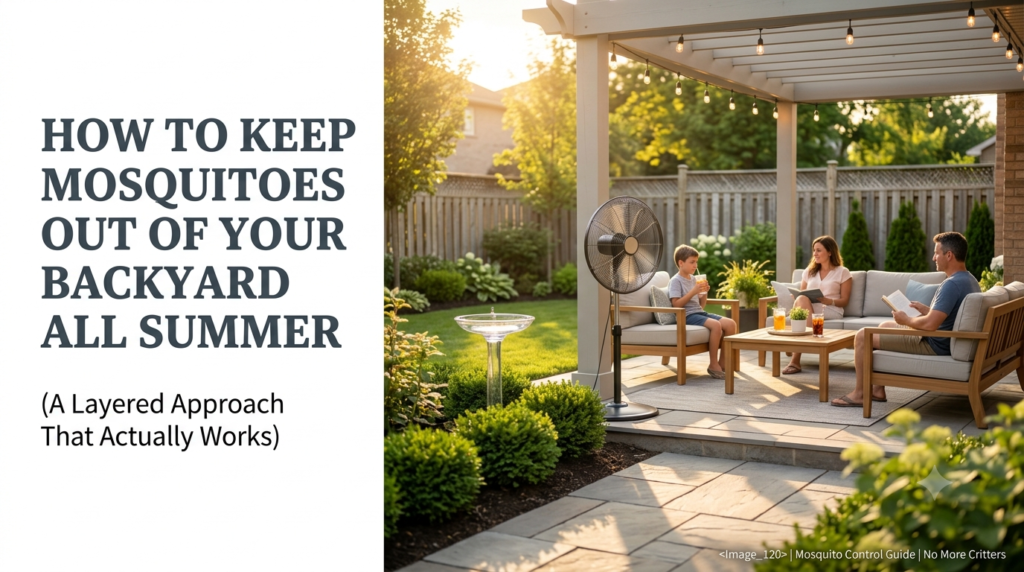
There’s no single product, plant, or trick that eliminates mosquitoes from a backyard. Anyone promising one solution is oversimplifying a problem that requires several things working together. But a layered approach — addressing breeding sources, treating water you can’t remove, managing landscaping, and adding personal protection — genuinely changes whether your backyard is usable all summer or abandoned by July.
Here’s the complete strategy, starting with the step that matters most.
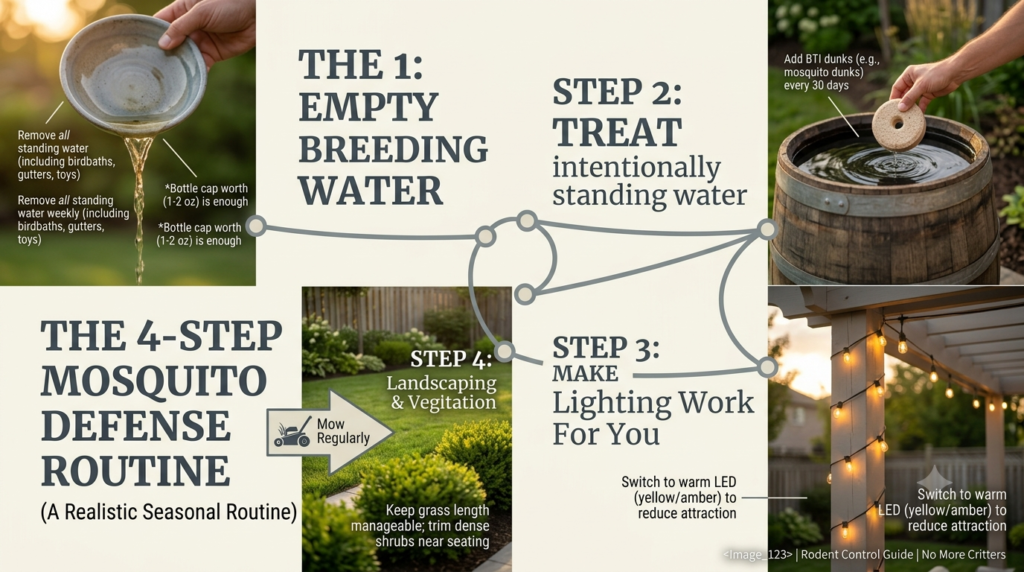
Step 1 — Eliminate Standing Water (This Matters More Than Everything Else Combined)
Mosquitoes can breed in as little as one to two fluid ounces of standing water — roughly a bottle cap’s worth. Every mosquito, from egg to adult, requires stagnant water to complete its life cycle. If you address nothing else, addressing this alone produces the biggest reduction in mosquito activity.
Walk your property specifically looking for standing water. The usual suspects are obvious — but the ones people miss are usually the actual source.
Check weekly:
- Bird baths — empty and refill with fresh water every few days; stagnant water is a nursery
- Plant saucers and pot trays — even small amounts collecting under potted plants are sufficient
- Clogged gutters — leaves and debris trap water and create a long-term breeding zone that’s easy to overlook because it’s out of sight
- Tarps, covers, and anything with a low spot that collects rain
- Children’s toys left outside, especially anything with a hollow or cupped shape
- Old tires — among the worst offenders due to how long they retain water
- Unused or overturned containers — buckets, watering cans, wheelbarrows
- Pool covers — even on a covered, unused pool, water pooling on top of the cover can harbor larvae
The standard: anything holding water for more than a few days needs to be emptied, covered, or removed. Make this a weekly walkthrough during peak season — mosquito eggs can hatch within days of suitable conditions.
Step 2 — Treat Water You Can’t Remove
Some water sources are intentional and can’t simply be eliminated — ornamental ponds, rain barrels, unused pools you’re not ready to drain.
BTI (Bacillus thuringiensis israelensis) is the answer here. It’s a naturally occurring bacteria, sold as “mosquito dunks,” that produces a protein toxic specifically to mosquito and black fly larvae — and nothing else. It’s safe for pets, birds, beneficial insects, fish, and the broader ecosystem. The larvae ingest it, can’t digest it, and die before reaching adulthood.
A single dunk provides up to 30 days of control in standing water. Drop one into rain barrels, ornamental ponds without fish, or any water feature you can’t drain. For smaller containers, a sprinkle or granular form works well and can be reapplied weekly.
For pools: if a pool is in regular use, maintaining proper chlorine levels keeps it inhospitable to mosquito larvae. If unused, either keep it covered tightly with no standing water collecting on the cover, or drain it.
Step 3 — Address Landscaping and Vegetation
Mosquitoes rest in shaded, humid vegetation during the day and are far more active in dense, overgrown landscaping than in open, well-maintained yards.
What to do:
- Mow regularly and keep grass length manageable — tall grass and weedy patches provide daytime resting habitat
- Trim back dense shrubs and groundcover, particularly anything growing close to seating areas
- Remove dead plant material and debris where moisture collects
- Choose permeable surfaces — gravel, mulch, or permeable pavers — over solid concrete for paths and patios, since these allow water to drain into the ground rather than pooling on the surface
Step 4 — Make Outdoor Lighting Work for You, Not Against You
Switching outdoor lighting to warm-colored LED bulbs — yellow or amber rather than cool white or blue — measurably reduces insect attraction, including mosquitoes, around your seating and entry areas.
White and blue-spectrum light attracts significantly more flying insects than warm-toned light. This is a simple, low-effort change that pays off over an entire season without any ongoing maintenance.
Step 5 — Use Physical Deterrents While You’re Outside
A simple oscillating fan on a porch, patio, or deck is one of the most effective and underrated mosquito deterrents available.
Mosquitoes are weak fliers. A consistent breeze makes it difficult for them to land and feed, and disperses the carbon dioxide plume from your breath that mosquitoes use to locate you in the first place. Position a fan near where people sit and the difference is immediate and noticeable.
Step 6 — Personal Repellent for Active Outdoor Time
For gardening, yard work, or extended time outside despite prevention efforts:
DEET-based repellents remain the most consistently effective option for direct skin protection.
Oil of lemon eucalyptus is the most effective plant-based alternative with genuine research support, offering protection duration closer to low-concentration DEET products than other natural options.
Citronella works as an area deterrent — candles and torches create a repellent zone but only while actively burning and only in still air; wind reduces effectiveness substantially.
Step 7 — Know What You’re Dealing With
Different mosquito species behave differently, and knowing which is active in your yard shapes your strategy.
Aedes mosquitoes (including the Asian tiger mosquito) are aggressive daytime biters, often attacking around the ankles while gardening at midday. They breed in small containers — even bottle caps — and stay relatively close to where they hatch.
Culex mosquitoes are more active at dusk and night, often the species responsible for evening patio problems, and are the primary vector of concern for West Nile virus. They favor larger, more stagnant water sources like clogged gutters, catch basins, and bird baths.
If bites are concentrated during the day near ground level, suspect Aedes and check small containers nearby. If the problem is worse at dusk near a water feature, suspect Culex and focus on that water source specifically.
For more on mosquito identification and bite treatment, see our complete mosquito guide.
A Realistic Seasonal Routine
Weekly: Walk the property checking for new standing water. Empty bird baths and refill with fresh water. Check gutters after storms.
Every 30 days: Replace BTI dunks in any water features you’re treating.
Monthly or before events: Consider a professional barrier spray treatment if mosquito pressure remains high despite consistent prevention — this targets adult mosquitoes directly and provides several weeks of reduced activity per application.
Ongoing: Keep grass mowed, vegetation trimmed back from seating areas, and outdoor lighting on warm-toned bulbs.
When to Call a Professional
If you’ve addressed standing water, treated what you can’t remove, and managed your landscaping — and mosquito pressure in your yard remains high enough to make outdoor time unpleasant, professional barrier spray treatments applied to vegetation can significantly reduce adult populations. These typically need reapplication every three to four weeks during peak season but provide a level of control that DIY measures alone often can’t match for severely affected properties.
We can match you with vetted local exterminators — no spam, no pressure.
No More Critters provides vetted pest identification and treatment information for homeowners. This site is a free service to assist homeowners in connecting with local service providers. All contractors and providers are independent. This site does not warrant or guarantee any work performed.
Filed under