
Something woke you up last night. A scratch. A scuttle. Maybe you found the evidence this morning, droppings along the baseboard, a gnawed corner on a cereal box. And now you’re standing in your kitchen wondering: where are they getting in?
That’s exactly the right question. Finding the entry point is the most important step. Traps catch individual mice, but until that opening is sealed, more will follow.
How to Find Where Mice Are Getting Into Your House
Start With What You Already Know
Pay attention to where you’ve seen the signs. Droppings, grease marks, chewed material, or sounds concentrated in one area are almost always near an entry point or a travel route between the entry and the nest. Those spots are your starting place.
Where to Actually Look
Mice can squeeze through a gap the size of a dime. That’s uncomfortable to sit with, but it narrows the search considerably — you’re looking for small, overlooked openings, not obvious holes.
Foundation and exterior walls
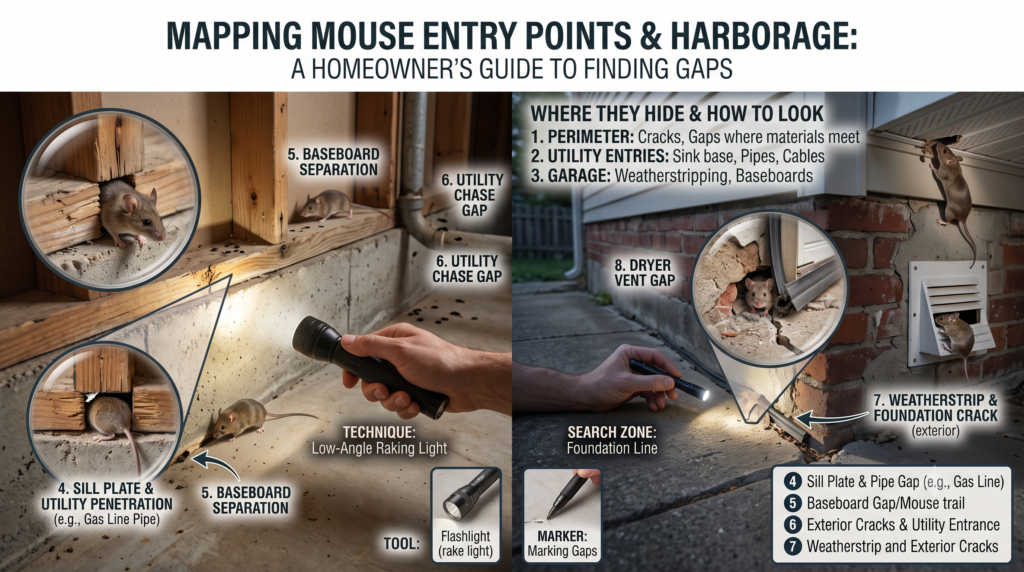
Walk the full perimeter at ground level. Look for cracks in the foundation, gaps where different materials meet (brick to siding, concrete to wood framing), and anywhere pipes, wires, or cables enter from outside. Even a hairline crack in aging mortar is worth noting.
Utility penetrations
Check under every sink where plumbing comes through the wall, there’s often a gap around the pipe that was never properly sealed. Same goes for dryer vents, gas lines, electrical conduits, and HVAC lines along the exterior.
Garage
One of the most common entry points and the most overlooked. Check where the garage door meets the ground, a worn weatherstrip leaves a gap mice use freely. Also check where the garage walls meet the floor, and the door between the garage and the main house.
Roofline and attic vents
Mice climb. Check where the roofline meets the soffit, around attic vents, and anywhere there’s damaged or missing trim. If you’re hearing sounds in the ceiling or upper walls, start here.
Basement and crawlspace
Check vents, window wells, and the sill plate, where the wooden framing of the house sits on the foundation. This joint is prone to gaps, especially in older homes where wood has settled over time.
How to Do a Proper Walkthrough
Set aside an hour and move slowly. Bring a flashlight and something to mark gaps as you find them.
On the exterior, go low, most entries are at or within a foot of ground level. Hold the flashlight at an angle so light rakes across the surface. This makes small gaps far easier to see than shining it straight on.
On the interior, open cabinet doors under every sink and check the wall behind the plumbing. Pull the stove away from the wall. Look at the corners where floor meets wall — baseboards that have separated even slightly are a known route.
On a cold night, you can sometimes feel a draft near entry points. On a bright day, look for light coming through from outside in dark spaces like crawlspaces or basement corners.
What to Do Once You Find It
Small gaps can be sealed with steel wool packed tightly into the opening, then covered with caulk or expanding foam. Mice won’t chew through steel wool the way they move through wood, plastic, or foam alone.
Larger openings — around pipes, along the sill plate, at utility penetrations — are better handled with hardware cloth (quarter-inch mesh) cut to size and secured before sealing around it.
Weatherstripping on doors and the garage should be inspected and replaced if it’s compressed, cracked, or leaving visible light gaps at the bottom.
When to Call a Professional
If you’ve done a thorough walkthrough and still can’t locate the entry point, or if you’re finding signs in multiple areas at once, a pest control professional is worth calling. They carry UV blacklight that shows urine trails clearly and have trained eyes for entry points that aren’t obvious to a homeowner.
A professional can also assess the scale of the infestation — because the number of mice inside changes how aggressively you need to seal and treat at the same time.
Learn more about mice