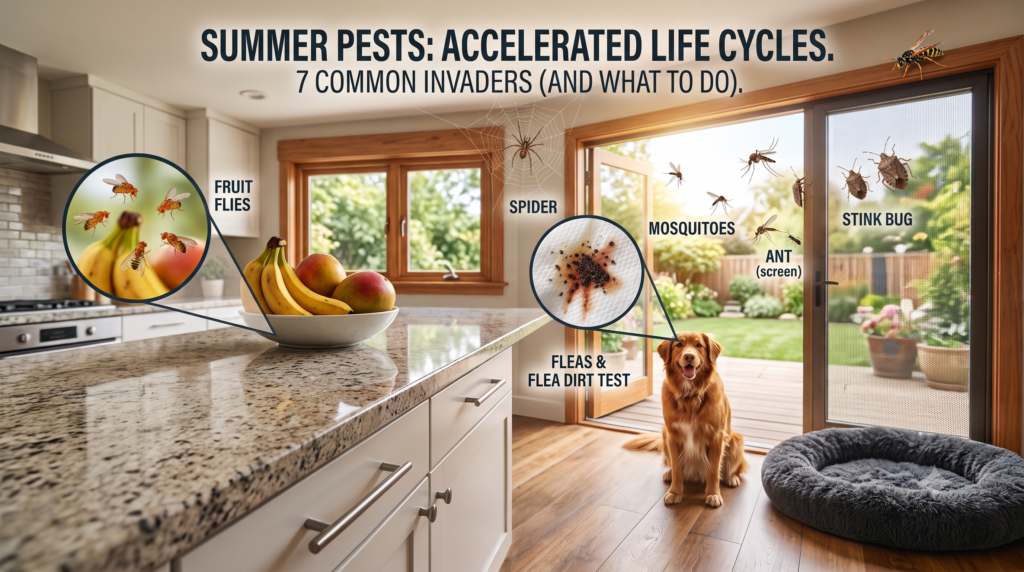
Summer doesn’t create pests. It accelerates them. The warmth compresses life cycles, expanding populations faster than any other season — insects that take weeks to hatch in spring emerge in days under July heat. And many of them, in search of water, food, or relief from that same heat, find their way inside.
Here’s what’s actually coming out in summer, what each one signals when it appears in or around your home, and how to respond without wasting time on the wrong fix.
1. Ants
Why they appear in summer: Ant colonies reach peak population in midsummer — a single Lasius niger (black garden ant) colony can contain 15,000 workers by August. Scout ants range up to 30 meters from the nest in search of food and water, and when they find either, they lay a pheromone trail that brings the rest. That thin line crossing your kitchen counter isn’t a random occurrence. It’s a directed survey.
What it signals: A food or moisture source — crumbs, a leaky pipe under the sink, condensation near an appliance. Rarely an infestation in the structural sense, but a colony close enough to your home that the scouts have committed the route to chemical memory.
What to do: Disrupt the trail with soapy water and find the source first. Bait stations (borax-based, slow-acting) are more effective than sprays because they travel back to the queen. Spraying kills scouts and triggers colony budding — splitting one nest into several.
→ Full guide: https://nomorecritters.com/pests/ants/
2. Mosquitoes
Why they appear in summer: Aedes albopictus can complete its entire life cycle — egg to biting adult — in under a week at 85°F. Summer rain fills every low spot and neglected container with breeding water, and longer daylight hours extend the window when females are actively feeding.
What it signals: Standing water within roughly 100 meters. Mosquitoes rarely travel far from where they hatched — which means the source is almost certainly on or immediately adjacent to your property.
What to do: Eliminate standing water first, every four days without exception. Treat water that can’t be drained with Bti (Bacillus thuringiensis israelensis) dunks. Personal repellents protect individuals but don’t reduce populations.
→ Full guide: https://nomorecritters.com/pests/mosquitoes/
3. Wasps
Why they appear in summer: Paper wasp (Polistes exclamans) and yellowjacket (Vespula squamosa) colonies grow through spring and hit maximum population in late summer — some yellowjacket nests reach 5,000 individuals by August. As natural food sources thin and the colony begins producing reproductive queens rather than workers, wasps become more aggressive and more attracted to human food and drink.
What it signals: An active nest nearby. Wasps foraging near food or entering the home through gaps around windows and eaves are almost always returning to or departing from a nest within 300 feet.
What to do: Locate the nest before attempting removal. Aerial paper wasp nests under eaves can often be treated at night with aerosol foam when the colony is inactive. Underground yellowjacket nests are best left to professionals — disturbing them without proper protection is genuinely dangerous, not just unpleasant.
→ Full guide: https://nomorecritters.com/pests/wasps/
4. Fleas
Why they appear in summer: Flea eggs hatch fastest between 70–85°F — summer temperatures are essentially optimal for the cat flea (Ctenocephalides felis), which is the species responsible for the overwhelming majority of household infestations regardless of whether the home has a cat. One female lays up to 50 eggs per day, which fall off the host and accumulate in carpet fibers, furniture, and bedding.
What it signals: Pet contact with infested outdoor areas, or a wildlife host (raccoon, opossum, stray cat) near the home. An indoor flea infestation without an obvious pet exposure often traces to a previous tenant’s pet or to wildlife sheltering under a porch or crawlspace.
What to do: Treat the pet, the home, and the yard simultaneously — addressing only one breaks the cycle in one location and allows reinfestation from the others. A single treatment is almost never sufficient because flea pupae are chemically resistant; expect a second application two weeks after the first.
→ Full guide: https://nomorecritters.com/pests/fleas/
5. Fruit Flies
Why they appear in summer: Drosophila melanogaster requires fermentation — overripe fruit, spilled alcohol, the residue inside recycling bins — to breed. Summer heat accelerates the fermentation process, which is why a bowl of fruit that sat fine in May becomes a breeding site in July. A single female can lay 500 eggs over her lifetime, and the life cycle from egg to adult takes eight to ten days at room temperature.
What it signals: A fermenting food source somewhere in the kitchen or adjacent space. The trash can, the recycling bin, the drain of the kitchen sink (where a thin biofilm of organic matter is enough), a forgotten potato or onion in a pantry corner.
What to do: Eliminate the source completely — fruit flies surviving without an identifiable food source are almost always breeding in a drain. Pour boiling water or a baking soda and vinegar solution down any suspect drain. Apple cider vinegar traps catch adults but don’t address breeding, so they work better as population monitors than as fixes.
→ Full guide: https://nomorecritters.com/pests/fruit-flies/
6. Spiders
Why they appear in summer: Most common house spiders don’t actually increase in number in summer — what increases is their visibility. Juvenile spiders hatched in spring reach sexually mature size by midsummer, and males of most species begin actively roaming in search of mates from July through September. Tegenaria domestica (the common house spider) and Pholcus phalangioides (the cellar spider) are the two species most likely to be encountered indoors during this period.
What it signals: A stable indoor insect population. Spiders are predators — they establish themselves where food is available. A sudden increase in spider activity often means an undetected insect problem is feeding them.
What to do: Address the insect source first. Spiders themselves are beneficial and almost never dangerous; the common house spider is not medically significant. If numbers are bothersome, sticky traps near baseboards and in corners reduce populations without pesticide.
→ Full guide: https://nomorecritters.com/pests/spiders/
7. Stink Bugs
Why they appear in summer: The brown marmorated stink bug (Halyomorpha halys) is an agricultural pest through summer — feeding on fruit trees, vegetables, and ornamentals — but it begins its move indoors in late summer and early fall as temperatures drop. Homes on the east coast and Pacific northwest see the highest activity because this is where the species established after its introduction from Asia in the 1990s.
What it signals: Agricultural land or ornamental plantings nearby, and gaps in the building envelope — window frames, utility penetrations, rooflines — that allow entry. Stink bugs aggregate in large numbers before overwintering, so a few in late summer often precede a significant fall invasion.
What to do: Seal entry points now, before fall. Stink bugs are harmless but emit a defensive odor when crushed or disturbed — vacuum removal into a sealed bag is the standard recommendation for individuals found indoors. Do not crush them near fabric or upholstery.
→ Full guide: https://nomorecritters.com/pests/stink-bugs/
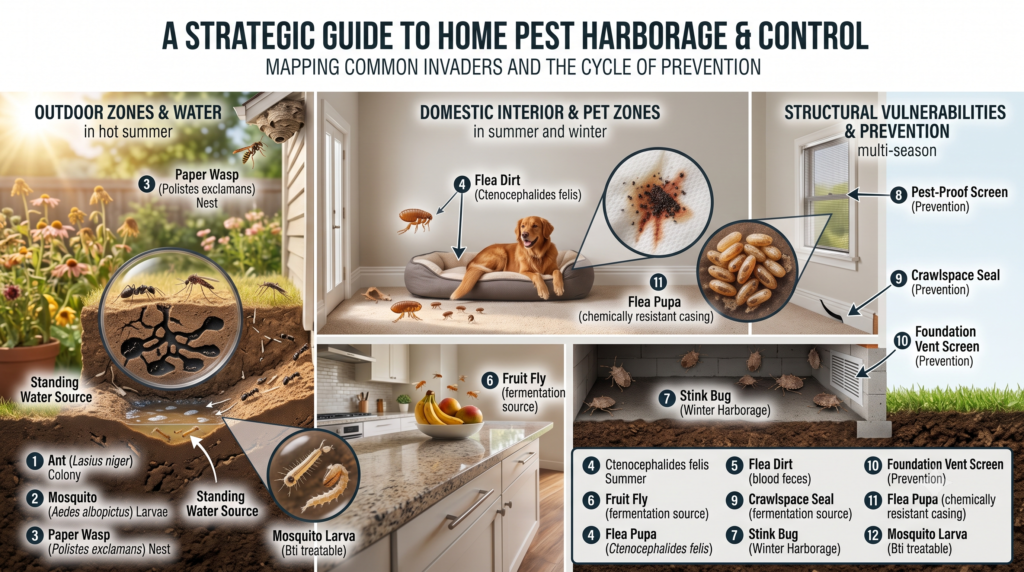
The Pattern Underneath All of It
Summer pests aren’t random. Each one is tracking something specific: fermentation, still water, a pheromone trail, a warm gap in a wall. Understanding what each pest is actually looking for in your specific home makes the fix obvious in a way that generic “call an exterminator” advice never quite manages.
Browse the full pest library for identification guides, treatment options, and when to bring in a professional: https://nomorecritters.com/pests/
If the summer pest situation in and around your home has moved past what a single fix addresses, a vetted local professional can assess the full picture.
No More Critters provides vetted pest identification and treatment information for homeowners. This site is a free service to assist homeowners in connecting with local service providers. All contractors and providers are independent. This site does not warrant or guarantee any work performed.
Filed under