The Complete Guide to Household Termites
Termites are often called “silent destroyers” because they chew through wood, flooring, and even wallpaper undetected. Early identification and preventative structural habits are critical to protecting your investment.
1. Identification: Who is in Your House?
Termites are frequently confused with winged ants (swarmers), but treating them requires a vastly different approach. Recognizing their distinct physical traits and nesting habits is vital.
Look closely at body shapes, wing sizes, and behaviors to identify the three primary types of termites:
-
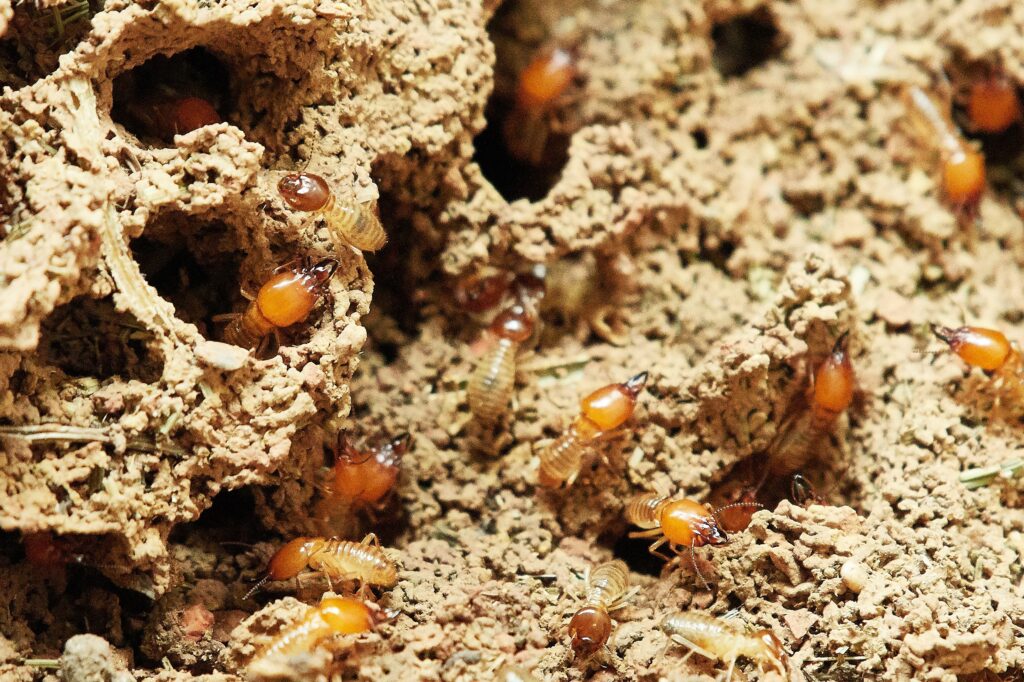
Subterranean Termites: Small ($3\text{mm}$ to $6\text{mm}$), creamy white to translucent (workers). They live in the soil and build distinctive, muddy tubes to travel upward into your home’s wooden framework. They are responsible for the vast majority of termite damage in North America.
-
Drywood Termites: Slightly larger ($9\text{mm}$ to $11\text{mm}$), pale brown. Unlike subterranean types, they do not need contact with the soil. They nest completely inside dry structural wood, roof rafters, and hardwood furniture.
-
Termite Swarmers (Alates): The reproductive members of a colony. They have dark bodies, straight antennae, a uniform waist (unlike the pinched waist of an ant), and two pairs of translucent wings that are identical in size and shape.
2. Why They Enter & What Keeps Them There
Termites do not enter your home out of malice; they are simply searching for cellulose, the organic compound found in wood and plant materials, which serves as their primary food source.
-
Soil-to-Wood Contact: For subterranean termites, any wooden structure directly touching the ground (like porch posts, deck supports, or low siding) acts as an open highway into the house.
-
Moisture and Rot: Wood that has been softened by plumbing leaks, faulty roof flashing, or poor ventilation is incredibly attractive to termites. They need moisture to survive, and damp wood is much easier for them to chew through.
-
Debris Around the Foundation: Firewood stacked against the house, thick wood mulch touching the foundation, and buried construction debris invite termites right to your home’s perimeter.
3. Potential Harm & Damage
Anatomy of Risk: Termites do not bite humans or pets, nor do they transmit diseases. Their entire threat profile is focused squarely on the physical and financial destruction of your property.
Human, Child & Pet Health
-
Allergen Triggers: While they don’t spread pathogens, termite colonies produce dust, fungal spores, and particulate matter within wall voids. When forced through ventilation systems, these can aggravate asthma and respiratory allergies in children and sensitive adults.
-
Structural Collapse Hazards: In extreme, long-term cases, severely weakened ceiling joists, subfloors, or porch supports can buckle or collapse, creating physical safety hazards for inhabitants.
Damage to the Property
-
Structural Wood Destruction: Termites eat wood from the inside out, leaving a thin outer veneer intact. They can hollow out support beams, studs, sills, and floor joists, entirely compromising the load-bearing capacity of your home.
-
Secondary Materials: To reach wood, termites will chew through drywall, plaster, foam insulation boards, and even thin sheet copper or plastic piping, causing secondary interior damage.
4. Prevention: How to Keep Them Out
Because structural repairs from termite damage can cost thousands of dollars, setting up a defensive barrier around your home is essential.
Structural Proofing
-
Maintain a Gap: Ensure there is at least a $15\text{cm}$ ($6\text{ inch}$) gap between the soil and the wooden siding or framing of your house.
-
Divert Water: Keep gutters clean and extend downspouts at least $1\text{ meter}$ away from the foundation to prevent soil from becoming saturated.
-
Smart Landscaping: Keep firewood, lumber, and paper scraps stored far away from the house. Avoid using thick wood mulch directly against the foundation; opt for pea gravel or rubber mulch instead.
Natural Deterrents (Scent & Material Barriers)
-
Cedar & Redwood: These woods contain natural oils and resins (like thujone) that act as natural deterrents to termites. Utilizing cedar mulch or building outdoor structures with heartwood cedar reduces the likelihood of attraction.
-
Vetiver Oil: Highly concentrated vetiver essential oil has been proven to repel subterranean termites and inhibit their tunneling behavior when applied to perimeter entry zones.
5. Control & Eradication Methods
If you have an active termite infestation, surface sprays like Raid will do absolutely nothing, as the vast majority of the colony resides deep within the earth or inside the core of the timber. Professional-grade intervention is highly recommended for termites, but understanding the mechanics of eradication helps you choose the right path.
Treatment Protocols