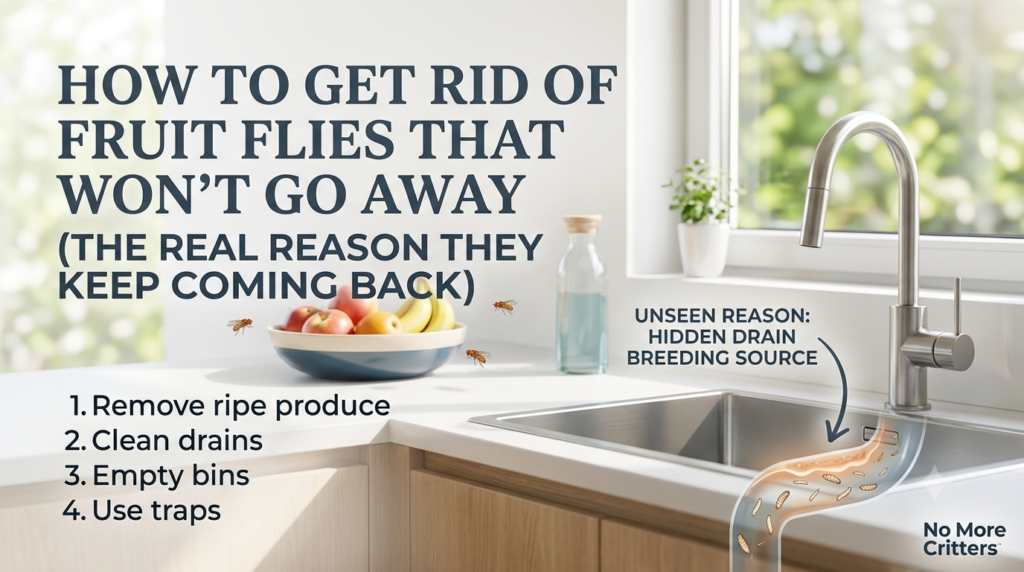
You cleaned the kitchen. You threw out the overripe banana. You wiped down every surface. And yet — they’re still there, hovering in a cloud every time you walk past the sink.
If you’ve been trying to get rid of fruit flies and they keep coming back, there’s a specific reason — and it’s almost never the one people assume. Here’s what’s actually keeping them around, and the sequence that actually works.
Why Fruit Flies Keep Coming Back After You Clean
The reason fruit flies won’t go away after cleaning is almost always a hidden breeding source that traps and sprays can’t reach — most commonly a drain.
This is the most important thing to understand about persistent fruit fly infestations. Fruit flies don’t just eat ripe fruit — they breed in any moist organic material: the thin film of organic matter that builds up inside kitchen and bathroom drains, the residue inside garbage disposals, standing liquid in recycling bins, the drip tray under the refrigerator, and even overwatered houseplant soil.
A trap catches adult flies. But if the breeding source remains, new adults emerge every single day. You can empty ten traps and still have fruit flies tomorrow.
Before anything else works, the breeding source has to be found and eliminated.
First — Make Sure It’s Actually Fruit Flies
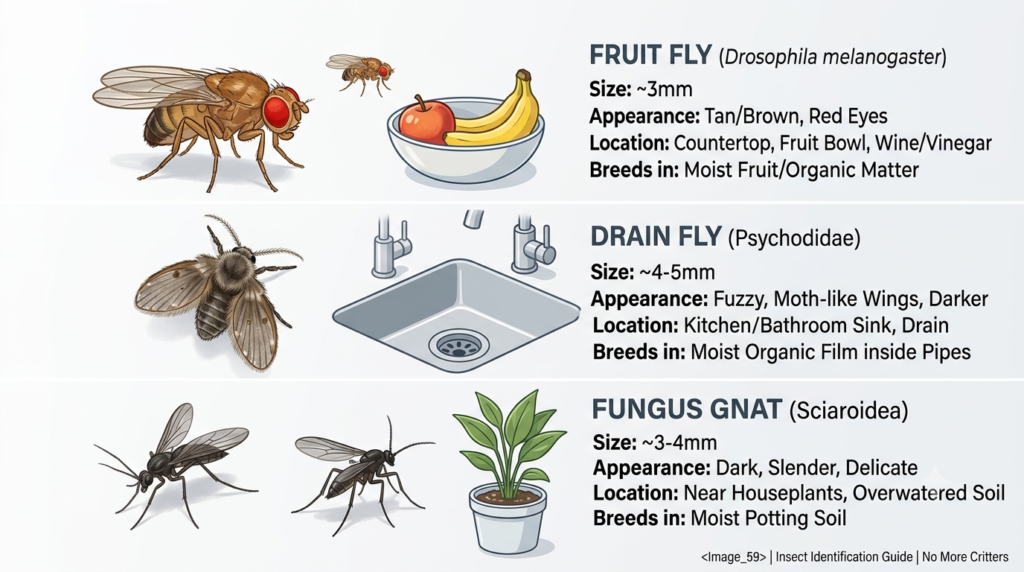
Three small flying insects get confused constantly, and the treatment for each is completely different.
Fruit flies (Drosophila melanogaster) — Tiny, about 3mm, with distinctive red eyes and tan to brown bodies. They hover near fruit, wine, vinegar, and anything fermenting. Most active near the kitchen counter and fruit bowl.
Drain flies — Slightly larger, fuzzy, moth-like wings. They cluster near drains and damp surfaces. If you see small fuzzy flies near your bathroom or kitchen sink, these are drain flies — not fruit flies. The fix is cleaning the drain, not the fruit bowl.
Fungus gnats — Dark, slender, and found hovering near houseplants. They breed in moist potting soil, not food. Letting soil dry out completely between waterings is the solution.
Getting the identification right before treating saves a significant amount of time and frustration.
The Hidden Breeding Sources Most People Miss
Kitchen drain — The number one source of persistent fruit fly infestations. Organic material accumulates inside drain pipes and provides the moist, fermenting environment fruit flies need to breed. You can’t see it, and spraying around the drain opening does nothing to reach it.
Garbage disposal — Same issue. The underside of the rubber splash guard and the interior of the disposal housing collect organic debris that ferments rapidly in summer heat.
Recycling bin — Rinsed bottles and cans still retain residue. A recycling bin that sits for a week in a warm kitchen is a fruit fly breeding ground.
Refrigerator drip tray — The shallow plastic tray under most refrigerators collects condensation and organic debris. Most homeowners have never cleaned it. Pull the refrigerator out, remove the tray, and clean it thoroughly.
Houseplants — Overwatered soil attracts fungus gnats, but very ripe or fermenting plant matter in the pot can also attract fruit flies.
Compost bin — Even an indoor countertop compost container that’s emptied regularly can harbor enough residue to sustain fruit fly activity. Empty it daily and clean the container weekly.
The Sequence That Actually Eliminates Fruit Flies
Do these in order. Skipping to traps without eliminating the breeding source extends the problem by weeks.
Step 1 — Remove all ripe and overripe produce Anything in a fruit bowl that’s past peak goes into the outdoor trash immediately. Not the kitchen bin. Outside.
Step 2 — Clean the drains Pour boiling water down every kitchen and bathroom drain. Follow with a drain cleaning gel or enzyme cleaner — products designed to break down the organic film inside pipes, not just bleach the surface. Bleach is largely ineffective for drain flies and fruit flies because it doesn’t stay in contact with the organic material long enough to address it.
Use a drain brush to physically scrub the inside of the drain opening. Clean the underside of the garbage disposal splash guard — remove it and scrub both sides.
Step 3 — Clean recycling and trash bins Rinse, wash, and dry all bins. Leave lids on. Take recycling out more frequently during the warm months.
Step 4 — Check the refrigerator drip tray and clean it
Step 5 — Set traps for remaining adults Once the breeding source is eliminated, adult flies that are already hatched need to be trapped. The most effective DIY trap: pour about half an inch of apple cider vinegar into a glass or jar, add two drops of dish soap, cover tightly with plastic wrap, and poke five to six small holes in the plastic. The vinegar attracts them, the soap breaks surface tension, and the plastic wrap prevents escape.
Commercial traps like TERRO fruit fly traps work on the same principle and are equally effective — the advantage is they’re ready to use and less messy.
Step 6 — Let it run for 48-72 hours With the breeding source gone and traps set, fruit fly populations drop significantly within two to three days. If they haven’t, there is still an active breeding source you haven’t found yet.
Why Summer Makes It So Much Worse
Fruit fly development accelerates dramatically with heat. At room temperature in summer, a fruit fly can complete its lifecycle — egg to adult — in as little as seven days. A female lays up to 500 eggs in her lifetime. One piece of overripe fruit left out overnight in July can seed an infestation within a week.
This is why fruit flies seem to appear out of nowhere in summer and why the same level of tidiness that works in winter doesn’t cut it in August.
For more on identifying and treating fruit flies, see our complete fruit fly guide.
What Doesn’t Work
Spraying insecticide in the kitchen — doesn’t reach breeding sources, leaves residue on food surfaces, and only kills adults already present. New adults emerge the next day.
Bleach down the drain — kills surface bacteria but doesn’t remove the organic film where breeding occurs. Enzyme cleaners are significantly more effective.
Traps alone without removing the breeding source — extends the problem indefinitely. Traps are the last step, not the first.
When to Call a Professional
Fruit flies almost never require professional pest control. The source is always organic material somewhere in the home. If you’ve eliminated every obvious source, checked all drains, cleaned all bins, and fruit flies persist after two weeks — a professional can use tools like moisture meters and UV lights to locate unusual breeding sources inside walls or under flooring.
We can match you with vetted local exterminators — no spam, no pressure.
No More Critters provides vetted pest identification and treatment information for homeowners. This site is a free service to assist homeowners in connecting with local service providers. All contractors and providers are independent. This site does not warrant or guarantee any work performed.
Filed under