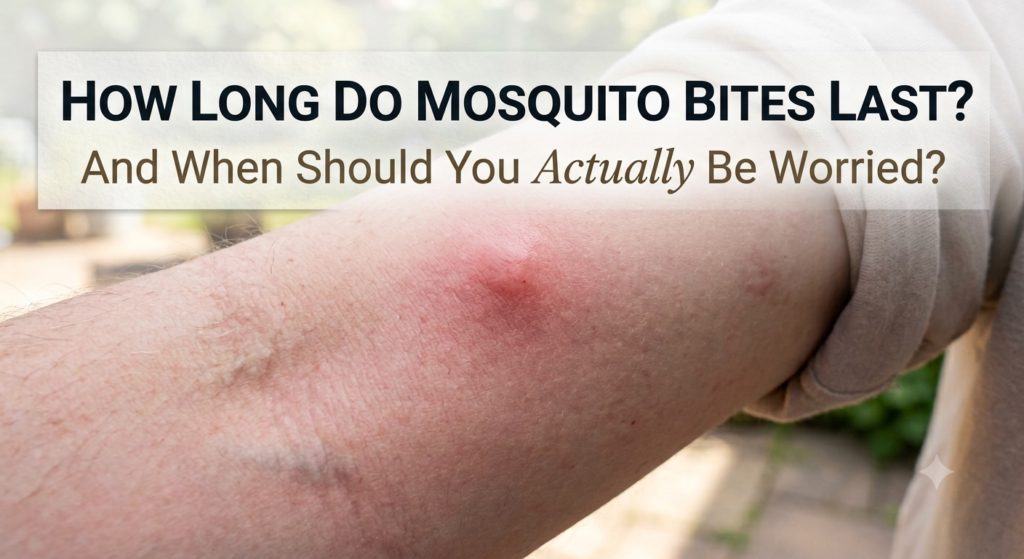
How Long Do Mosquito Bites Last — And When Should You Actually Be Worried?
It’s the middle of summer. You’ve got a red, itchy bump on your arm that feels like it’s been there forever. So how long do mosquito bites last — and at what point does a bite stop being a nuisance and start being something worth paying attention to?
For most people, a mosquito bite is annoying but entirely harmless. But there are specific signs that mean something more is going on, and knowing the difference saves you both unnecessary anxiety and unnecessary delay.
The Normal Mosquito Bite Timeline
A typical mosquito bite follows a predictable pattern:
Within minutes: A small raised bump appears at the bite site — this is your immune system responding to proteins in mosquito saliva.
First 24 hours: Itching intensifies, peaking around 24 to 36 hours after the bite. The bump may become redder and slightly more swollen during this window.
Days 2-3: Swelling and redness begin to calm. The bump starts to flatten.
Days 4-7: Most bites fade completely. The skin returns to normal.
For the majority of people, a mosquito bite is essentially gone within a week. Mild itching or faint discoloration can sometimes linger a day or two longer, particularly if the area was scratched.
Why Some Bites Last Longer Than Others
Not every mosquito bite resolves on the same schedule. Several factors extend the timeline:
Scratching — this is the biggest one. Scratching keeps the inflammatory response active, can break the skin, and dramatically increases healing time. A bite that would have faded in four days can last two weeks if scratched consistently.
Bite location — bites on the ankles, wrists, and feet tend to swell more and linger longer because of thinner skin and more movement in those areas. Bites on the upper face can cause significant swelling around the eye that lasts several days.
Skin sensitivity — some people mount a stronger immune response to mosquito saliva than others. This is particularly common in young children, whose immune systems haven’t yet been desensitized to the proteins in mosquito saliva.
Multiple bites — when your body is managing inflammation from several bites simultaneously, each one may take longer to resolve.
What Is Skeeter Syndrome — And Do You Have It?
Skeeter syndrome is an allergic reaction to mosquito saliva that produces a much larger, more painful response than a typical bite — and it can last three to ten days.
Most people think of mosquito bites as small itchy bumps. With skeeter syndrome, the reaction can be one to four inches across — swollen, red, warm to the touch, and sometimes blistering. In more significant cases it can cause low-grade fever and fatigue.
The key distinction: skeeter syndrome is not dangerous, and it is not an infection. It’s a localized allergic response. It develops within hours of the bite and continues to progress for up to 12 hours before beginning to resolve on its own.
Skeeter syndrome is most common in young children. Adults can develop it too, but reactions sometimes become less severe over time as the immune system becomes more familiar with mosquito saliva proteins.
If you or your child consistently has unusually large, painful reactions to mosquito bites, mention it to a doctor. Antihistamines taken before significant outdoor exposure can reduce the severity of reactions.
Signs a Mosquito Bite Is Infected
A typical mosquito bite does not become infected on its own. Infection almost always follows scratching that breaks the skin, introducing bacteria from fingernails.
Signs of a bite infection:
- Redness that spreads outward from the bite rather than fading
- Increasing warmth and pain at the site
- Pus or discharge
- Red streaks extending from the bite
- Fever
A red streak spreading outward from a bite is a sign of lymphangitis — a spreading infection that warrants same-day medical attention, not a wait-and-see approach.
When to See a Doctor
Most mosquito bites need nothing more than time and a cold compress. But see a doctor if:
- A bite develops signs of infection as described above
- You have an unusually large reaction — swelling larger than four inches, blistering, or fever — for the first time
- You develop flu-like symptoms within two weeks of mosquito exposure: fever, headache, body aches, nausea. These can be signs of West Nile virus, which is rare but worth ruling out, especially in older adults or anyone with a compromised immune system.
West Nile virus affects less than 1% of people bitten by an infected mosquito, and around 80% of those infected show no symptoms at all. But the window for symptoms is 2-14 days after the bite, so if something feels off after significant outdoor mosquito exposure, mention it to your doctor.
How to Make a Mosquito Bite Heal Faster
The goal is to calm the reaction without scratching:
- Apply a cold compress for 10 minutes at a time — this numbs the area and reduces swelling
- Apply 1% hydrocortisone cream to reduce itching and inflammation
- Make a paste of baking soda and water and apply for 10 minutes — this helps neutralize the itch response
- Take an oral antihistamine if multiple bites are causing significant discomfort
- Keep the area clean, especially if skin is broken
The single most effective thing you can do is not scratch. Everything else is secondary.
For more on reducing mosquito populations around your home and yard, see our complete mosquito guide.
When to Call a Professional
If mosquitoes are consistently a problem around your home or yard, the source is almost certainly standing water nearby — gutters, plant saucers, bird baths, or low spots in the yard. Eliminating breeding sites is far more effective than any repellent.
For persistent yard infestations, professional barrier spray treatments can significantly reduce populations throughout the season.
We can match you with vetted local exterminators — no spam, no pressure.
No More Critters provides vetted pest identification and treatment information for homeowners. This site is a free service to assist homeowners in connecting with local service providers. All contractors and providers are independent. This site does not warrant or guarantee any work performed.
Filed under