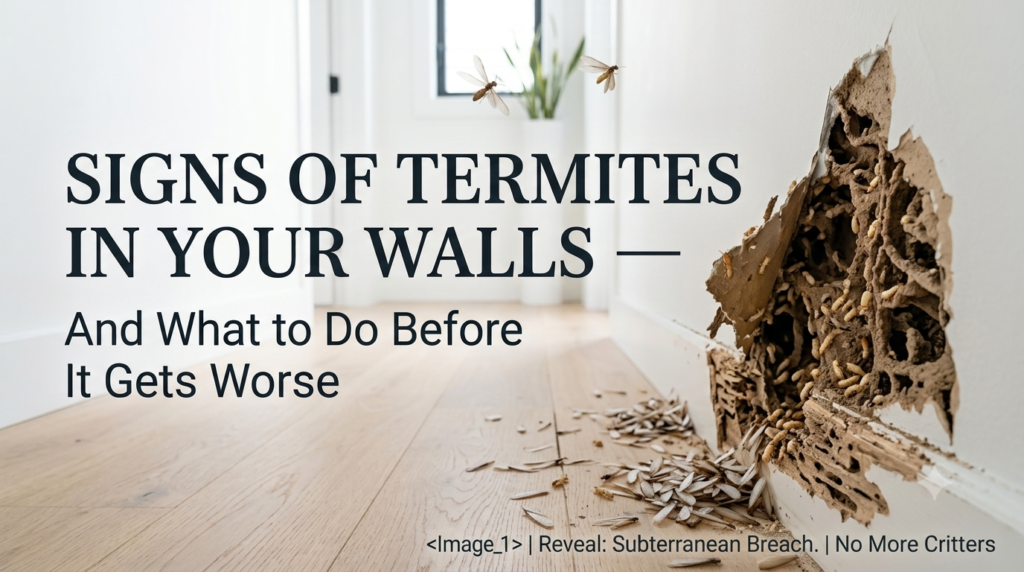
Termites are called silent destroyers for a reason. By the time most homeowners notice something is wrong, a colony may have been active inside the walls for months or longer. The damage doesn’t announce itself — it accumulates quietly, behind surfaces that look completely normal from the outside.
Knowing the signs of termites in walls, floors, and foundations is one of the most valuable things a homeowner can do, because catching an infestation early is the difference between a treatment and a rebuild.
Why Termites Are So Hard to Detect
Termites feed from the inside out, leaving the outer surface of wood intact while hollowing out the interior. By the time visible damage appears on the surface, the structural damage beneath is already significant.
Unlike rodents or cockroaches, termites leave no trails in open areas. They live inside wood, inside soil, and inside wall voids — never exposed to light or open air if they can avoid it. A colony of hundreds of thousands of termites can occupy a home for years without being seen.
This is why most termite infestations are discovered either during renovations — when walls come down — or during a real estate inspection. The warning signs exist, but they’re subtle and easy to dismiss as settling, humidity damage, or normal wear.
The Two Types of Termites You Need to Know
Identifying which type of termite you’re dealing with determines everything about what signs to look for and how treatment proceeds.
Subterranean Termites (Reticulitermes species — the most common in North America) Live in soil and travel into structures through mud tubes. They require moisture to survive and typically attack wood at or near ground level first. Subterranean termites cause the majority of termite damage in North America. Their colonies can number in the millions.
Drywood Termites (Incisitermes and related species) Live entirely inside dry wood — no soil contact required. They infest attic framing, furniture, door frames, and structural wood higher in the building. More common in warmer coastal regions. Infestations are often discovered higher up in the structure.
Knowing which you have matters because treatments differ significantly — subterranean termites are typically addressed with soil treatments or bait stations, while drywood termites often require localized or whole-structure fumigation.
Signs of Termites in Walls — What to Look For
Mud Tubes on Foundation Walls or Interior Surfaces
Mud tubes — pencil-width tunnels made of soil, saliva, and wood debris — are the most definitive visible sign of subterranean termite activity.
Subterranean termites cannot survive exposure to open air. They build these shelter tubes to travel between their underground colony and the wood they’re feeding on — protecting themselves from predators and maintaining the humidity they need to survive.
Find them along: foundation walls (inside and outside), crawl space walls, garage walls, and anywhere concrete or masonry meets wood. They look like thin brown veins running vertically up a surface.
The test: break a small section of the tube. If it is rebuilt within a few days, the colony is active and feeding nearby.
Hollow-Sounding Wood
Tap along your baseboards, door frames, and wall studs with a screwdriver handle. Wood that has been hollowed out by termites produces a distinctly hollow or papery sound rather than a solid thud.
This works because termites consume the interior of wood while leaving the outer surface intact — the surface looks fine but is essentially a shell.
Frass — Termite Droppings
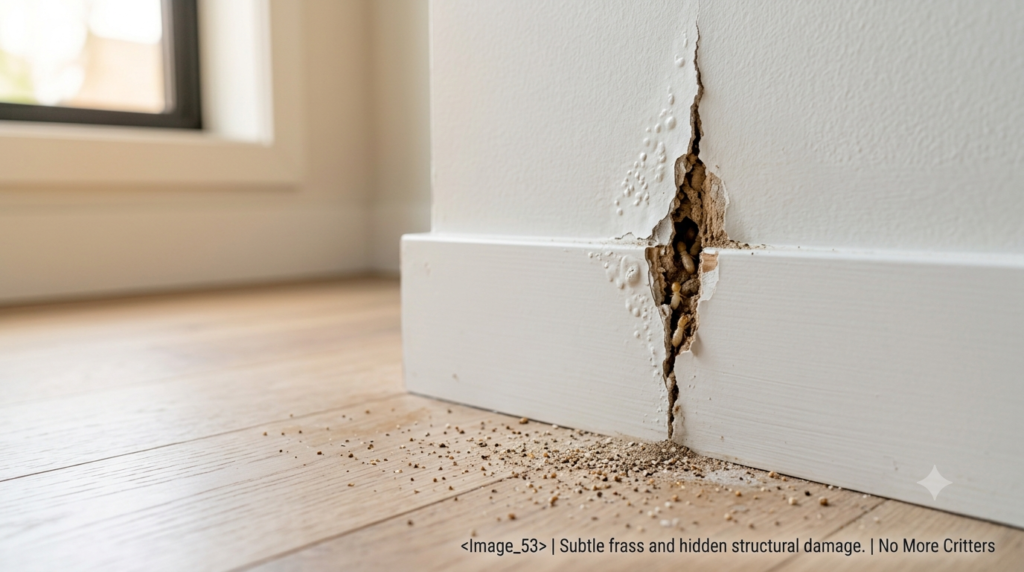
Frass is the tell-tale sign of drywood termites. It looks almost exactly like sawdust or coffee grounds — tiny, wood-colored pellets accumulating in small piles on surfaces below infested wood.
The test: clean up the pile completely. If a new pile appears in the same location within a day or two, the infestation is active. Frass that keeps coming back is not sawdust from a renovation — it’s drywood termites pushing their droppings out of kick-out holes bored into infested wood above.
Bubbling or Peeling Paint Without a Water Source
Termites introduce moisture as they tunnel through wood and drywall. This moisture causes paint to bubble, blister, or peel — often mimicking water damage in areas where no leak exists.
If you notice paint damage on an interior wall that has no plumbing behind it and no history of moisture, termite activity should be on your list of causes to rule out. The same applies to unexplained ripples or soft spots in drywall.
Discarded Wings Near Windows and Doors
Winged termites — called swarmers or alates — emerge from a mature colony to mate and establish new colonies. After landing, they shed their wings, leaving small piles of equal-length wings on windowsills, door frames, and along baseboards.
Finding swarmers or discarded wings indoors is one of the clearest signs that a termite colony is already established inside or very near the structure — not just in the yard. Swarmers emerging from inside walls mean the colony has been present long enough to reach reproductive maturity.
Termite wings are equal in length on both pairs — this distinguishes them from flying ants, whose front wings are longer than the rear pair.
Sticking Doors and Windows
As termites damage wood framing around door and window openings, the structure subtly shifts. Doors and windows that suddenly stick, warp, or no longer close properly — especially in the absence of recent humidity changes — can indicate termite damage in the surrounding frame.
Clicking Sounds in the Walls
Put your ear close to a wall where you suspect activity. Soldier termites bang their heads against wood to signal alarm when the colony is disturbed. Worker termites are audible eaters. A faint clicking or rustling sound from inside a wall, particularly at night, is worth investigating further.
The Termite Swarm — What It Means When You See It
A termite swarm is not an infestation beginning — it is a sign that an infestation is already well established. Colonies typically don’t produce swarmers until they are three to five years old and contain hundreds of thousands of individuals.
Seeing swarmers emerge from your walls, floor, or ceiling is cause for immediate professional inspection. Seeing them emerge from outside near the foundation is cause for prompt inspection as well — those swarmers are looking for a new home, and yours is close.
For more on identification and treatment options, see our complete termite guide.
What to Do If You See These Signs
Do not spray the area or disturb mud tubes beyond the test described above. Spraying termites with store-bought insecticide pushes them deeper into the structure without eliminating the colony, and disrupting activity can cause the colony to split and move to different areas of the home.
Do this instead:
- Document what you’ve found with photographs
- Note the location, how many signs, and when you first noticed them
- Schedule a professional inspection — most pest control companies offer free termite inspections
- Do not begin renovations or repairs to affected areas until after inspection
Termites are one pest where professional treatment is not optional. The colony is inside the structure. Consumer products cannot reach it effectively. Attempting to treat it yourself almost always results in delayed professional treatment and more extensive damage.
When to Call a Professional
Immediately — if you see any of the following:
- Mud tubes on your foundation, inside or outside
- Swarmers or discarded wings indoors
- Frass accumulating in consistent locations
- Wood that sounds hollow where it previously didn’t
- Paint damage with no identifiable water source
The earlier a professional inspection happens, the more treatment options are available and the lower the repair cost. Termite damage compounds silently. A colony caught this month is significantly less expensive to address than the same colony caught next year.
We can match you with vetted local exterminators — no spam, no pressure.
No More Critters provides vetted pest identification and treatment information for homeowners. This site is a free service to assist homeowners in connecting with local service providers. All contractors and providers are independent. This site does not warrant or guarantee any work performed.
Filed under