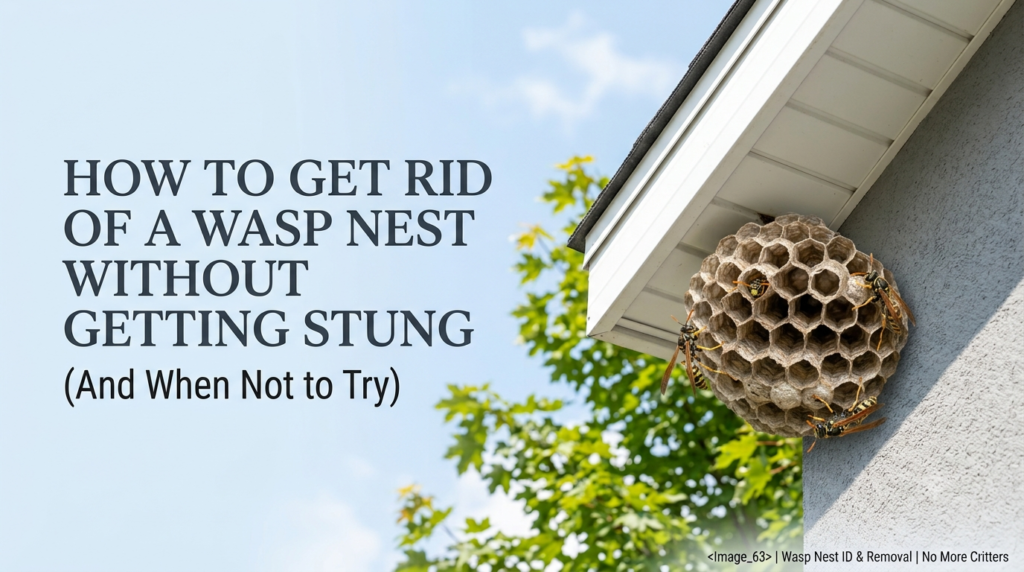
You found a wasp nest. Maybe it’s tucked under the eave above your front door, maybe it’s a grey papery mass hanging in the corner of the garage, maybe you accidentally disturbed it while gardening and retreated faster than you thought possible.
The good news is that many wasp nests can be handled without a professional. The important news is that the approach depends entirely on the type of nest, where it is, and how large it has grown. Getting this wrong means getting stung — possibly many times.
Identify the Nest Before You Do Anything
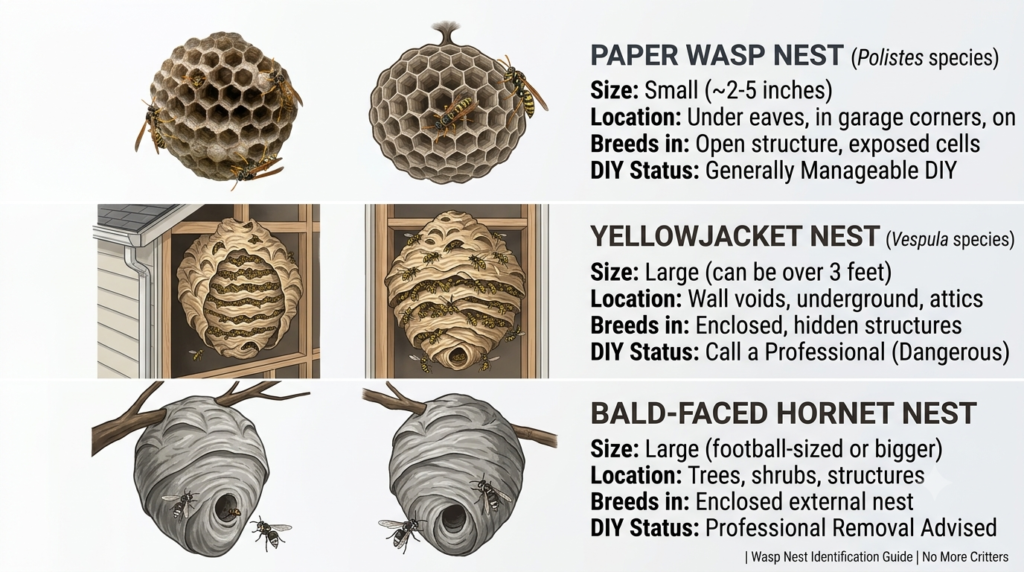
The single most important step is identifying what species you’re dealing with. Different wasps behave differently, and the treatment approach — and when to call a professional — differs significantly.
Paper Wasps (Polistes species) Build open, umbrella-shaped nests with visible hexagonal cells — they look like upside-down honeycombs with no outer covering. Found under eaves, in garage corners, and on fence tops. Paper wasps are relatively docile unless the nest is directly threatened. They are the most manageable for DIY removal.
Yellowjackets (Vespula species) The most aggressive common wasp in North America. They build enclosed nests inside wall voids, underground, inside attic spaces, and sometimes in abandoned rodent burrows in the yard. The nest entrance is often a small hole — you may hear buzzing before you see anything. Yellowjacket nests can contain tens of thousands of workers by late summer. They sting repeatedly and release alarm pheromones that recruit other colony members to attack.
Bald-Faced Hornets (Dolichovespula maculata) Build large, grey, football-shaped enclosed nests in trees, shrubs, and on structures. Highly aggressive defenders. A nest above head height in a tree or attached to your house fascia warrants professional removal.
The rule of thumb: paper wasp nests are manageable DIY. Yellowjackets in wall voids or underground and bald-faced hornet nests should go to a professional.
The Most Important Rule — Timing
Always approach a wasp nest after dark. Never during the day.
Wasps are cold-blooded and become sluggish in cooler temperatures. At night, nearly the entire colony is inside the nest and inactive. During the day, forager wasps are out and will return to find an agitated colony if you disturb the nest — making a bad situation significantly worse.
Wait until at least 30 minutes after full dark. Use a red-light flashlight if you need visibility — wasps cannot see red light and will not be attracted to it the way they respond to white light.
What to Wear
No exposed skin. This is not optional.
- Long sleeves, long pants tucked into socks
- Gloves — heavy leather or thick rubber
- Eye protection — safety glasses or goggles
- Hat or hood covering your neck
- Closed shoes
If you have a known allergy to wasp stings, do not attempt DIY removal under any circumstances. Carry your epinephrine auto-injector if you proceed despite this advice.
How to Remove a Paper Wasp Nest
What you need: Aerosol wasp and hornet spray rated for long-range use (most spray 15-20 feet). Available at any hardware store.
The steps:
- Approach after dark in full protective clothing
- Stand at least 10-15 feet from the nest
- Aim at the nest entrance — for open paper wasp nests, aim at the base where wasps cluster
- Spray until the nest is thoroughly saturated — do not stop early
- Back away immediately without running — calm, deliberate movement
- Leave the area and do not return until the following morning
- The next day, check for any surviving wasps. If the nest is still active, repeat the treatment at night
- Once no activity is visible for 24 hours, knock the nest down with a long stick, seal it in a plastic bag, and dispose of it in an outdoor trash can
Do not knock down a nest that still has living wasps inside it. This releases the colony in an agitated state.
Dish Soap and Water — The Non-Chemical Option
For small paper wasp nests caught very early — golf ball sized or smaller — a mixture of dish soap and water sprayed directly at the nest can be effective. The soap clogs the wasps’ breathing pores.
Mix 2 tablespoons of dish soap into a spray bottle of water. Approach at night, spray the entrance and nest thoroughly, and retreat. This works best on small nests and is not reliable for large or enclosed nests.
The Biggest Misconceptions About Wasp Nest Removal
“I’ll just knock it down with a broom.” Do not do this. Ever. Physically striking a nest without first killing the colony releases hundreds of agitated wasps at close range. This results in multiple stings at minimum.
“I’ll do it during the day when I can see better.” Daytime removal means forager wasps are active and will join the defense. Night removal significantly reduces the number of wasps available to respond.
“I’ll flood it with the garden hose.” Wet, agitated wasps are still capable of stinging. The hose approach distributes wasps erratically rather than eliminating them.
“Burning it will work.” Fire is dangerous, ineffective, and will cause structural damage if the nest is on or near your home. This approach causes injuries and property damage consistently.
Yellowjackets in Wall Voids or Underground — Call a Professional
If the nest is inside a wall void, under your deck, in your attic, or in a ground burrow, DIY removal is not advisable for most homeowners. These situations involve:
- Nests that are inaccessible to spray from a safe distance
- Colonies that can number in the tens of thousands
- The risk of wasps entering the interior of your home if the nest is in an exterior wall
A professional will treat the nest opening with a residual dust or foam that the wasps carry into the nest, eliminating the colony without direct access to the nest itself.
For more on wasp identification and seasonal behavior, see our complete wasp guide.
Preventing Wasps From Coming Back
Wasps don’t reuse old nests, but they do return to the same general area to build new ones the following spring.
Decoy nests — wasps are highly territorial and won’t build near another colony’s nest. Hanging a paper bag stuffed with newspaper or a commercially available decoy nest under your eaves before spring can deter queens from choosing that site.
Seal entry points — gaps around fascia boards, soffits, and utility penetrations are common nest-building entry points for yellowjackets. Seal these in late fall after the colony has died off.
Remove food sources — late-season yellowjackets are increasingly attracted to sweet drinks and food. Keep outdoor eating areas clean and use covered trash cans.
When to Call a Professional
Call before attempting DIY removal if:
- The nest is inside a wall, ceiling, attic, or underground
- The nest is larger than a grapefruit
- You have a known or suspected allergy to wasp stings
- The species is bald-faced hornets
- The nest is in a location where safe distance is impossible
We can match you with vetted local exterminators — no spam, no pressure.
No More Critters provides vetted pest identification and treatment information for homeowners. This site is a free service to assist homeowners in connecting with local service providers. All contractors and providers are independent. This site does not warrant or guarantee any work performed.
Filed under