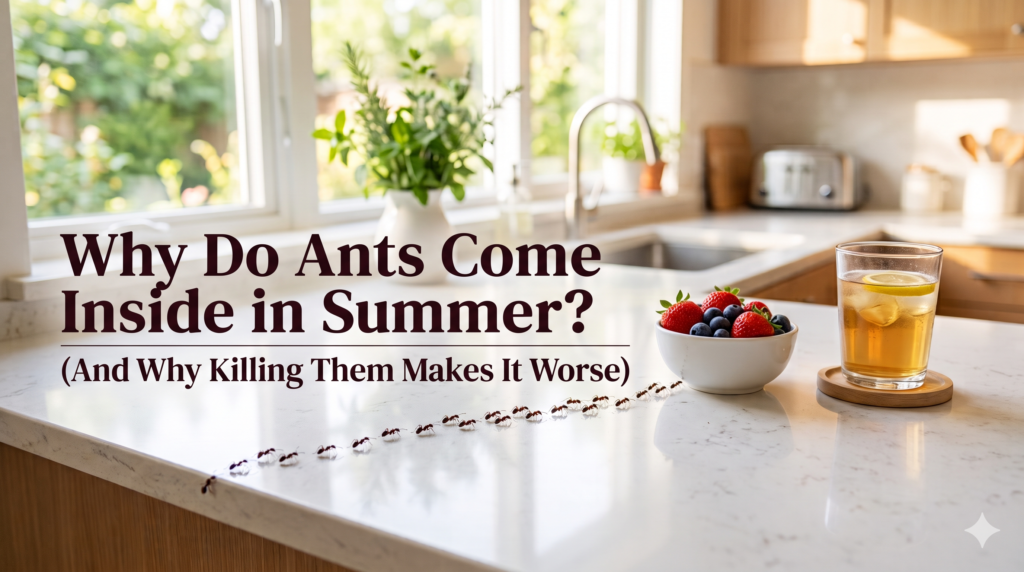
Why Do Ants Come Inside in Summer? (And Why Killing Them Makes It Worse)
It’s the middle of July. You haven’t changed anything about how you clean. And yet — there’s a thin black line moving across your kitchen counter like it’s been there the whole time.
Why do ants come inside in summer when they have an entire yard to live in? The answer has everything to do with their colony biology, and understanding it changes how you respond. Because the most instinctive thing most people do — reaching for the spray — is often the single action that makes a summer ant problem dramatically worse.
Here’s what’s actually happening, and what to do instead.
Why Summer Is Peak Season for Ants Indoors
Ant colonies don’t stay the same size year-round. From spring through summer, the queen is laying eggs at her highest rate, and the colony population can explode into the hundreds of thousands. More ants in the nest means more mouths to feed — which means more worker ants, also called foragers or scout ants, ranging out in search of food and water.
A single scout ant can travel up to 30 meters from the nest. When it finds a food source — even a sticky drop of juice on your counter — it lays a pheromone trail on the way back. That chemical signal tells every other forager in the colony exactly where to go. Within hours, you have a line.
Summer heat also affects this in two additional ways. It dries out outdoor food and water sources faster, pushing ants to seek alternatives. And in periods of heavy rain, nest flooding drives entire colonies to relocate — sometimes directly into the walls or foundation of the nearest building.
Common Types of House Ants in Summer (And How to Identify Them)
Not all ants behave the same way indoors, and identifying which species you have changes what you should do about it.
Odorous House Ants are the most common indoor ant in North America. Small, dark brown to black, and slow-moving in a trail. When crushed, they smell like rotten coconut — that’s the tell. They nest both outdoors and inside wall voids and under floors. They are drawn almost entirely to sugary foods and moisture.
Pavement Ants are slightly larger, brown to black, and typically enter homes through cracks in the foundation or along utility lines. They eat almost anything — sweets, proteins, grease.
Carpenter Ants are the ones worth taking seriously. Large — often 6-12mm — black or red-and-black, and they do not eat wood. They excavate it. They nest inside moisture-damaged wood: window frames, door frames, beams behind leaking pipes. If you’re seeing large black ants on the second floor of your home, or near a window frame, this is not a nuisance problem. This is a structural one.
Winged ants emerging from wall crevices indoors is a definitive sign that a colony is established inside your home — not just passing through.
Why Spraying Ants Makes the Problem Worse
This is the most important thing in this article. Read it before you open anything under the sink.
Spraying ants with contact insecticides makes the problem worse because it triggers a survival mechanism called “colony budding.” When the colony detects a threat, the queen splits the nest into multiple smaller groups that scatter to new locations, turning one localized issue into multiple widespread infestations.
When you spray ant trails with a contact insecticide, you kill the foragers you can see. But the spray also distributes a chemical signal that the colony reads as danger. Their response is called colony budding — the queen splits the colony into multiple smaller groups, each moving to a new location. One nest becomes three. Three nests become nine.
Pest professionals see this pattern constantly: a homeowner sprays a trail in the kitchen, and two weeks later has ants in the bathroom, the bedroom, and behind the refrigerator. The spray worked exactly as advertised. It just communicated the wrong message to the colony.
What Actually Works
Gel bait is the correct tool. It works because foragers carry it back to the nest, feeding it to the colony — including the queen. The colony doesn’t detect danger. It detects food. This is what eliminates the nest rather than just relocating it.
Apply gel bait in small pea-sized dots — not lines, not blobs — near where you’re seeing trail activity. Inside cabinet hinges. Along the kick plate under the stove. Near the gap where pipes enter under the sink. The dots need to be small enough that the ants consume them entirely and carry the remainder back.
Do not clean the area before applying bait. The pheromone trail is what guides ants to the bait. Cleaning it disrupts their path and reduces effectiveness.
Do not use sprays and bait simultaneously. The spray repels ants away from the bait.
For the trail itself: Wipe it down with white vinegar or soapy water after placing bait elsewhere. This disrupts the pheromone signal without creating a danger response the way insecticide does.
For entry points:
- Seal gaps around pipes under sinks with steel wool and caulk
- Apply weatherstripping under exterior doors
- Move firewood and compost piles at least 18 inches from the foundation
- Trim branches and shrubs that contact the exterior walls — ants use these as bridges
Identifying the Source Before You Treat
Gel bait works best when placed close to the nest. Follow the ant trail — don’t disrupt it — and observe where the ants are going when they’re not heading toward food. They’re usually returning to the nest.
Common indoor nesting locations: inside wall voids near plumbing, under bathroom tiles, inside hollow door frames, beneath kitchen appliances, and — in the case of carpenter ants — inside any wood that has been water-damaged.
If you find the trail leads outside, the nest is likely in the yard or foundation. Exterior granular bait placed along the perimeter is the right approach for outdoor nests.
💡 What to Do with the Can of Raid Under Your Sink
If you already bought a contact pest spray, do not throw it in the trash. It is still incredibly useful—just not on an active indoor ant trail. Instead of wasting the product, repurpose it today for perimeter prevention.
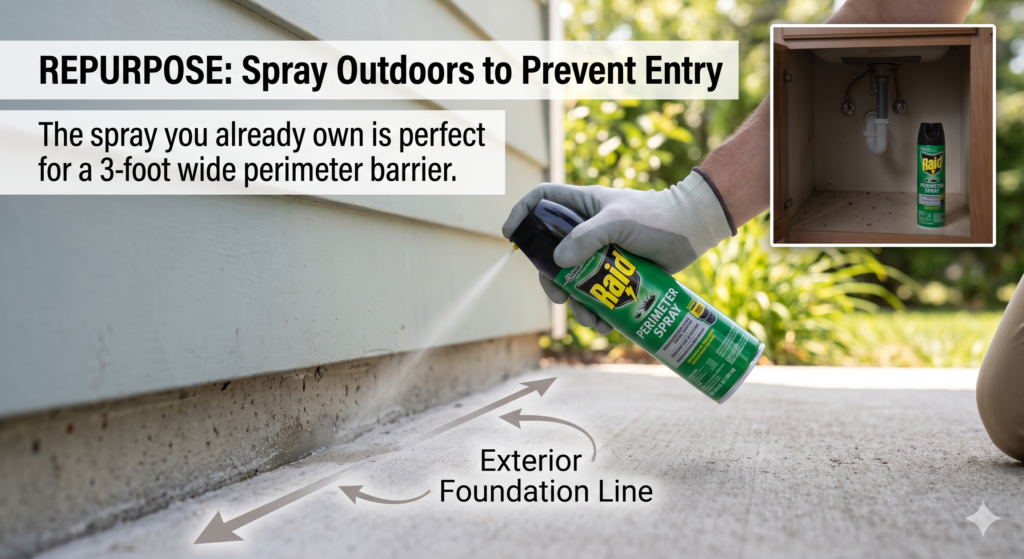
Here is how to use your existing spray safely and effectively without making your indoor ant problem worse:
- Take It Outside: Take that aerosol can or pump spray to the exterior of your home.
- Create a Chemical Barrier: Spray a continuous line along your home’s foundation, around basement window wells, and under the thresholds of exterior doors.
- Intercept the Scouts: This creates an outdoor boundary. When future scout ants try to crawl inside to escape the summer heat, they will cross the dried spray and be stopped before they ever find your kitchen.
- Save It for ‘Lone Wolves’: Keep the spray handy indoors strictly for solitary, non-colonizing pests that wander in, like a lone spider, an earwig, or a centipede.
What to Do Tonight
- Place gel bait dots in 4-5 locations along the trail, close to where it appears to originate
- Do not disturb the trail itself
- Remove obvious food sources: wipe down counters, seal anything open in the pantry, pick up pet food bowls
- Check under every sink for drips or standing water
This week:
- Seal gaps around plumbing with steel wool and caulk
- Add door sweeps to any exterior doors with visible gaps underneath
- Move firewood away from the house
For full identification help and treatment options by ant species, see our complete ant guide.
When to Call a Professional
If you are seeing large black ants — particularly near window frames, door frames, or on upper floors — have a professional inspect for carpenter ants before assuming the problem is cosmetic. Carpenter ant damage compounds silently and is expensive to repair.
Also call a pro if gel bait hasn’t produced a noticeable reduction in activity within two weeks. At that point, the nest location likely requires professional access to treat effectively.
We can match you with vetted local exterminators — no spam, no pressure.
No More Critters provides vetted pest identification and treatment information for homeowners. This site is a free service to assist homeowners in connecting with local service providers. All contractors and providers are independent. This site does not warrant or guarantee any work performed.