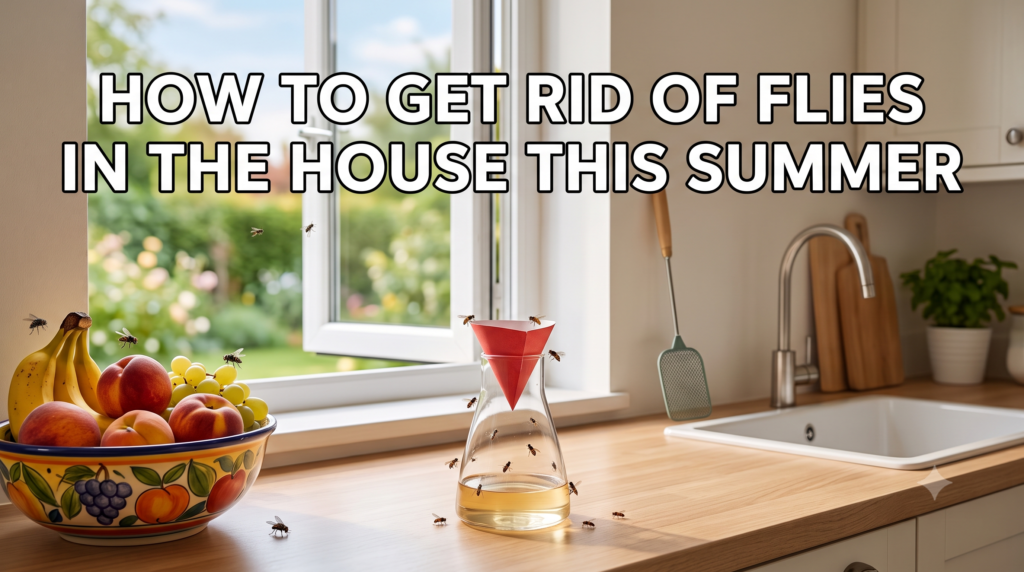
There is nothing quite as annoying as a housefly darting across the living room or a cloud of tiny fruit flies hovering over the kitchen sink. As summer temperatures peak, fly lifecycles accelerate dramatically. A single female housefly (Musca domestica) can lay up to 500 eggs over the course of her lifetime — in batches of 75 to 150 at a time — turning a minor annoyance into a full infestation before most people realize what’s happening.
If the swatting isn’t working, here is exactly how to get rid of flies in the house this summer — safely, quickly, and without relying on harsh chemicals.
Identify the Source of Your Summer Fly Problem
Before eliminating them, it helps to know which fly has moved in. Different species are drawn to entirely different breeding grounds.
Fruit Flies (Drosophila melanogaster)
Tiny, slow-flying insects hovering near the trash can, fruit bowl, or kitchen sink are almost certainly fruit flies. They are drawn to fermenting organic matter — overripe fruit, the sugary residue in an unwashed recycling bin, the organic biofilm that builds up inside sink drains. Removing the fruit bowl alone rarely stops them, because the breeding site is usually somewhere wetter and less visible.
Houseflies and Blowflies
Large, dark grey, or metallic flies buzzing against window panes are typically houseflies or blowflies (Calliphora species). They enter through open doors, torn screens, or gaps around siding, and they are drawn to decomposing garbage, pet waste, and forgotten food spills. Because they readily land on bacteria-rich surfaces before landing on food, keeping them out of the kitchen is a genuine health priority.
Drain Flies (Psychoda species)
Often mistaken for fruit flies, drain flies are small, moth-like, and almost always found near drains, pipes, or standing water. If the fruit fly traps aren’t catching anything, drain flies living in a slow or rarely-used drain may be the real culprit.
How to Get Rid of Flies in the House: A Step-by-Step Summer Fly Control Plan
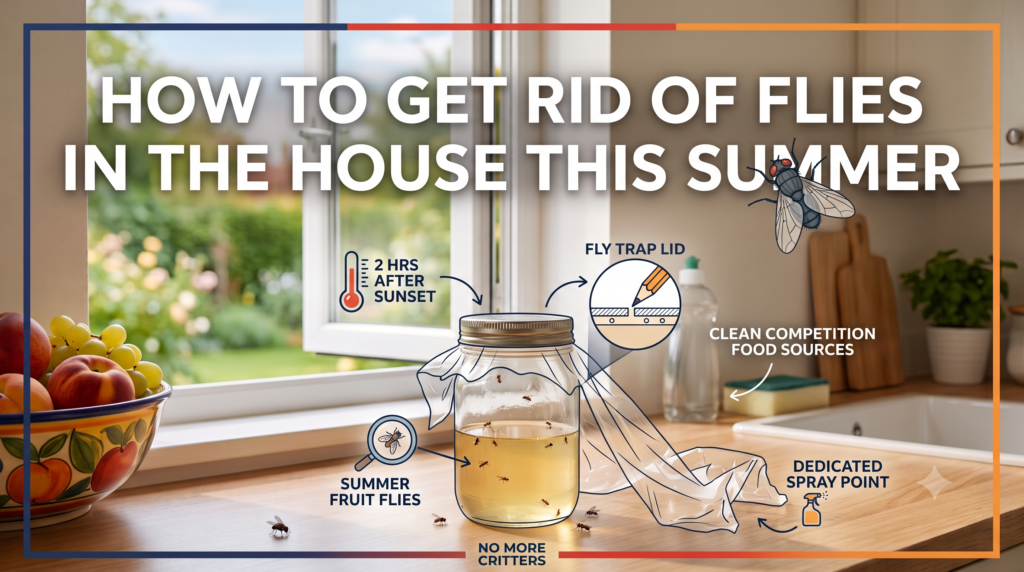
Step 1 — Build a Simple Apple Cider Vinegar Trap
For fruit flies, fill a small jar or ramekin with apple cider vinegar and add three drops of liquid dish soap. Leave it uncovered on the counter. The flies are drawn to the fermented scent, but the dish soap breaks the liquid’s surface tension and they sink on contact. Results usually appear within 24 hours.
Step 2 — Sanitize the Kitchen Drain
Pour half a cup of baking soda down the drain, follow with half a cup of white vinegar, let it fizz for ten minutes, then flush with boiling water. This breaks down the organic biofilm where both fruit flies and drain flies breed. For persistent drain fly problems, repeat every few days for a week.
Step 3 — Secure Every Trash Bin
Indoor and outdoor garbage cans both need tightly fitting lids. Wash the interiors with a diluted bleach solution to remove the fermented residue and odors that draw flies in the first place. A bin that smells clean stops being a breeding signal.
Step 4 — Inspect and Repair Window Screens
A gap of 6mm or larger is enough for a housefly to enter. Walk through the house and check every screen for tears, bent frames, or gaps around the edges. For doors left open in summer, a magnetic mesh screen door closes automatically and keeps flies out without blocking airflow.
For Houseflies: Sticky Traps and Entry Point Control
For larger houseflies (Musca domestica) and blowflies (Calliphora species), the apple cider vinegar trap won’t do much — they’re not drawn to fermentation the way fruit flies are. What works:
Sticky fly traps or fly ribbon hung near windows and doorways catch houseflies reliably. They’re drawn to light, so placement near a bright window is more effective than placement near the trash. Not the most elegant solution, but one of the most consistent.
A light trap — an electric trap that attracts flies with UV light and catches them on a sticky board — works well for persistent housefly problems without the noise or smell of a zapper. Place it away from competing light sources for best results.
Entry point control remains the most important housefly strategy. Unlike fruit flies that breed indoors, houseflies are almost always coming in from outside. Every open gap is an invitation. Check door sweeps, seal gaps around utility lines entering the house, and repair any screen tears larger than 6mm — that’s roughly the minimum gap a housefly needs to squeeze through.
Long-Term Indoor Fly Prevention
Once the active population is cleared, keeping flies out comes down to cutting off what draws them in: fermenting food, standing moisture, uncovered waste, and easy entry points. Empty kitchen bins every one to two days in summer. Store ripe fruit in the refrigerator. Fix any slow drains before they become breeding grounds. Check that door sweeps and weatherstripping are intact around exterior doors.
When a Fly Infestation Needs a Professional
If traps are filling up but the population isn’t declining — or if large flies keep appearing despite a clean kitchen — there may be a hidden source. A dead rodent inside a wall void, a cracked sewage pipe, or a drainage problem beneath the crawlspace can sustain a fly population indefinitely regardless of how clean the visible surfaces are. When DIY methods aren’t making a dent, a professional inspection is the next step.