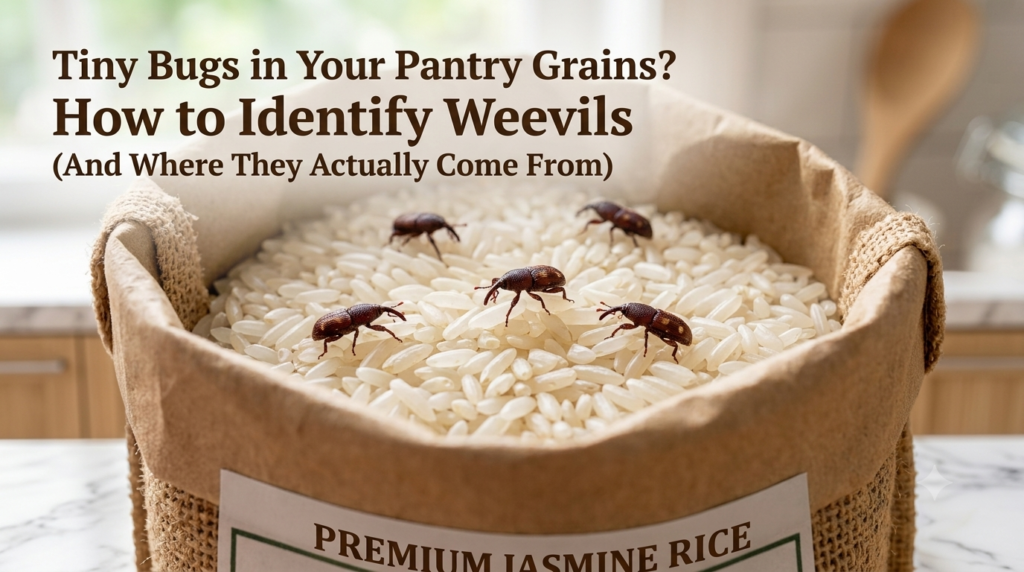
You open the rice. Or the flour. Or the oats you bought three weeks ago and sealed with a clip. And there they are — tiny reddish-brown specks moving slowly through the grain, with what appears to be a miniature snout on the front of their heads.
If you have weevils in your pantry grains, you’re not alone and your home is not dirty. Weevils are one of the most commonly searched pantry pests in North America, and the reason most people find them is not what they expect. Understanding where pantry weevils actually come from — and what actually eliminates them — changes everything about how you respond.
What Do Weevils in Pantry Grains Look Like?
Weevils belong to the family Curculionidae — one of the largest beetle families on earth. The feature that sets them apart from every other pantry bug is their snout: a long, curved projection from the front of the head that makes them look almost comically prehistoric up close.
They are small — between 2mm and 6mm depending on species — and reddish-brown to nearly black in color. They move slowly and deliberately. When disturbed, granary weevils will often play dead, tucking their legs in and going completely still.
What you will not see unless you look closely: the larvae. Female weevils drill into individual grain kernels, deposit a single egg inside, and seal the hole with a waxy secretion. The larva hatches and feeds entirely within the kernel, invisible, for 4-6 weeks before emerging as an adult. By the time you see movement in your rice or flour, the infestation has been developing for weeks.
Granary Weevil vs Rice Weevil vs Maize Weevil — What’s the Difference?
[IMAGE: Side-by-side comparison of granary weevil and rice weevil | alt: “granary weevil vs rice weevil identification comparison”]
The three species most likely to be in your pantry are closely related but behave differently — and the difference matters for how contained the problem is.
Granary Weevil (Sitophilus granarius) Shiny reddish-brown, about 3-4mm, no wings. Because it cannot fly, a granary weevil infestation tends to stay in one area — wherever the infested grain is. It prefers whole hard grains: wheat, oats, barley, rye. It does not establish in flour or processed grain products, though it will crawl across them. Found more commonly in cooler climates.
Rice Weevil (Sitophilus oryzae) Slightly smaller, reddish-brown with four faint pale spots on the wing covers — this is the visual tell that distinguishes it from the granary weevil. It has functional wings and can fly short distances, particularly in warm conditions. A single female can lay up to 400 eggs in a five-month lifespan, making rice weevil infestations spread faster and further. Targets rice, corn, pasta, cereals.
Maize Weevil (Sitophilus zeamais) Very similar in appearance to the rice weevil, slightly larger. Also winged. Prefers corn but will infest rice, wheat, and other whole grains. Less common in household settings than the other two but increasing in warmer climates.
The quick visual test: If the weevil has four pale spots on its wing covers, it’s a rice or maize weevil and it can fly. If it’s uniformly shiny with no markings, it’s a granary weevil and it can’t.
Where Do Pantry Weevils Actually Come From?
Weevils almost never enter your home from outside. They arrive inside the groceries you bring home.
This is the most important thing to understand about pantry weevil infestations, and it’s what most people get wrong. Weevils are not coming through your window screens or up through the foundation. They are entering your home inside a bag of rice, a box of cereal, or a container of oats that was already infested — often before it left the warehouse or even the mill.
Female weevils lay eggs inside individual grain kernels. The eggs and developing larvae are invisible to the naked eye and cannot be detected through sealed packaging. By the time you purchase the product, development may already be underway. A few weeks at room temperature is all it takes for adults to emerge.
This is why pantry weevil infestations appear suddenly in otherwise clean, well-managed kitchens. It has nothing to do with sanitation. It has everything to do with the supply chain.
Summer accelerates this process. Warm temperatures shorten the weevil life cycle and trigger faster hatching. A product that sat dormant through winter may produce its first visible adult weevils in July or August.
Why Spraying Your Pantry Does Not Work
Spraying insecticide inside a pantry where food is stored does not eliminate a weevil infestation — it contaminates your food storage area and leaves the source of the problem untouched.
Weevils are internal feeders. The larvae are sealed inside individual grain kernels throughout their development. A surface spray cannot reach them. Even if you kill every adult weevil visible on your shelves, the next generation is already developing inside your grain, sealed away from any chemical treatment.
Beyond ineffectiveness, applying insecticides in food storage areas creates a genuine contamination risk. Pantry sprays are not safe for surfaces that contact food or for open food containers. Using them in this context is specifically against label directions for most products.
The source of the infestation is inside the grain. Surface treatment of the shelves does not address it.
How to Get Rid of Weevils in Grains Completely

This is a systematic process. Shortcuts create recurring infestations.
Step 1 — Empty the entire pantry. Everything comes out. Not just the suspect items. Weevil adults are mobile and will have explored neighboring products. Check every bag, box, and container of dry grain — flour, rice, pasta, oats, cornmeal, cereals, dried beans, spices in cardboard packaging.
Step 2 — Inspect and discard. Look for adult weevils, grain dust, clumping, webbing, or tiny holes in individual kernels. Any product showing signs of infestation gets sealed in a bag and taken directly to the outdoor trash — not the kitchen bin. When in doubt, discard.
Step 3 — Freeze new or suspect items. Place any dry grain products you want to keep — or any new purchases — in the freezer for a minimum of 4 days. Freezing kills eggs and larvae at all stages. After freezing, transfer to airtight hard-sided containers.
Step 4 — Clean the pantry thoroughly. Vacuum all shelves, corners, and crevices. The vacuum bag or canister contents go directly to the outdoor trash. Wipe all surfaces with white vinegar — it’s effective against weevil eggs and residue and safe for food surfaces. Allow to dry completely before restocking.
Step 5 — Restock in airtight containers only. Weevils can chew through thin plastic bags and cardboard. Transfer everything to glass jars or hard-sided plastic containers with tight-fitting lids. This is the single most effective long-term prevention measure.
For more on weevil identification and species-specific treatment, see our complete weevil guide.
How to Prevent Weevils from Coming Back
The freezer method: Place all new dry grain purchases in the freezer for 4 days before putting them in the pantry. This eliminates any eggs or larvae present at time of purchase. It requires no ongoing effort after the initial habit is established.
Airtight containers: Glass mason jars are ideal. Hard-sided plastic with secure lids works. Thin-walled containers, zip-lock bags, and original cardboard or paper packaging do not. Weevils can penetrate all of them.
Bay leaves: Placing dried bay leaves in pantry shelves and inside grain containers is a traditional deterrent with some evidence behind it. The volatile oils in bay leaves are repellent to weevils. It will not eliminate an active infestation but can discourage establishment.
Buy in smaller quantities: The longer dry grains sit at room temperature, the more opportunity any dormant eggs have to hatch. Buying grains in quantities you’ll use within 2-3 months reduces the window of risk significantly.
When to Call a Professional
Weevils rarely require professional pest control. The source is the food itself, not the structure of your home, and thorough cleaning plus proper storage resolves almost all household infestations.
Call a professional if:
- You have eliminated all infested food, thoroughly cleaned, and restocked in proper containers — and weevils continue to appear after several weeks
- You are finding weevils in areas outside the pantry, which may indicate a different stored product pest entirely
In those cases a professional inspection can identify whether you’re dealing with a secondary pest species or an unusual harborage location.
We can match you with vetted local exterminators — no spam, no pressure.
No More Critters provides vetted pest identification and treatment information for homeowners. This site is a free service to assist homeowners in connecting with local service providers. All contractors and providers are independent. This site does not warrant or guarantee any work performed.