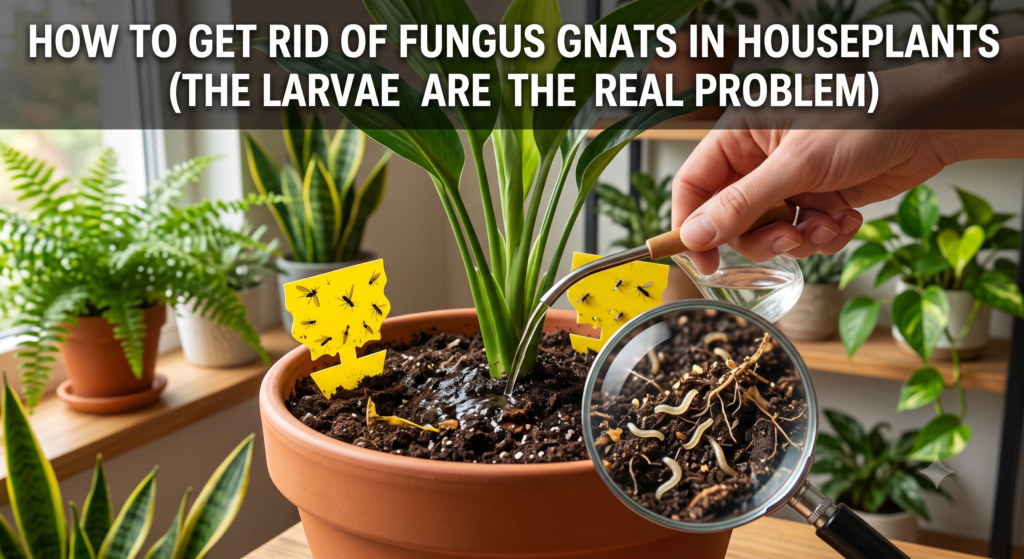
Those tiny dark flies hovering just above your houseplant soil are fungus gnats — and the frustrating truth is that swatting or spraying the adults won’t solve your problem. The infestation lives underground, in the top few inches of your potting mix, where larvae are feeding on fungi and plant roots. Here’s how to actually get rid of them.
What are the tiny flies coming out of my houseplant soil?
Fungus gnats (family Sciaridae, primarily Bradysia species) are small, dark, delicate flies about 1/8 inch long. They look like tiny mosquitoes and are often mistaken for fruit flies — but where fruit flies hover around food and produce, fungus gnats are almost exclusively interested in damp, organically rich potting soil. If the flies scatter when you disturb the soil surface, you’re dealing with fungus gnats.
The adults live only about a week, but in that time a single female can lay up to 200 eggs in moist soil. At 70°F, a new generation completes in three to four weeks. An untreated infestation can produce thousands of insects within two months.
Are fungus gnats harmful to plants?
The adults are harmless — they don’t bite people, don’t feed on plants, and are considered a nuisance only. The larvae are a different matter.
Fungus gnat larvae live in the top two to three inches of soil, feeding primarily on fungi and decaying organic matter. In most home situations this causes no serious damage. But in heavy infestations, larvae chew plant root hairs and tunnel into roots themselves — stunting growth, causing wilting, and in severe cases killing seedlings and young plants outright.
A wilting houseplant that seems to have enough water is worth looking at more carefully. Root damage from fungus gnat larvae mimics drought stress because the roots can no longer take up water properly.
Why do I keep getting fungus gnats in my houseplants?
One word: moisture. Larvae cannot survive in dry soil. The most common reason gnats keep recurring is overwatering — especially in winter, when plants use less water but many people continue watering on their usual schedule. The soil stays wet, the top layer never fully dries, and fungus gnats move in.
Other contributors: rich peat-heavy potting mixes, standing water in drain saucers, bringing outdoor plants inside in fall (a major and often overlooked vector), and occasionally new potting mix already carrying eggs from damp storage.
How to Get Rid of Fungus Gnats in Houseplants? (And their larvae)
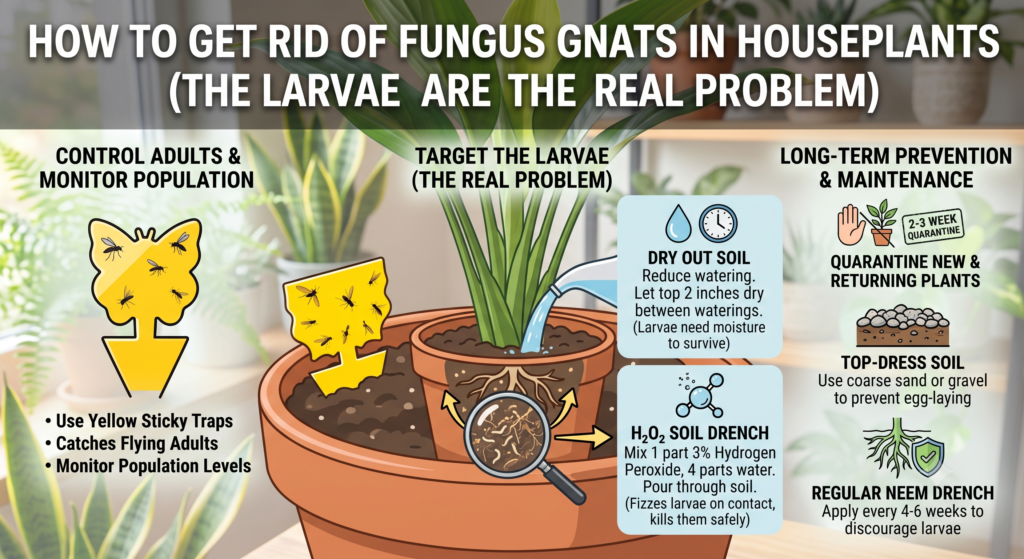
This is the core of the fix. The adults disappear once the larvae are addressed — the cycle breaks.
Let the soil dry out — allow the top two inches to dry completely between waterings. Larvae die within four to seven days in dry conditions. For plants that tolerate it, bottom watering keeps the surface dry while still hydrating roots. This single change often breaks a mild infestation over two to three weeks.
Hydrogen peroxide soil drench — mix one part 3% hydrogen peroxide with four parts water and water the soil thoroughly. It fizzes on contact with larvae and kills them without harming the plant. Repeat every five to seven days for two to three weeks.
Bacillus thuringiensis israelensis (Bti) — 90–95% effective against larvae within 24–48 hours. Found in products like Mosquito Bits and Gnatrol. Apply as a soil drench so it reaches larvae in the lower soil layers. Multiple applications spaced five to seven days apart are necessary to catch successive waves of newly hatched larvae. One of the safest and most effective options for home use.
Neem oil soil drench — two teaspoons neem oil, one teaspoon dish soap, one liter of warm water. Apply weekly for four to six weeks. Disrupts larval development and discourages adults from laying eggs in treated soil.
Repot with fresh soil — for heavy infestations, repotting is the fastest reset. Remove the plant, rinse the roots, discard all old soil, and repot in fresh well-draining mix amended with perlite or pumice.
How to get rid of adult fungus gnats flying around plants
Yellow sticky traps near the soil surface catch significant numbers of adults and let you monitor whether the population is declining. Space plants apart, run a fan on low near heavily infested collections, and avoid aerosol sprays — killing flying adults is largely ineffective and the problem is in the soil anyway.
How to stop fungus gnats from coming back
Always check the top inch or two of soil before watering. Adapt your schedule seasonally — plants need far less water in winter. Use pots with drainage holes and empty saucers after watering. Quarantine any new plant or returning outdoor plant for two to three weeks before letting it join the collection. Top-dress pots with coarse sand or gravel to discourage egg-laying at the surface. A preventive neem drench every four to six weeks keeps larval populations below damaging levels.
When to call a professional
A widespread, recurring infestation across a large plant collection that hasn’t responded to soil treatment and watering correction over four to six weeks warrants a closer look from a pest professional.
Filed under