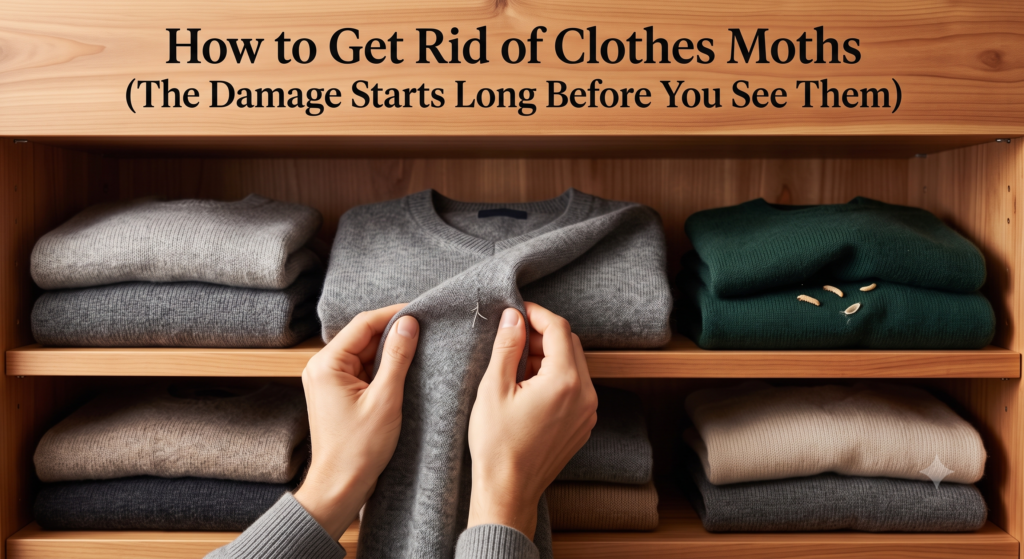
By the time you find holes in your favorite wool sweater, clothes moth larvae have been feeding quietly in your closet for weeks — sometimes months. The adults don’t eat fabric at all. It’s their larvae that do the damage, hidden in dark folds and undisturbed corners, invisible until the destruction is already done. Here’s how to find them, kill them, and stop them from taking anything else.
How do I know if I have clothes moths?
Irregular holes in natural fiber garments — wool, cashmere, silk, fur. Ragged, uneven, clustered where fabric sits folded or pressed against itself. Fine silk webbing in folds and seams from the webbing clothes moth (Tineola bisselliella), or small cigar-shaped silk cases from the casemaking clothes moth (Tinea pellionella). Tiny granular frass the same color as the fabric being eaten. Thinning carpet pile in low-traffic corners under furniture. Small cream-colored larvae with dark heads, half an inch long, retreating into seams when disturbed. Adult moths — small, buff-colored, about 1/4 inch, with a reddish tuft on the head — crawling rather than flying in dark closet corners.
Do clothes moths actually eat fabric?
No. This is the most important thing to understand. Adult clothes moths don’t eat at all — they live only to mate and lay eggs. A female lays 40–50 eggs directly onto fabric, glued into folds and seams. Eggs hatch in four to ten days. Larvae feed immediately and can remain in the larval stage for months — sometimes over two years — before pupating.
Killing the adult moths you can see does almost nothing. The larvae are the problem.
Where are clothes moths hiding?
Under collars, inside pockets, along interior seams. The back corners of wardrobes where the base meets carpet. Under heavy furniture — sofas, beds, dressers — where wool rugs haven’t been vacuumed in months. Along carpet edges at skirting boards. Inside stored boxes containing wool, fur, or feathers. Behind heating vents where fiber and hair accumulate.
The infestation typically anchors in one spot — a rarely worn coat, a stored blanket — and spreads from there.
So How do I get Rid of Clothes Mothes and How do I kill clothes moth larvae in my closet?
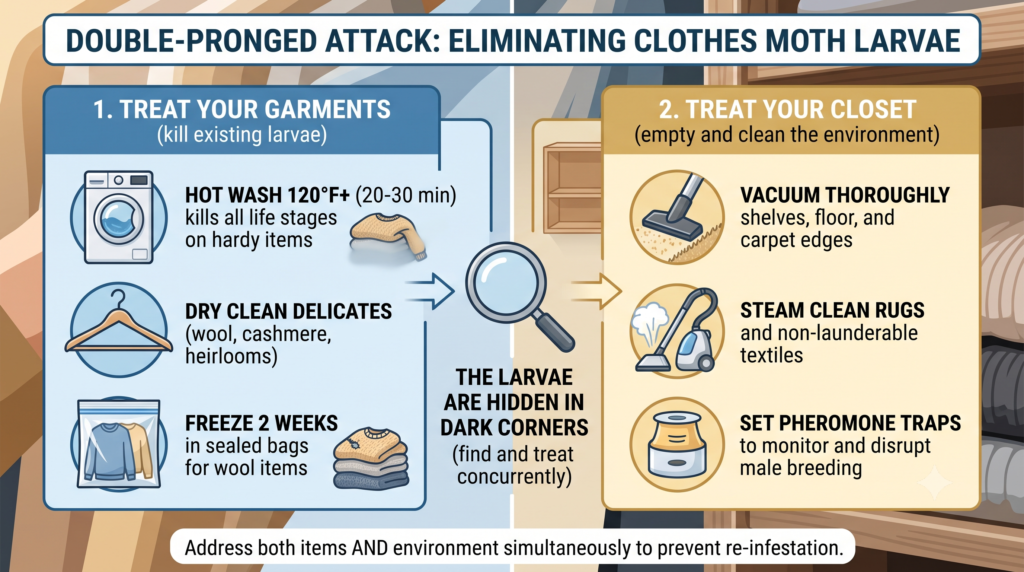
Treat the environment and the garments simultaneously. Addressing only one leaves the other as a reservoir.
Hot wash above 120°F for 20–30 minutes kills all life stages. Check garment labels first — wool and cashmere often need cold water or dry cleaning. Dry cleaning is the safest option for delicate or heirloom pieces. Freezing in a sealed bag at 0°F for two weeks also kills all stages — allow items to return to room temperature before opening.
Vacuum every surface of the closet, the carpet edges, and under all furniture. Empty the vacuum outside immediately — larvae can survive inside and re-establish. Steam cleaning kills eggs and larvae in carpets, rugs, and upholstery that can’t be laundered.
Pheromone traps catch adult males, disrupt breeding, and let you monitor whether the population is declining. Insecticide sprays containing permethrin or bifenthrin applied to closet walls, shelves, and carpet edges — not to garments — provide residual protection for several weeks.
What to do with damaged clothing
Assess honestly. Minor damage on a garment worth keeping — treat and repair. Heavily infested items — bag and discard, not donate. Any item showing damage or larvae should be treated before going back into storage.
Carpets and upholstery
Wool rug damage starts as surface thinning before progressing to bare patches at the backing. Vacuum edges and hidden areas thoroughly first. Steam clean if the material tolerates it. Apply insecticide spray along carpet edges and under furniture after cleaning. Valuable or antique rugs with significant damage warrant professional assessment.
When to call a professional
When the infestation has spread from one closet to carpets and upholstery across multiple rooms. When thorough treatment hasn’t stopped fresh damage after four to six weeks. When irreplaceable items are at risk. When the anchor point of the infestation isn’t clear.
Return to all guides.
Filed under