You’ve seen it everywhere — spray white vinegar on your ant trail and they’ll disappear. It’s one of the most shared home remedies on the internet. You probably already have a bottle under the sink. So does vinegar actually get rid of ants, or is it one of those things that sounds right but doesn’t hold up?
The answer is more nuanced than yes or no — and understanding exactly what vinegar does and doesn’t do to ants will save you a lot of time and frustration.
What Does Vinegar Actually Do to Ants?
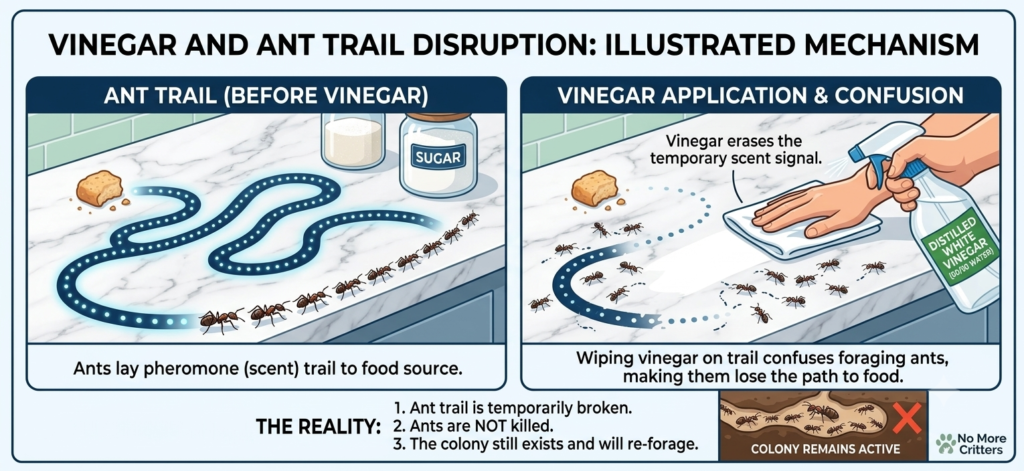
Vinegar does not kill ants. It disrupts their pheromone trails — temporarily — which causes them to lose their path to a food source.
Ants navigate almost entirely by scent. When a scout ant finds food, it lays down a chemical trail of pheromones on the way back to the nest. Every ant that follows reinforces that trail. The line you see marching across your counter is a pheromone highway.
White vinegar, when sprayed directly on that trail and wiped clean, disrupts the scent signal. The ants that were following it can no longer find the path. For a short window — usually 30 minutes to a few hours until the vinegar evaporates — the trail is effectively erased.
But the colony is still there. The scout ants are still foraging. And the moment the vinegar scent dissipates, they will find the food source again and lay a new trail.
Is Vinegar Safe for Pets and Kids?
Yes — diluted white vinegar is one of the safest options available for households with pets and children. A 50/50 solution of white vinegar and water sprayed on surfaces and wiped down poses no meaningful risk to dogs, cats, or small children who touch or lick the area afterward.
This is actually one of the strongest arguments for using vinegar as part of your ant response — not because it eliminates the infestation, but because it buys you time to set up proper treatment without exposing your family to insecticides.
A few notes on safety:
- Apple cider vinegar works similarly but leaves a sticky residue — stick to white distilled vinegar
- Undiluted vinegar can damage natural stone surfaces like marble and granite — always dilute before spraying on countertops
- Essential oils added to vinegar sprays are not all pet safe — peppermint and tea tree oil in particular are toxic to cats. Plain vinegar and water is the safest formulation
Common Types of Ants in Summer and Why Vinegar Affects Them Differently
Odorous house ants — the most common indoor ant — are heavily pheromone-dependent and respond well to trail disruption with vinegar. Their name comes from the rotten coconut smell they emit when crushed, and their trail pheromones are similarly volatile, meaning vinegar disrupts them effectively.
Pavement ants are slightly less responsive to trail disruption since they use multiple navigation methods, but vinegar still slows their foraging.
Carpenter ants are largely unaffected by vinegar. They don’t rely on pheromone trails the same way smaller ants do, and they are often nesting inside wall voids or moisture-damaged wood. A vinegar spray on your counter will do nothing to address a carpenter ant problem.
When to Use Vinegar — and When Not To
Use vinegar when:
- You’ve just spotted a fresh ant trail and want to disrupt it immediately while you set up bait
- You want to clean surfaces after an ant visit in a way that’s safe for pets and children
- You’re doing light prevention along windowsills and door frames in a household with cats
Don’t rely on vinegar when:
- You have an established infestation — vinegar addresses the trail, not the colony
- You’re seeing ants from multiple directions or locations — this indicates multiple entry points or a nest indoors
- You’ve already sprayed vinegar twice and the ants keep returning — the colony is active and needs bait, not trail disruption
What Actually Eliminates an Ant Infestation
The only consumer-grade treatment that addresses the colony rather than just the foragers is gel bait. Forager ants carry the bait back to the nest, feeding it to the colony including the queen. Without the queen reproducing, the colony collapses.
Apply gel bait in small pea-sized dots near — not on — the pheromone trail. Inside cabinet hinges, under the refrigerator motor, along the kick plate of the stove. Do not spray vinegar or any cleaner on or near bait placements — it will disrupt the trail that guides ants to the bait.
The sequence that works:
- Identify where the trail is coming from
- Place gel bait near the harborage area
- Use diluted vinegar to clean surfaces away from bait placements
- Do not disturb the trail near bait — let the ants find it
For detailed identification and treatment by ant species, see our complete ant guide.
When to Call a Professional
If gel bait hasn’t produced a noticeable reduction in activity within two weeks, or if you’re seeing large black ants near wooden structures, call a professional before assuming the problem is cosmetic. Carpenter ant damage is silent and expensive.
We can match you with vetted local exterminators — no spam, no pressure.
No More Critters provides vetted pest identification and treatment information for homeowners. This site is a free service to assist homeowners in connecting with local service providers. All contractors and providers are independent. This site does not warrant or guarantee any work performed.
Filed under