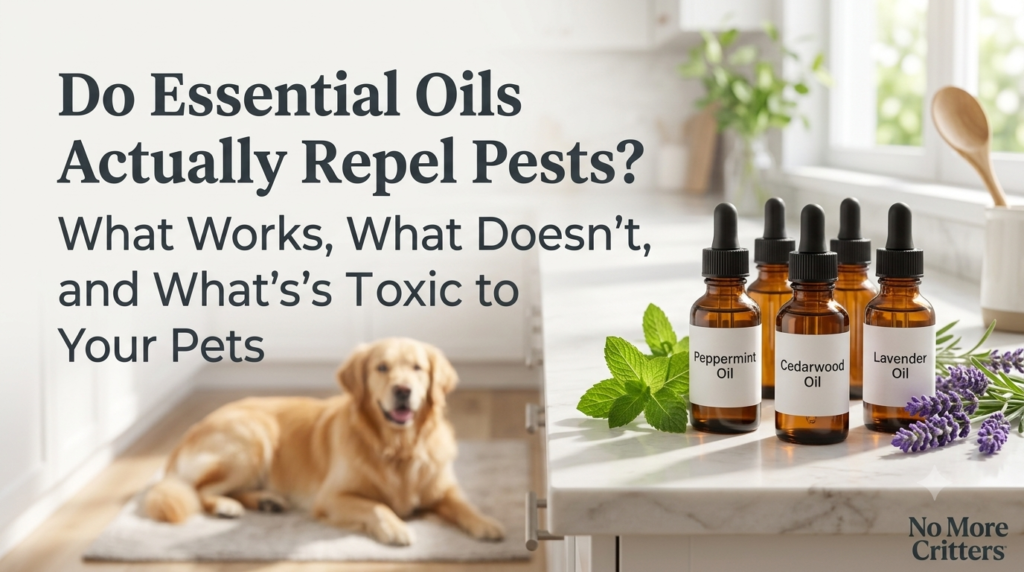
Essential oils for pest control show up everywhere — peppermint oil for mice, tea tree oil for ants, eucalyptus for spiders. Social media makes it look simple. A few drops on a cotton ball, tuck it in a corner, done.
The reality is more complicated. Some essential oils genuinely work as deterrents for specific pests. Others do almost nothing. And several that are commonly recommended for pest control are outright toxic to cats and dogs — a fact that rarely makes it into the viral posts sharing these tips.
Here’s an honest breakdown of what the research actually supports.
What Essential Oils Can and Cannot Do
Essential oils are deterrents, not treatments. They repel pests from a specific area temporarily — they do not eliminate an infestation, kill a colony, or address a nest.
This distinction matters enormously. If you have an established ant colony, a mouse that has found a food source, or a cockroach population in your walls, essential oils will not solve the problem. They may move activity to a different area of your home while the underlying infestation continues.
Where essential oils genuinely have a role: prevention and early-stage deterrence. If you want to discourage pests from entering through a specific gap, or you’re dealing with occasional wandering insects rather than an established infestation, essential oils can be a useful, low-toxicity first step.
Which Essential Oils Actually Work as Pest Deterrents
Peppermint oil — mice, spiders, some ants This is the most research-supported essential oil for pest deterrence. Peppermint contains menthol and other compounds that are genuinely aversive to mice and spiders. Studies have shown repellent effects, though the duration is limited to hours — not days — as the volatile compounds evaporate quickly.
Application: Soak cotton balls in undiluted peppermint oil and place near entry points, inside cabinet corners, and along baseboards. Replace every 1-2 weeks or whenever the scent fades. Mix with water for a spray — about 10-15 drops per cup of water — and apply along windowsills and door frames.
Peppermint safety: Safe for dogs in the concentrations used for pest deterrence. Toxic to cats — cats cannot metabolize menthol and other compounds in peppermint oil. Do not use peppermint oil diffusers, sprays, or cotton balls in homes with cats.
Cedarwood oil — moths, silverfish, some beetles Cedar has a long history as a textile pest deterrent — cedar chests and closets repel clothes moths and silverfish. The active compound is cedrol, which disrupts the pheromone receptors of these insects.
Application: Cedar blocks or rings in closets and dresser drawers. Cedar oil sachets in storage areas with wool, silk, or natural fiber clothing. Cedar oil sprays along baseboard of closets.
Cedarwood safety: Generally considered low toxicity to dogs and cats at typical deterrent concentrations.
Citronella — mosquitoes Citronella is one of the few essential oils with substantial peer-reviewed research supporting its efficacy. It genuinely repels mosquitoes — but only while the scent is actively present. Citronella candles and diffusers create a repellent zone that dissipates quickly in any wind or air movement.
Citronella safety: Mildly toxic to dogs and cats if ingested in quantity. Outdoor use in candle form poses minimal risk. Indoor diffusers in enclosed spaces with pets should be used cautiously.
Lavender — moths, fleas, some flying insects Lavender oil has demonstrated repellent effects against moths and some flea species in laboratory settings. Evidence for other pests is limited. Useful in closets and storage areas as a moth deterrent.
Lavender safety: Generally safe for dogs. Use with caution around cats — lavender contains linalool and linalyl acetate which cats cannot metabolize efficiently.
Essential Oils That Are Commonly Recommended But Don’t Work Well
Tea tree oil — frequently cited for ants and cockroaches. Laboratory studies show some repellent effect at very high concentrations, but at household-safe dilutions the effect is minimal. More importantly, tea tree oil is highly toxic to cats and dogs — even small amounts can cause ataxia, tremors, and liver damage in pets. It should not be used as a pest deterrent in any household with animals.
Eucalyptus oil — some repellent effect for specific insects, but limited practical evidence for household pests. Also toxic to cats in typical concentrations.
Lemon and orange oils — mild deterrent effect for some ants. The d-limonene in citrus peel disrupts ant trails similarly to vinegar but doesn’t last significantly longer. Not a meaningful treatment for infestations.
The Pet Safety Chart You Need Before Using Any Essential Oil
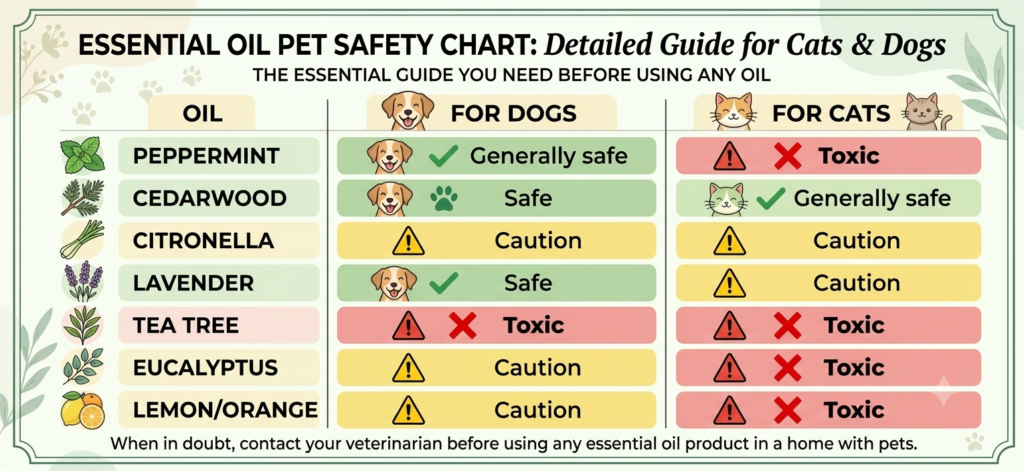
When in doubt, contact your veterinarian before using any essential oil product in a home with pets.
How to Use Essential Oils as Part of a Pest Prevention Strategy
Essential oils work best as one layer of a broader prevention approach — not as a standalone solution.
Combine with:
- Sealing entry points with caulk and steel wool
- Removing food sources — sealed containers, clean pet bowls, no standing water
- Sticky trap monitoring to detect activity early
- Gel bait for any active ant trails
Realistic expectations:
- Peppermint oil near a mouse entry point may deter a mouse that hasn’t committed to the entry yet. It will not deter a mouse that has already established a route to a food source.
- Cedar sachets in a closet will discourage clothes moths from settling. They will not eliminate an active moth infestation in fabric.
- Citronella outdoors reduces mosquito landing on your skin. It does not reduce the mosquito population in your yard.
For more on natural spider prevention and when to be concerned about species in your home, see our complete spider guide.
When to Call a Professional
Essential oils and natural deterrents are appropriate for prevention and very early-stage pest activity. If you have an established infestation — visible pest activity daily, droppings, damage, or multiple locations — move to targeted treatment and call a professional if treatment doesn’t produce results within two weeks.
We can match you with vetted local exterminators — no spam, no pressure.
No More Critters provides vetted pest identification and treatment information for homeowners. This site is a free service to assist homeowners in connecting with local service providers. All contractors and providers are independent. This site does not warrant or guarantee any work performed.
Filed under