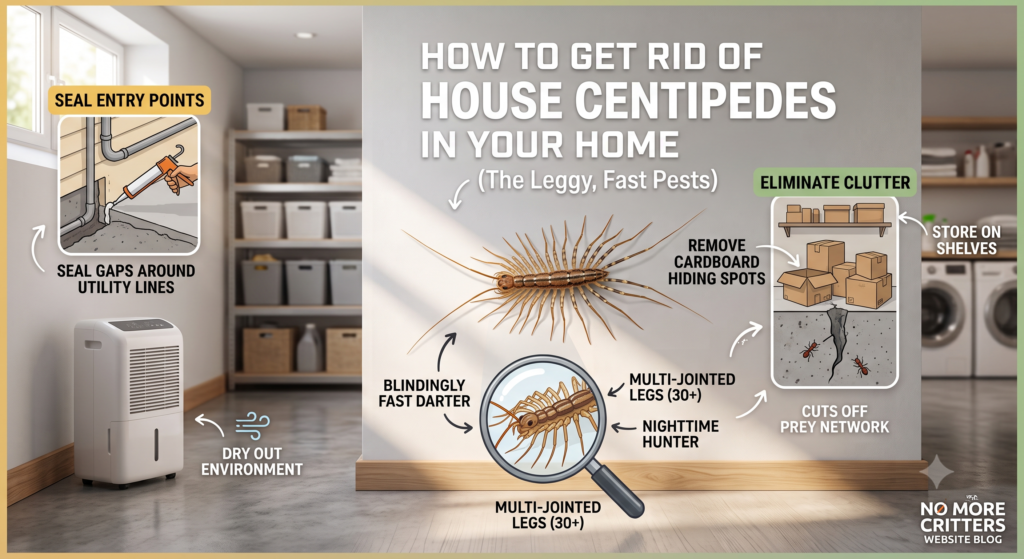
Few indoor pests trigger an instant panic reaction quite like the house centipede (Scutigera coleoptrata). With their long, thread-like legs and startling speed — capable of moving up to 0.4 metres per second — discovering one sprinting across a basement wall or disappearing into a drain is enough to ruin anyone’s evening. And because they’re most active at night, most people never see them during the day at all, which makes a sudden sighting feel even more alarming.
While house centipedes are technically beneficial predators that hunt other insects, nobody wants them as roommates. Here is exactly how to get rid of house centipedes by targeting their environment, cutting off their food supply, and keeping them out for good. Now, here’s how to get rid of house centipedes in your home.
Why House Centipedes Are Inside Your Home
Unlike many summer pests that wander indoors by accident, house centipedes choose indoor spaces for two very specific reasons: moisture and prey, both of which can be found in a house. Unfortunately for you, this makes your home very attractive to these critters.
The Need for High Humidity
Unlike many insects, centipedes lack the waxy outer layer that helps arthropods retain moisture. Without it, they dry out and die quickly in low-humidity environments. This is why they almost always appear in damp basements, crawlspaces, bathrooms, and around concrete cracks — anywhere the air stays heavy. A humid basement isn’t just comfortable for them. It’s a survival requirement.
An Abundant Prey Network
A notable centipede population is almost always a warning sign of a secondary infestation. House centipedes are strict carnivores, actively hunting spiders, ants, silverfish, carpet beetle larvae, and other small arthropods. If they’ve moved in, something is feeding them. Eliminating house centipedes for good means eliminating what they’re eating.
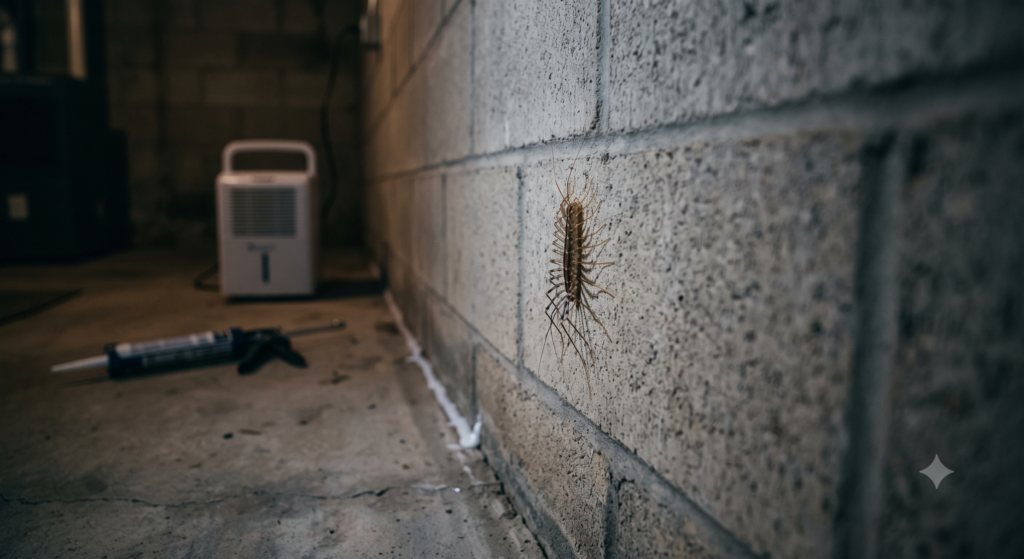
How to Get Rid of House Centipedes In Your Home: A Step-by-Step Strategy
Step 1 — Drastically Lower the Humidity
Install a high-capacity dehumidifier in the basement or crawlspace and set it to maintain relative humidity below 50%. This removes the moist microclimate house centipedes require to survive, making the space genuinely hostile to them rather than just inconvenient. This single step does more than any trap or spray.
Step 2 — Seal Ground-Level Entry Gaps
Walk the basement perimeter with a tube of silicone caulk. Seal gaps along the top of the foundation wall, openings around basement window frames, and the expansion joints where concrete floor slabs meet the walls. Even small gaps are sufficient entry points for a fast-moving centipede.
Step 3 — Clear Baseboard Hiding Spots
House centipedes shelter in dark, undisturbed spaces during the day — cardboard boxes, stacked newspapers, storage bins sitting directly on the floor. Moving storage onto raised wire shelving removes their daytime refuge and forces them into the open where conditions are less survivable.
Secure the Exterior Perimeter
Long-term basement bug prevention starts outside. Damp piles of decaying leaves, thick mulch beds, and rotting firewood stacked directly against the foundation all trap moisture against the walls and create breeding grounds for the smaller insects centipedes prey on. Keeping a clear, dry buffer zone around the foundation removes the conditions that draw centipedes toward the house in the first place.
When Persistent Sightings Require Professional Help
If the basement has been dried out, clutter cleared, and visible cracks sealed — but large centipedes keep appearing — the root problem is likely deeper in the structure. A high volume of active centipedes points to an established colony of prey insects living inside wall voids or beneath the subfloor. When DIY moisture control isn’t breaking the cycle, a professional inspection is the right next step to locate the hidden food source and address it properly.