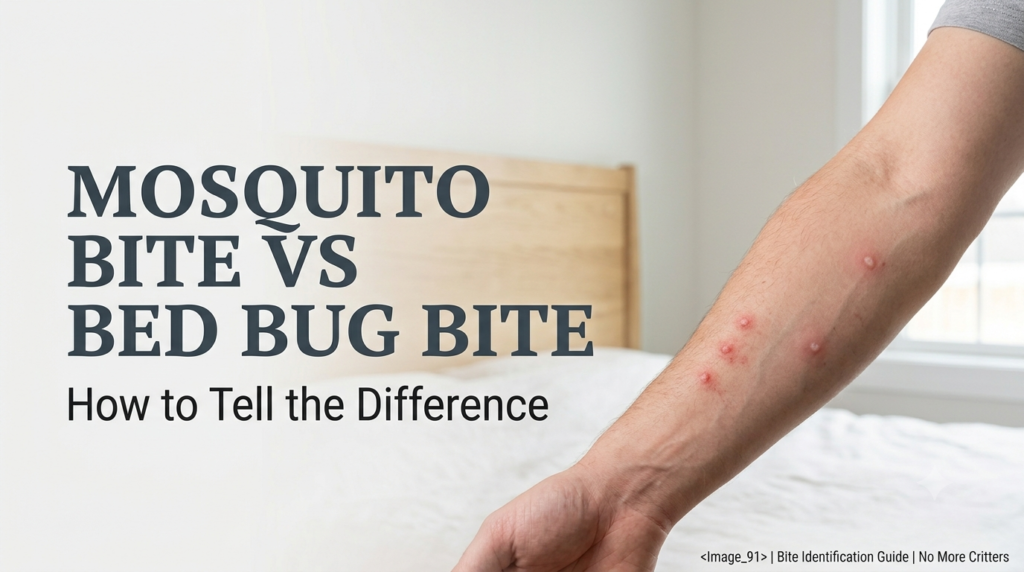
You woke up with red, itchy welts and no memory of being bitten. Or you came inside after a summer evening and found marks you weren’t expecting. Both situations produce the same question: mosquito or something else?
Mosquito bites and bed bug bites look nearly identical in isolation. But there are reliable differences — in pattern, timing, location, and what you find in the room — that point clearly toward one or the other when you know what to look for.
The Single Most Reliable Tell: Pattern
This is the fastest way to distinguish the two.
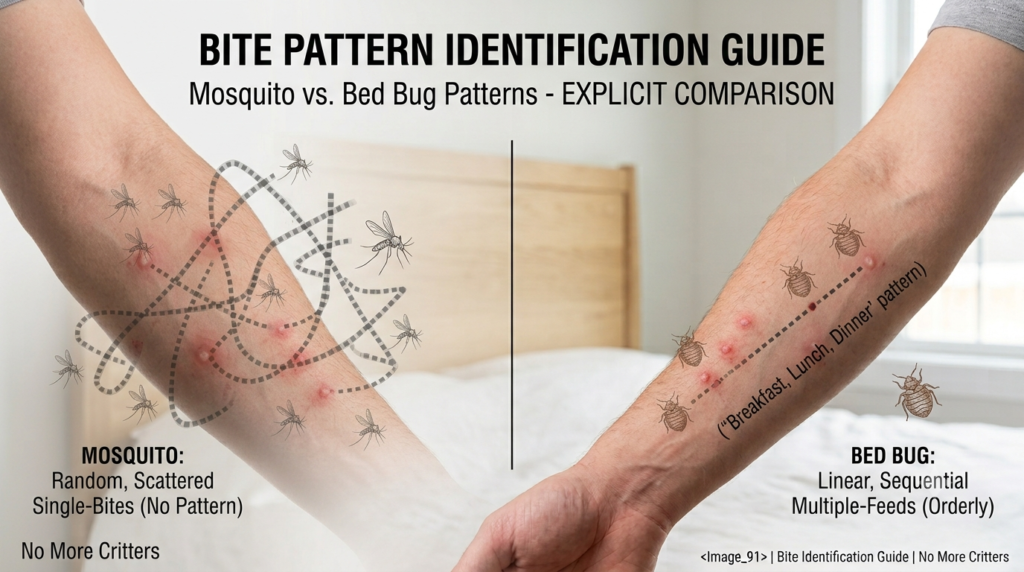
Bed bug bites appear in clusters, lines, or zigzag patterns — three or more bites grouped together or running in a row. This happens because a single bed bug feeds multiple times as it moves slowly across skin during the night. Pest professionals call this the “breakfast, lunch, and dinner” pattern. Finding a neat line of three to five bites is a strong indicator of bed bugs.
Mosquito bites are random and scattered. A mosquito lands, bites once, and moves on. The bites appear as isolated welts distributed unevenly across the body with no grouping, no lines, and no predictable pattern.
If your bites are in a line or cluster: bed bugs are the more likely culprit. If your bites are scattered randomly: mosquitoes are more likely.
Timing — When Did the Bites Appear?
Mosquito bites are immediate. Most people feel the bite as it happens or notice the welt within minutes. If you came inside from the garden at dusk and found a bite forming on your ankle, that’s a mosquito.
Bed bug bites are delayed. Bed bugs inject an anesthetic with their saliva, which numbs the area while they feed — you feel nothing. The bite reaction can take 24 to 72 hours to appear. This is one of the main reasons people struggle to connect their bites to a specific night or location.
The key question: did the bites appear while you were indoors, and were they not there when you went to sleep? Bed bugs feed at night while you sleep. If you went to bed without bites and woke up with them — and you weren’t exposed to mosquitoes indoors — bed bugs are the more likely explanation.
Location on the Body
Bed bug bites concentrate on skin that is exposed during sleep — arms, shoulders, neck, face, and legs. It is unusual to find bed bug bites on areas covered by clothing or bedding during the night, like the torso or lower back.
Mosquito bites are less predictable. Mosquitoes are attracted to heat, carbon dioxide, and movement, and will bite exposed skin wherever they find it — including feet, ankles, and the back of the neck during outdoor activity. Mosquitoes can also bite through thin clothing.
What the Bites Look Like Up Close
Both produce red, raised, itchy welts. The differences are subtle:
Mosquito bites are typically dome-shaped, round, and puffy — often with a small central puncture mark where the proboscis entered. They turn from a pale raised bump to a reddish-brown mark within hours.
Bed bug bites tend to be slightly flatter and more uniform in size than mosquito bites. They often have a small darker red dot at the center. In sensitive individuals, they can become quite inflamed and may blister.
Neither is a reliable visual identifier on its own — the pattern and timing are far more diagnostic than the appearance of individual bites.
The Reaction Timeline
Mosquito bites itch immediately and intensely, then gradually fade over two to five days. Most are gone within a week without treatment.
Bed bug bites may not itch at all initially — then the itching intensifies over the following days and can persist for one to two weeks. Some people develop no visible reaction to bed bug bites at all. Others develop significant inflammation and rash-like responses.
How to Confirm Bed Bugs — Look for Evidence Beyond the Bites
Bites alone cannot confirm a bed bug infestation. Some people have no visible reaction, and the bites themselves look too similar to other insects to be certain. The confirmation comes from finding evidence in the room.
Check your mattress seams and box spring with a flashlight:
- Live bed bugs — small, flat, reddish-brown, about the size of an apple seed
- Shed skins — translucent empty casings
- Tiny white eggs — found in mattress seams and crevices
- Dark rust-colored stains on sheets or mattress — dried blood or fecal matter from bed bugs
Check behind the headboard, inside the bed frame joints, and along the baseboard near the bed. Bed bugs hide within a few feet of where they feed.
If you find any of these signs alongside bite patterns — get a professional inspection immediately.
What About Flea Bites?
For completeness — flea bites are commonly confused with both:
Flea bites are typically concentrated on the lower legs and ankles, often in clusters of two or three. They are intensely itchy almost immediately and may have a small red halo around the puncture. If you have pets and the bites are primarily below the knee, fleas are more likely than bed bugs or mosquitoes.
Disease Risk — An Important Distinction
Mosquitoes are known disease vectors — they can transmit West Nile virus, Zika, dengue fever, and malaria in regions where these diseases are present. If you develop flu-like symptoms within two weeks of significant mosquito exposure, mention it to a doctor.
Bed bugs do not transmit disease. Their bites are uncomfortable and can cause secondary infection from scratching, but there is no disease transmission risk from the bite itself.
For full identification and treatment of bed bugs, see our complete bed bug guide.
What to Do Based on Your Assessment
If you think it’s mosquitoes:
- Eliminate standing water around the home
- Use EPA-registered repellent containing DEET or picaridin outdoors
- Repair window screens
- Treat bites with cold compress and hydrocortisone cream
If you think it’s bed bugs:
- Do not move mattresses or furniture — this spreads the infestation
- Encase the mattress and box spring in bed bug-proof covers
- Wash all bedding in hot water and dry on high heat for 30 minutes
- Call a professional — bed bug infestations almost always require professional treatment to eliminate completely
We can match you with vetted local exterminators — no spam, no pressure.
No More Critters provides vetted pest identification and treatment information for homeowners. This site is a free service to assist homeowners in connecting with local service providers. All contractors and providers are independent. This site does not warrant or guarantee any work performed.
Filed under