
It’s one of the most repeated pieces of pest advice — scatter mothballs in the attic, basement, or wherever you’re hearing scratching, and the mice will leave. It’s been passed down for generations. It’s also wrong, and using mothballs this way is actually against federal law.
Here’s what mothballs actually do, why the myth persists, and what genuinely works instead.
Do Mothballs Repel Mice? The Direct Answer
No. Mothballs are not an effective mouse repellent, and using them outside of sealed, airtight containers for their labeled purpose is illegal under EPA regulations.
This surprises most people. Mothballs are sold over the counter, so the assumption is that any use is fine. But every mothball product is registered with the EPA for a specific, narrow purpose: protecting stored fabric items from clothes moths inside sealed, airtight containers. The label legally restricts use to that purpose. Scattering mothballs in an attic, basement, crawl space, or anywhere with airflow is a violation of that label — and federal pesticide law makes it illegal to use any registered pesticide in a way inconsistent with its labeling.
Why the Myth Exists — And Why It Doesn’t Actually Work
Mothballs contain naphthalene or paradichlorobenzene, chemicals that slowly convert from solid to gas at room temperature, producing the distinctive strong odor. In a sealed container, this gas builds up to a concentration strong enough to kill moth larvae and eggs.
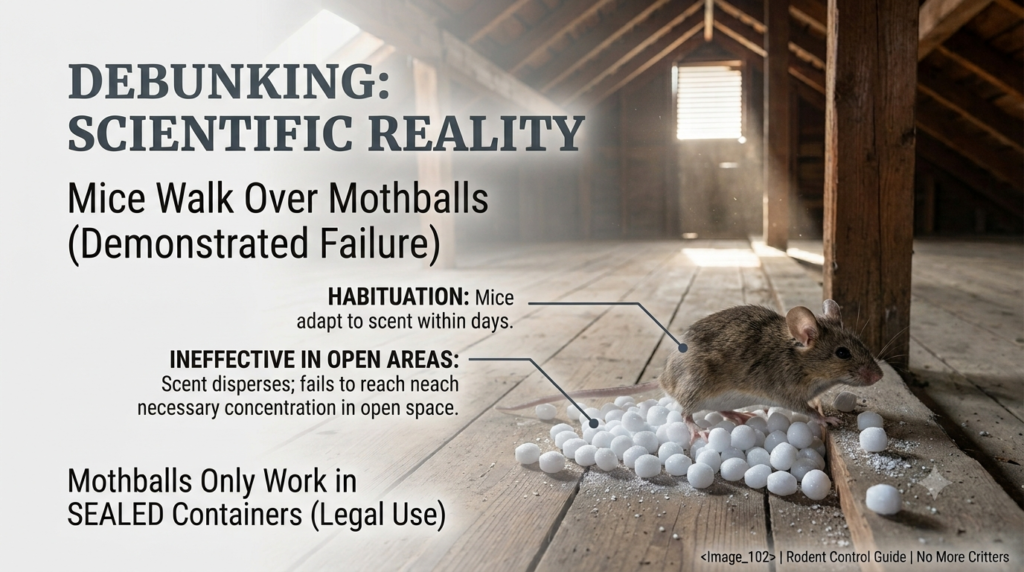
The problem in open spaces: that same gas disperses rapidly in any area with airflow — an attic, basement, or crawl space is nothing like a sealed plastic bin. The concentration needed to bother a mouse never builds up. Mice have been documented walking directly past and over mothballs without any behavioral change.
Even in cases where mice initially avoid an area due to the smell, they adapt quickly. Mice are highly food and shelter motivated — if the area offers what they need, the unpleasant smell is not enough to override that instinct for long. Within days, most mice habituate to the odor entirely.
Why Using Mothballs This Way Is Actually Dangerous
Naphthalene exposure is a genuine health hazard, not just an unpleasant smell.
When inhaled or ingested in sufficient quantity, naphthalene interferes with red blood cells’ ability to carry oxygen, a condition called hemolytic anemia. This risk is especially serious for infants, young children, and anyone with G6PD deficiency, a relatively common genetic condition that significantly increases sensitivity to naphthalene toxicity.
Mothball gas is heavier than air. In an attic, it doesn’t vent upward and away — it sinks downward through ceiling gaps, light fixtures, and small cracks into the living space below, where the household breathes it for as long as the mothballs remain. The odor and the chemical residue can persist for months or even years, particularly if it’s been absorbed into insulation.
There’s also a poisoning risk for children and pets — mothballs are often brightly colored or shaped in ways that can be mistaken for candy or treats. Ingestion is a medical emergency requiring immediate poison control contact.
The honest summary: mothballs used this way pose a real health risk to your household while providing essentially no benefit against mice.
What About Other “Natural” Mouse Repellents?
Since mothballs don’t work, it’s worth addressing the other commonly recommended DIY repellents — because most of them share the same fundamental limitation.
Dryer sheets — A persistent myth with no supporting evidence. Mice have been documented pulling dryer sheets apart to use the soft fibers as nesting material, which is the opposite of a deterrent effect.
Bar soap — No scientific evidence supports this as a mouse deterrent of any kind.
Peppermint oil — Genuinely has some short-term deterrent effect due to its strong scent irritating a mouse’s sensitive nasal passages. But the scent dissipates within one to two days, requiring constant reapplication, and mice adapt to it over time the same way they adapt to mothball odor.
Ultrasonic repellent devices — Sound waves don’t penetrate walls or insulation effectively, creating “shadow zones” behind drywall where mice remain undisturbed. Limited evidence supports their effectiveness as a standalone solution.
Ammonia — Some believe the smell mimics predator urine. Using ammonia indoors is strongly discouraged due to its own respiratory hazards, particularly in enclosed spaces — the cure here may be as risky as the problem.
The pattern across all of these: scent-based deterrents offer, at best, a temporary disruption. None of them address why mice are present in the first place, and none of them prevent new mice from entering once the scent fades.
What Actually Works
Sealing entry points is the only method that produces lasting results. Mice can squeeze through gaps as small as a dime — about 6mm. Every gap around pipes, vents, utility lines, and foundation cracks is a potential entry point.
The process:
- Inspect the exterior foundation, utility penetrations, and areas where pipes enter the home
- Pack steel wool tightly into any gap larger than 6mm — mice cannot chew through steel wool the way they can chew through caulk or foam alone
- Seal over the steel wool with caulk for a finished, weatherproof seal
- Check door sweeps on all exterior doors and replace if gaps are visible
Remove food access. Store all dry goods in hard-sided airtight containers. Clean up crumbs and spills promptly. Keep pet food sealed and don’t leave bowls out overnight.
Use snap traps for mice already inside. Place flush against baseboards — not perpendicular to the wall — since mice travel along edges. Peanut butter is an effective, long-lasting bait.
Reduce outdoor harborage near the foundation. Move firewood, brush, and debris away from the exterior walls. This removes staging areas mice use before finding their way in.
For full identification and treatment options, see our complete mouse guide.
When to Call a Professional
If you’ve sealed visible entry points and mice persist, or if the infestation involves multiple rooms or floors, a professional can identify entry points that aren’t visible from a standard inspection — often using tools like black light and tracking powder to map exact rodent pathways through a structure.
We can match you with vetted local exterminators — no spam, no pressure.
No More Critters provides vetted pest identification and treatment information for homeowners. This site is a free service to assist homeowners in connecting with local service providers. All contractors and providers are independent. This site does not warrant or guarantee any work performed.
Filed under