You woke up with unexplained bites. Or you spotted a tiny dark smear on your sheet. Or something small and fast disappeared into the mattress seam before you could get a good look.
Knowing the early signs of bed bugs is the difference between catching a small problem and dealing with a large one. The earlier you identify them, the simpler the solution. This guide walks you through exactly what to look for, how to tell if you have bed bugs versus something else, and what to do the moment you find evidence.
The Earliest Signs of Bed Bugs (Before the Infestation Grows)
Here’s something most people don’t know: roughly 30% of people don’t react to bed bug bites at all. So if you’re waiting for bites to tip you off, you may not get that signal — or someone else in your household might while you feel nothing.
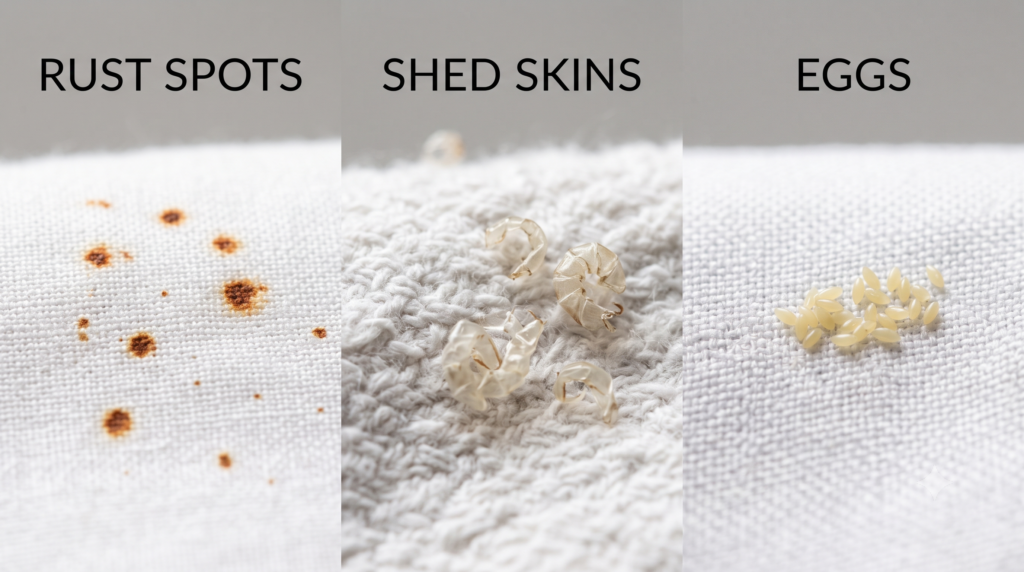
The non-bite signs that often show up first:
- Small rust or reddish-brown spots on sheets or mattress seams. These are either fecal deposits (digested blood, small and smeared) or the result of rolling onto a bug in the night. They look like a felt-tip pen mark or a tiny droplet of rust.
- Shed skins. Bed bug nymphs molt five times before reaching adulthood, leaving behind translucent, empty casings. These are easier to spot than the bugs themselves and tend to collect in mattress seams or along box spring edges.
- Pale yellow or white eggs. About 1mm long — the size of a pinhead — and clustered in tight seams or fabric folds. You’ll likely need a flashlight.
- A faint sweet or musty odor in the bedroom. This only appears in more established infestations, but if the room smells different and you can’t explain it, file that away.
Where to Look: First Signs of Bed Bugs on Your Mattress and Beyond
A flashlight and a flat-edged card (a credit card works) are your best tools here. Work through these zones in order:
- Mattress seams and piping — run your card slowly along every seam. This is the most common hiding spot for early-stage infestations.
- Box spring fabric edges and stapled seams — flip the box spring and check where the fabric is attached to the frame.
- Headboard — particularly the back surface, any screw holes, and joints where pieces connect.
- Bed frame joints and slat grooves — small, dark, and warm. Ideal hiding territory.
- Nightstand drawers and back panel — bed bugs don’t stay in the bed; they spread to nearby furniture.
- Baseboards within 15 feet of the bed — look for the rust-colored spotting along the edge where baseboard meets floor.
- Electrical outlet covers and picture frames — only in more established infestations, but worth checking if other signs are present.
Go slow. Use bright light. You’re looking for something the size of an apple seed — flat, oval, brown, and fast.
Bed Bug Signs vs. Bites From Other Bugs — How to Tell the Difference
This is the question most people have and the answer most articles skip. Here’s a quick comparison:
| Bed Bugs | Fleas | Mosquitoes | Carpet Beetles | |
|---|---|---|---|---|
| Bite pattern | Line or cluster, often on arms, neck, torso | Ankle and lower leg, random | Single welts, anywhere | Rash-like, no distinct bite marks |
| Timing | Bites appear while sleeping | Bites felt immediately | Bites felt immediately | Prolonged contact |
| Signs left behind | Rust spots, shed skins, eggs in seams | Flea dirt (black specks), visible jumping insects | None | Larvae, shed skins in carpet |
| Active time | Nighttime only | Day and night | Dawn/dusk mostly | Not a biter — reaction to fibers |
If your bites appear overnight on exposed skin and you’re finding rust-colored specks in the bed, bed bugs are the likely explanation.
What to Do the Moment You Find Evidence
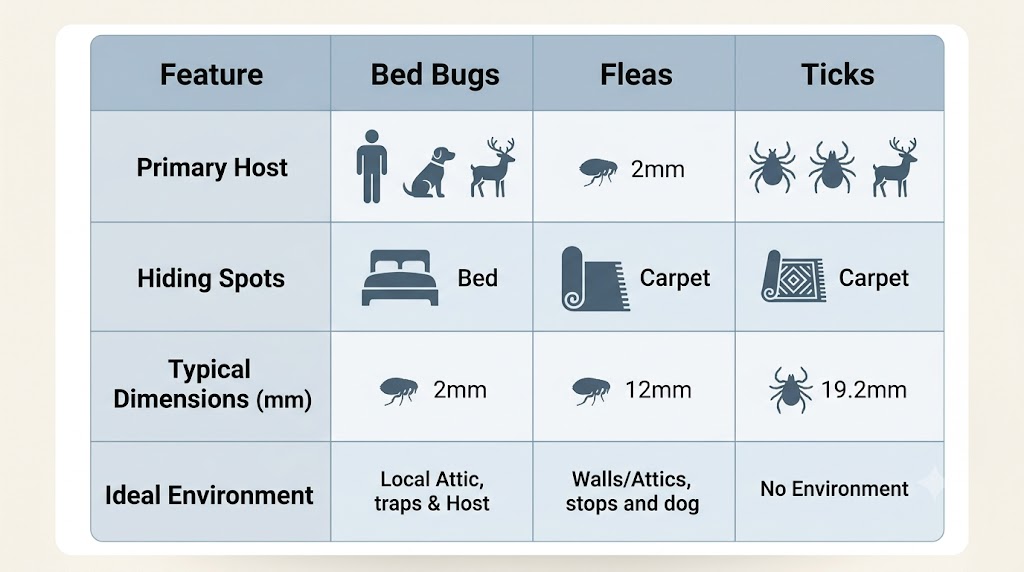
Stay calm. And stay in your bed. Sleeping somewhere else is one of the most common — and counterproductive — reactions people have. Bed bugs follow heat and carbon dioxide. If you move to the couch, they follow. You’ve now spread the infestation to a second room.
Here’s what to do instead:
1. Don’t throw out the mattress. It almost never solves the problem (bed bugs live in the surrounding furniture and baseboards, not just the mattress) and it risks spreading bugs through the house as you carry it out.
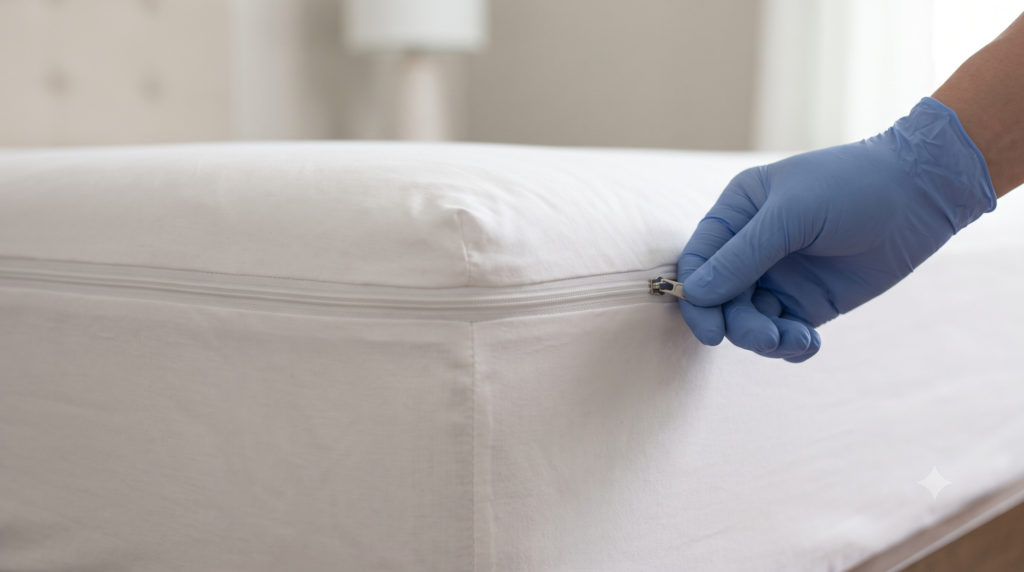
2. Encase the mattress and box spring immediately. A zippered, bed bug-proof enclosure traps any bugs inside and cuts off their access to you. It won’t eliminate an infestation, but it stops the immediate feeding cycle.
3. Launder everything on the highest heat setting. Sheets, pillowcases, duvet covers, clothing that was nearby, curtains. Heat above 120°F kills bed bugs at all life stages — including eggs. Dry on high for at least 30 minutes after items are fully dry.
4. Vacuum the mattress, box spring, and bed frame thoroughly. Use a crevice attachment along every seam. Immediately seal the vacuum bag in a plastic bag and take it outside to the trash.
5. Document what you found. If you’re a renter or you stayed somewhere recently, photos of the bugs or signs matter for any claim you may need to make.
Safe DIY Treatment — and Its Honest Limits
For a small, genuinely early-stage infestation (signs in one area only, caught within the first few weeks), these approaches have a real track record:
- Diatomaceous earth (food-grade) along baseboards and bed frame joints. It works by damaging the bugs’ outer coating over time — not instant, but effective and safe around pets and children once settled.
- Silica gel desiccants (sold specifically for bed bugs) work faster than diatomaceous earth and have a strong research backing. Apply in thin layers in cracks and crevices.
- Bed bug-specific heat devices for individual items — like a ZappBug or similar heat treatment bag — can treat luggage, clothing, and small items that can’t go in the dryer.
What doesn’t work despite what you’ve read: rubbing alcohol (evaporates too fast, fire hazard, doesn’t penetrate harborage areas), lavender or tea tree oil sprays, ultrasonic repellers.
If you have pets: diatomaceous earth is generally safe once it has settled and is not being actively disturbed. During application, keep pets out of the room until the dust settles. The silica-based products are similarly low-risk once dry.
When You Need a Professional
DIY has a realistic ceiling. If any of the following are true, professional heat treatment is the more reliable path:
- Signs of bed bugs appear in more than one room
- You’ve been treating for 3 or more weeks and still finding live bugs
- The infestation has been present for more than 4–6 weeks (eggs, nymphs, and adults are all present and harder to break with surface treatments alone)
- You live in a multi-unit building where adjacent units may be the source
Professional heat treatment — where the entire space is brought above 120°F for 90 minutes or more — is the most effective single-visit option available and reaches areas no spray can. Many pest control companies also offer follow-up chemical treatments as a second phase.
FAQ
What are the very first signs of bed bugs?
The earliest signs of bed bugs are usually non-bite: tiny rust-colored spots on sheets or mattress seams, shed nymph skins, or pale yellow egg clusters in fabric folds. Bites are often a later or inconsistent signal.
Can I have bed bugs and not see them?
Yes. Bed bugs are experts at hiding in tight, dark spaces. During the day, they retreat into seams, joints, and wall cracks. You may have an active infestation for weeks before seeing a live bug.
How do I know if it’s bed bugs or something else biting me at night?
Look for the physical signs in the bed and room rather than relying on the bite appearance alone. Rust-colored spots, shed skins, and visible eggs in mattress seams are the clearest confirmation.
Do bed bugs go away on their own?
No. Without a host (you), they can survive for months in a dormant state — which is why vacant apartments can still have active infestations. They don’t leave; they wait.
Are bed bugs dangerous?
Bed bugs are not known to transmit disease. The primary concerns are skin reactions from bites (which can be severe in some people), sleep disruption, and the psychological toll of a persistent infestation. They are a serious nuisance, but not a health emergency in the way some pests are.
Filed under