By the time you spot a cockroach crawling across the kitchen floor in broad daylight, the infestation isn’t beginning — it’s already established. Cockroaches are nocturnal and spend daylight hours hidden in cracks, wall voids, and behind appliances specifically to avoid being seen. A daytime sighting means the hiding spots are overcrowded enough that roaches are being pushed out to forage during hours they’d normally avoid.
This is exactly why learning the early physical evidence matters more than waiting to see a live roach. Here’s what shows up first, and where to look.
Droppings — The Most Common First Sign
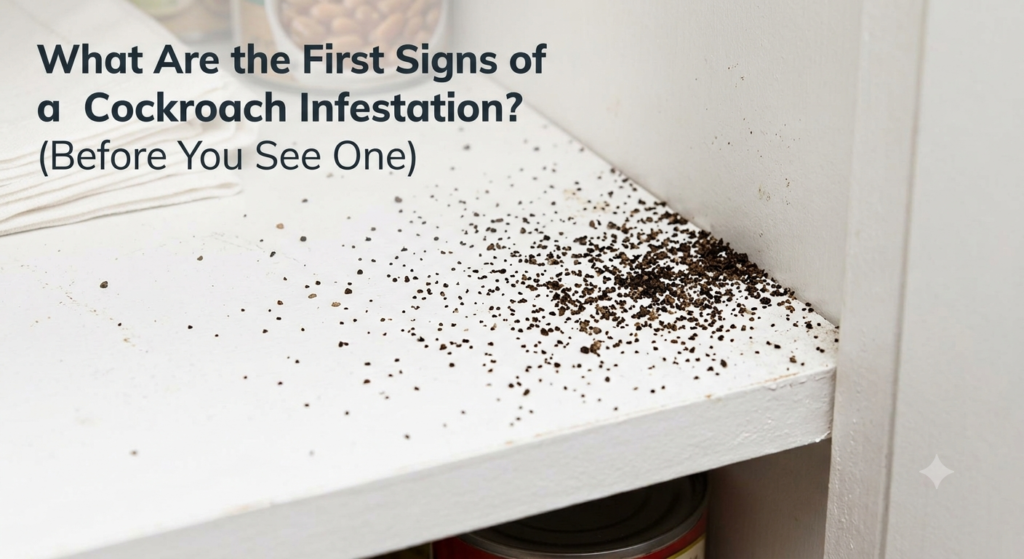
Cockroach droppings are the single most frequently reported first sign of infestation, and they appear well before you’re likely to see a live cockroach.
What they look like depends on the species and size of the roach producing them:
Small species (German cockroaches): Droppings resemble coffee grounds or coarse black pepper — tiny, dark specks scattered in the area of activity.
Larger species (American, Oriental, Smoky Brown): Droppings are cylindrical pellets, similar in shape to mouse droppings but with one key difference — cockroach droppings have visible ridges running along the sides, almost like a fennel seed. Mouse droppings are smooth.
Where to check: inside kitchen cabinets, particularly along the back wall and corners. Under the sink. Behind and underneath the refrigerator and stove. Inside drawers near food storage. Bathroom cabinets. Basements and utility rooms.
The density of droppings tells you something important — a few scattered specks may indicate a single scout roach exploring. Clusters or consistent accumulation in one area indicate an established population nearby.
Egg Cases (Oothecae) — Confirmation of Active Breeding
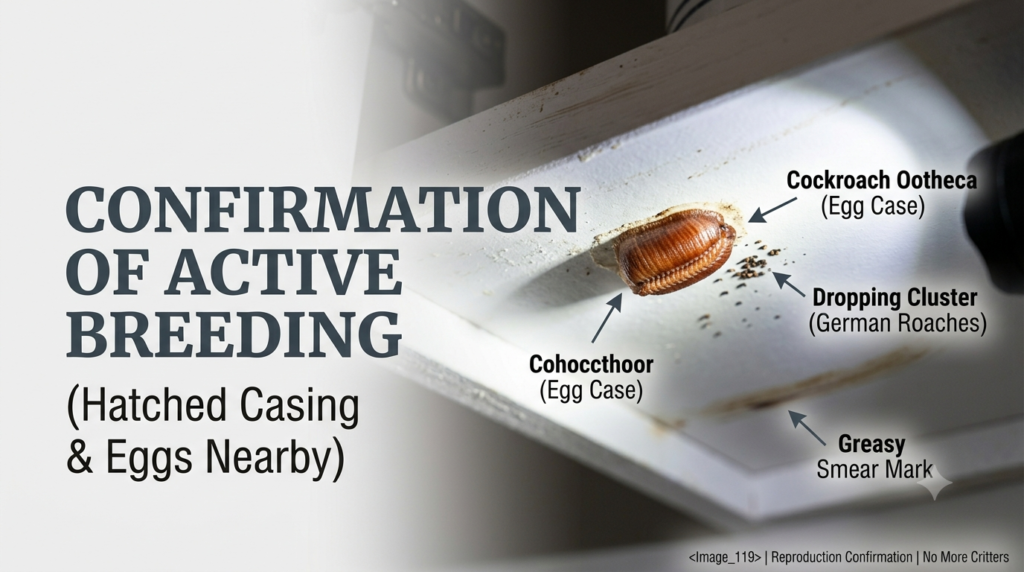
Female cockroaches don’t lay individual eggs — they produce a single hard capsule called an ootheca that contains anywhere from 16 to 50 eggs depending on the species.
Oothecae are oval, brown to reddish-brown, and roughly the size of a kidney bean or smaller. Females glue them to protected surfaces using a sticky secretion — meaning you won’t find them rolling loose, but firmly attached.
Where to check: the underside of furniture and shelves, the back of kitchen appliances, deep inside cardboard boxes, inside pantry shelving, and behind books or stacked paper goods in storage.
Finding even a single intact ootheca is significant — it confirms active reproduction is happening nearby, with dozens of nymphs developing. An empty, hatched casing confirms a new generation has already joined the population.
Smear Marks — Evidence of Travel Routes
In humid environments, cockroaches leave dark brown to black greasy smear marks instead of solid droppings — these form as their bodies and waste mix with moisture along surfaces they repeatedly travel.
Smear marks appear on walls, baseboards, and floor-wall junctions, particularly in damp areas: under sinks, near leaking pipes, around bathtubs, and inside poorly ventilated cabinets.
The test: wipe the mark clean. If it reappears within a few days in the same location, that confirms active, ongoing cockroach traffic along that specific route — not an old, resolved stain.
Shed Skins — Signs of Growth and Maturity
Cockroaches molt multiple times as they grow from nymph to adult, leaving behind a translucent, pale shell shaped like the insect itself. Finding shed skins — typically in the same hidden areas as droppings and egg cases — confirms that nymphs are actively maturing in your home, which means the population is established and growing, not just passing through.
The Smell — An Often Overlooked Early Indicator
A persistent musty, oily odor — particularly noticeable in enclosed spaces like cabinets, drawers, and pantries — is produced by cockroach pheromones and intensifies as the population grows.
This smell is easy to dismiss as general staleness or a need to clean, but a lingering odor that doesn’t resolve with normal cleaning, especially concentrated in one cabinet or area, is worth investigating further. Even a single German cockroach can produce a noticeable smell in an enclosed space.
Gnaw Marks on Packaging
Cockroaches are scavengers that will chew through cardboard, paper, and even soft plastic to reach food. Irregular holes or ragged edges on cereal boxes, pet food bags, or other packaging in your pantry — especially combined with droppings nearby — point toward cockroach activity rather than simple wear.
Cockroach Droppings vs Mouse Droppings — Don’t Confuse Them
This distinction matters because the treatment approach is completely different.
Cockroach droppings: Small, often under 2mm for German cockroaches, with visible ridges along the sides. Larger species produce cylindrical pellets with blunt, ridged ends.
Mouse droppings: Smooth surfaced, pointed at both ends, shaped like a grain of rice, typically 3-6mm.
If the droppings you’ve found have visible texture or ridging rather than a smooth surface, you’re more likely looking at cockroaches than mice.
Where to Focus Your Inspection
Cockroaches need warmth, moisture, and food — and tend to concentrate where all three overlap.
Highest priority areas:
- Under the kitchen sink
- Behind and underneath the refrigerator, especially the motor housing
- Inside lower kitchen cabinets, particularly back corners
- Under and behind the stove
- Bathroom cabinets and around sink plumbing
- Basements and utility rooms with any moisture
- Behind major appliances that generate warmth
An adult German cockroach can squeeze into a gap as narrow as 1/16 inch — younger nymphs fit into even smaller spaces, which is why infestations can be well established in wall voids, appliance motors, and cabinet crevices long before any visible activity appears on open surfaces.
For full identification and treatment by species, see our complete cockroach guide.
What to Do If You Find Early Signs
Don’t reach for a spray first. Gel bait is significantly more effective for early-stage infestations — it’s carried back to the nest and affects the broader population, including individuals you haven’t seen. Sprays only kill what’s directly exposed and can scatter remaining roaches to new hiding spots.
Apply gel bait in small dots near the areas where you found droppings, smear marks, or egg cases — inside cabinet hinges, along appliance motor housings, in the gap under the stove kick plate.
Clean droppings and smear marks promptly — beyond the pheromone signal they leave for other roaches, they’re a genuine source of allergens and bacteria.
When to Call a Professional
If gel bait hasn’t shown noticeable reduction in activity within two weeks, or if you’re finding droppings in multiple rooms, the infestation is likely beyond what consumer products can fully address. Cockroaches hide in spaces — wall voids, appliance interiors, behind wallpaper — that aren’t accessible during a standard inspection but are exactly where professional treatment focuses.
We can match you with vetted local exterminators — no spam, no pressure.
No More Critters provides vetted pest identification and treatment information for homeowners. This site is a free service to assist homeowners in connecting with local service providers. All contractors and providers are independent. This site does not warrant or guarantee any work performed.
Filed under