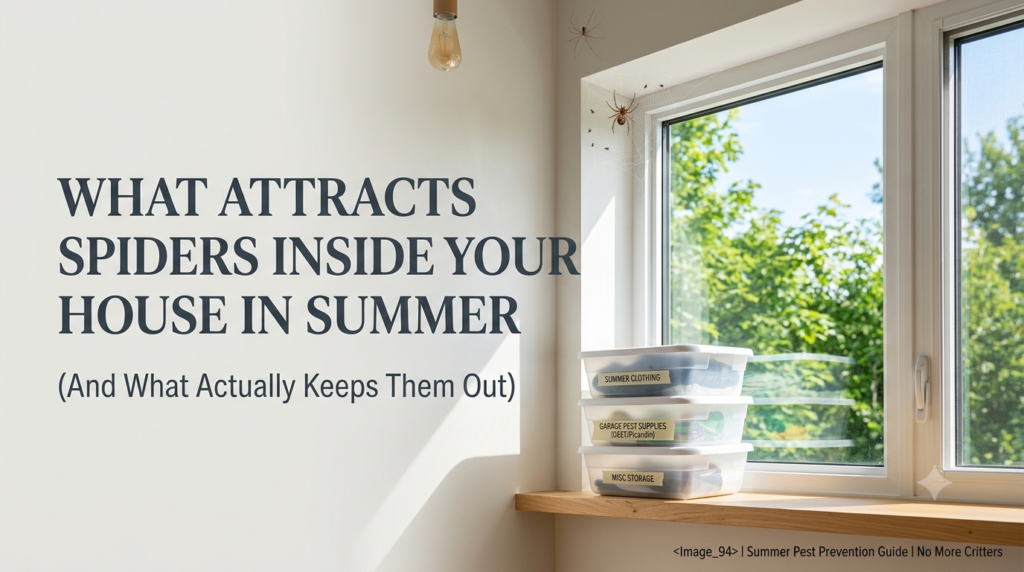
Summer brings more spiders indoors — and if you’ve noticed an uptick in webs in the corners, spiders on the ceiling, or the occasional eight-legged surprise in the bathroom, you’re not imagining it. Spider activity genuinely increases in summer, and there are specific reasons for it.
The good news: the fixes are mostly practical and don’t require sprays. Understanding what brought them in tells you exactly what to change.
Why Summer Specifically Brings More Spiders Inside
Spiders don’t come inside because they’re attracted to your home. They come inside because your home has what they need — and summer makes those things more abundant.
There are three summer-specific drivers:
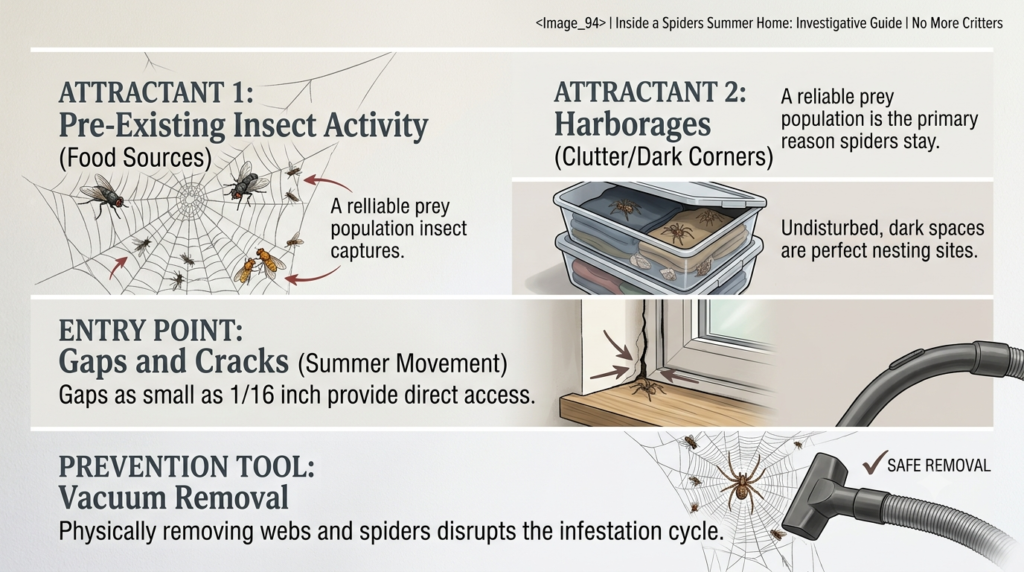
1. More prey insects. Summer is peak season for flies, mosquitoes, fruit flies, gnats, moths, and ants. Spiders are predators. They follow their food supply. If your home has a summer insect problem — even a mild one you haven’t fully noticed — spiders will find it.
2. Extreme outdoor heat. When outdoor temperatures climb into the high 80s and 90s, your climate-controlled home becomes genuinely attractive. Spiders seek stable temperatures, and the cool interior of a house during a heat wave is a significant draw.
3. Breeding season. Many spider species mate in late summer and early fall. Male spiders actively roam during this period searching for females, which is why you’re more likely to see spiders moving across open floor spaces in summer and fall — they’re not exploring, they’re looking for a mate.
The Real Reason Spiders Are in Your Home: Another Pest Problem
If spiders are consistently in your home, there is almost always an underlying insect population feeding them.
This is the most important thing to understand about spiders indoors. A house spider doesn’t move in because it likes your decor. It moves in because something it eats is already there. Spiders that stay and build webs have found a reliable food source.
Common spider prey found in homes: flies, mosquitoes, fruit flies, gnats, moths, ants, cockroaches, silverfish, and earwigs.
If you’re seeing more spiders than usual, ask: what insects are also more active in this home? Addressing the insect population reduces the spider population. Killing spiders without addressing the prey doesn’t work — more spiders find the same food source.
Common House Spiders vs Species Worth Paying Attention To
The vast majority of spiders found indoors in North America are completely harmless. Understanding which species you’re seeing removes a significant amount of anxiety.
Common House Spider (Parasteatoda tepidariorum) — The most common indoor spider in North America. Small, brownish, and typically found in upper corners and along ceiling lines. They build messy, irregular webs. Harmless to humans. Excellent at catching insects.
Cellar Spider / Daddy Longlegs (Pholcus phalangioides) — Long, thin legs, small body, typically found in basements, cellars, and undisturbed corners. Completely harmless. The persistent myth that they are highly venomous is false — they have no meaningful venom for humans.
Jumping Spiders (Salticidae family) — Small, compact, often colorful. They don’t build webs — they actively hunt. You’ll see them moving on walls and windows in daylight. Harmless and actually quite beneficial.
Wolf Spiders (Lycosidae family) — Large, fast, ground-hunting. Often mistaken for more dangerous species due to their size. They carry their egg sacs on their abdomen. Bite only if handled and pinched, and the bite is similar to a bee sting in healthy adults.
The Two That Matter:
Black Widow (Latrodectus species) — Shiny black with a red hourglass marking on the underside of the abdomen. Found in dark, undisturbed spaces: garages, woodpiles, under outdoor furniture, crawl spaces. Medically significant bite — seek medical attention.
Brown Recluse (Loxosceles reclusa) — Tan to brown, with a distinctive violin-shaped marking on the back. Found in warm, dry, undisturbed spaces: behind baseboards, in stored boxes, inside closets and shoes. Found primarily in the south-central United States. Bite can cause tissue damage — seek medical attention.
If you’re not in the geographic range of brown recluses, and you haven’t found a black widow, the spiders in your home are almost certainly harmless.
What’s Actually Drawing Spiders In — The Checklist
Outdoor lighting is one of the most significant and overlooked spider attractants. White and yellow outdoor lights attract moths, flies, and other flying insects at night. Spiders build webs near these lights to intercept prey. Switching outdoor lights to amber or sodium vapor bulbs — which flying insects cannot see — dramatically reduces the insect congregation around entry points, and therefore the spider activity.
Gaps and cracks around doors, windows, and utility penetrations are how spiders enter. A spider doesn’t need much — any gap wide enough to slide a piece of paper through is wide enough for most house spiders.
Clutter in basements, garages, and storage areas provides both harborage and prey. Stacked cardboard boxes, piles of old newspapers, and undisturbed corners give spiders exactly what they need — dark, still, sheltered spaces with insect activity nearby.
Vegetation touching the exterior — shrubs, vines, and branches that contact your siding or windows create a direct pathway from outdoor habitat into your home. Spiders travel along these bridges.
Firewood stored against the house is one of the most common ways wolf spiders and black widows enter homes. Store firewood at least 20 feet from the house and off the ground.
Moisture — leaking pipes, condensation, humid basements, and damp crawl spaces attract the insects that attract spiders.
How to Reduce Spiders Without Chemicals
Step 1 — Reduce outdoor lighting attractiveness. Switch to amber LED bulbs outside. Keep lights off when not needed. Move lighting away from entry points where possible.
Step 2 — Seal entry points. Caulk gaps around windows and door frames. Install door sweeps on exterior doors. Seal around utility line penetrations.
Step 3 — Manage the vegetation perimeter. Trim shrubs and branches so they don’t contact the house. Maintain an 18-inch gap of bare ground between mulch or plant beds and the foundation.
Step 4 — Reduce clutter. Clear out storage areas in basements and garages. Remove stacked cardboard — transfer to plastic bins with lids.
Step 5 — Address the insect population. Fix any moisture issues that attract insects. Store food in sealed containers. Fix window screens.
Step 6 — Remove webs consistently. A spider whose web is repeatedly removed will typically relocate. Use a vacuum with a hose attachment to remove webs and the spider simultaneously.
For full identification of common and dangerous spider species, see our complete spider guide.
When to Call a Professional
If you find a black widow or brown recluse inside your home — particularly with children or pets present — professional treatment is appropriate. A professional can locate and treat harborage areas you can’t safely access and apply residual treatments that prevent re-entry.
We can match you with vetted local exterminators — no spam, no pressure.
No More Critters provides vetted pest identification and treatment information for homeowners. This site is a free service to assist homeowners in connecting with local service providers. All contractors and providers are independent. This site does not warrant or guarantee any work performed.
Filed under