You opened the bathroom cabinet and one shot across the wall faster than you thought was physically possible for something that old-looking. Or you pulled a book off the shelf and found something silvery wriggling between the pages.
Silverfish are genuinely unsettling. Their speed, their prehistoric appearance, their three tail appendages, their preference for dark and damp. Everything about them reads as threatening.
The honest answer: silverfish are not dangerous to you, your children, or your pets. But they are not harmless either — and understanding what they actually damage changes how urgently you address them.
Do Silverfish Bite?
No. Silverfish do not bite humans or pets. Their mouthparts are designed for scraping and consuming starchy materials — they cannot pierce skin, and they have no venom or sting.
Even if you pick one up — which most people understandably don’t want to do — it will not attempt to bite you. Silverfish avoid contact with anything larger than themselves. Their survival strategy is speed and hiding, not confrontation.
This is one of the most common questions people search after finding silverfish in their home, and the answer is definitively reassuring: silverfish are physically incapable of harming you through contact.
Do Silverfish Transmit Disease?
No. Silverfish do not carry or transmit pathogens, bacteria, viruses, or parasites to humans or animals.
Unlike mosquitoes, ticks, or cockroaches — which are known vectors for various diseases — silverfish have no disease transmission history. They do not contaminate food in the way rodents do. Even if one has crawled across food you later eat, there is no meaningful health risk from the contact.
The one indirect health consideration: silverfish thrive in humid environments. A home with enough humidity to support a significant silverfish population may also have mold growth or dust mite activity — both of which can trigger respiratory irritation and allergies. The silverfish themselves don’t cause this, but their presence in large numbers can signal environmental conditions that affect indoor air quality.
Are Silverfish Dangerous to Pets?
No. If a cat or dog catches and eats a silverfish — which cats in particular sometimes do — there is no toxicity risk. Silverfish are not poisonous.
A pet might experience very mild digestive discomfort from eating an insect, but silverfish specifically pose no meaningful risk. They don’t bite, they’re not venomous, and they carry no pathogens that affect cats or dogs.
So What Are Silverfish Actually Harmful To?
Silverfish cause real damage — but to your belongings, not your body.
Silverfish (Lepisma saccharina) are one of the oldest insect species on earth — they predate the dinosaurs by more than 100 million years. They’ve survived this long by eating almost anything high in starch, cellulose, or protein. In a home, that means:
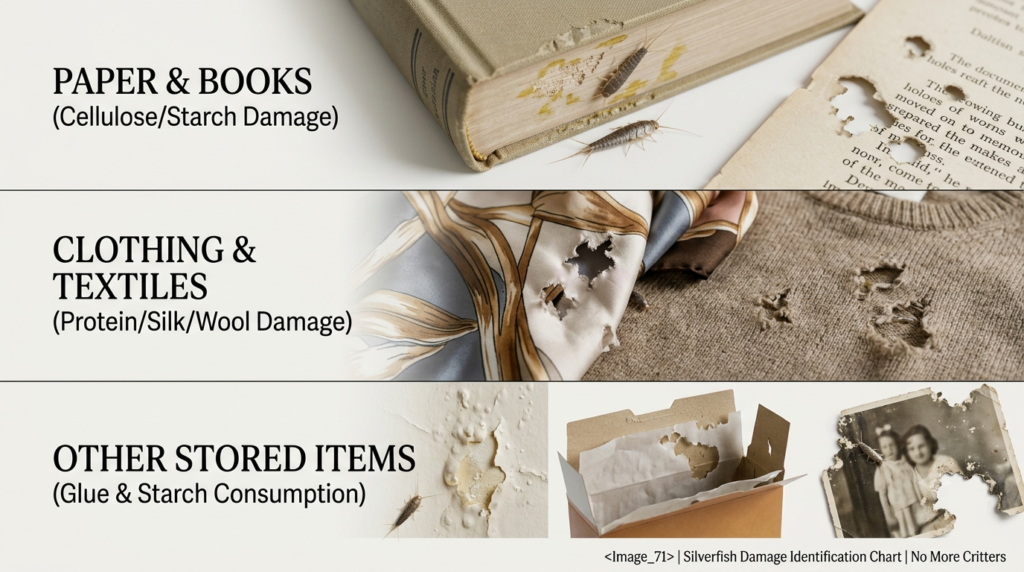
Books and documents — silverfish eat the starch in paper, the glue binding book spines, and the paper itself. They leave irregular surface damage and yellow staining. Irreplaceable books, photographs, and documents stored in humid areas are particularly vulnerable.
Clothing and textiles — silverfish eat natural fibers including cotton, linen, silk, and anything sized or starched. Wool is particularly attractive. They leave irregular holes in fabric that look similar to moth damage.
Wallpaper — silverfish eat the glue behind wallpaper and the paper surface itself. Unexplained bubbling or peeling wallpaper in a bathroom or basement may have silverfish behind it.
Stored dry goods — silverfish can chew through cardboard packaging to reach cereal, rice, flour, and other starchy pantry items. They are drawn to the paper boxes themselves as much as the food inside.
Photos and artwork — any paper-based item stored in damp conditions is at risk.
Silverfish vs Firebrat — What’s the Difference?
Firebrats (Thermobia domestica) are frequently confused with silverfish. They’re closely related, similar in shape and size, but have a mottled brown or grey coloring rather than the uniform silvery sheen of silverfish. Firebrats also prefer higher temperatures — they’re commonly found near furnaces, boilers, and hot water pipes — while silverfish prefer cool, moist environments like bathrooms and basements.
The treatment is essentially the same for both: reduce humidity, eliminate harborage areas, and apply diatomaceous earth or bait along baseboards.
What Does a Silverfish Infestation Tell You?
Finding one silverfish occasionally is not alarming — they wander. Finding multiple silverfish regularly, or finding them in multiple rooms, tells you something specific about your home:
High humidity — silverfish require humidity above 75% to reproduce. A persistent infestation means your home has a moisture problem worth addressing: a slow leak, poor bathroom ventilation, a damp basement, or inadequate crawl space airflow.
Undisturbed storage areas — silverfish breed in dark, still spaces where they’re not disturbed. Cardboard boxes of stored items in basements, closets, and attics are ideal. Moving and checking stored items regularly disrupts breeding.
Paper and starch available — stacks of newspapers, old books, unsealed pantry items.
A silverfish problem is worth addressing not just to stop the damage to belongings, but because the humidity conditions that support them often need attention for the overall health of the home.
How to Get Rid of Silverfish
Reduce humidity first — this is the most important step. Run bathroom exhaust fans during and after showers. Use a dehumidifier in the basement. Fix any plumbing leaks. Silverfish cannot reproduce in dry conditions.
Diatomaceous earth — food-grade diatomaceous earth dusted along baseboards, inside cabinet bases, and in closets kills silverfish on contact by abrading their waxy outer layer. Safe for humans and pets.
Silverfish bait stations — placed inside bookshelves, closet corners, and along baseboards. Effective for ongoing control.
Seal stored items — transfer pantry goods to hard-sided airtight containers. Store paper documents and books in sealed plastic bins rather than cardboard boxes, especially in basements.
Cedar — cedar blocks and sachets in closets repel silverfish from textile storage areas.
For full treatment options, see our complete silverfish guide.
When to Call a Professional
A silverfish infestation significant enough to damage books, clothing, or wallpaper repeatedly suggests a moisture problem that warrants professional assessment — both for the pest and for what the humidity is doing to the structure of your home.
We can match you with vetted local exterminators — no spam, no pressure.
No More Critters provides vetted pest identification and treatment information for homeowners. This site is a free service to assist homeowners in connecting with local service providers. All contractors and providers are independent. This site does not warrant or guarantee any work performed.
Filed under