
You found something on the kitchen floor. Small, dark, scattered. You’re hoping it’s dirt. It’s probably not dirt.
Knowing what mouse droppings look like — and how to tell them apart from rat droppings, cockroach droppings, and other debris — is the first step in figuring out exactly what you’re dealing with and how serious it is. Here’s what to look for and what to do next.
What Mouse Droppings Look Like
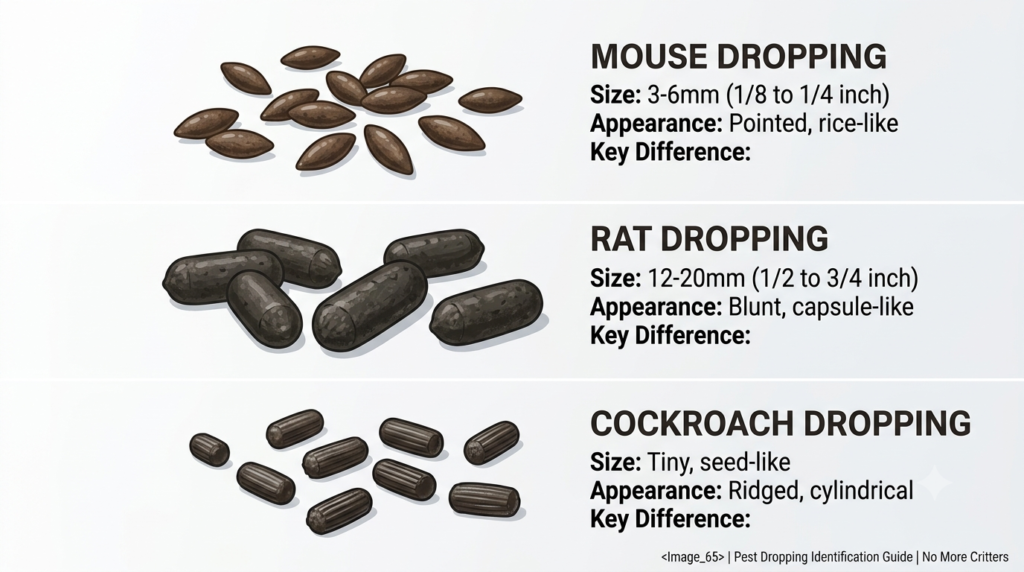
Mouse droppings are small, dark, and shaped like a grain of rice — pointed at both ends, typically 3 to 6mm long (about 1/8 to 1/4 inch), and dark brown to black in color.
They look like:
- Dark grains of rice
- Tiny black seeds
- Small raisins — though much smaller
Fresh droppings are black, soft, and slightly shiny. As they age over the course of a week or two, they turn brown and then gray, becoming dry and crumbly. You can tell the difference between a fresh and old dropping by texture — fresh ones are slightly pliable, old ones crumble when disturbed.
Never touch droppings with bare hands. Mouse droppings can carry hantavirus, salmonella, and leptospirosis.
Mouse Droppings vs Rat Droppings — The Key Differences
Both look similar — dark, rice-shaped — but size tells you immediately which rodent you’re dealing with.
Mouse droppings: 3-6mm long (1/8 to 1/4 inch), pointed at both ends, scattered widely as the mouse moves
Rat droppings: 12-20mm long (1/2 to 3/4 inch), blunt ends, capsule-shaped rather than rice-shaped, typically found in concentrated piles rather than scattered
The size difference is significant and easy to see. If the droppings you found are larger than a grape seed, you’re likely dealing with rats rather than mice — which changes the treatment approach considerably.
Norway rat droppings are brown and blunt at both ends. Roof rat droppings are darker and more pointed. Either way, if the droppings are large, call a professional.
Mouse Droppings vs Cockroach Droppings
This is a common source of confusion. Both are small and dark. The difference:
Mouse droppings are smooth, tapered to a point at both ends, and look like grains of rice.
Cockroach droppings are similar in size but have distinctive ridges — horizontal lines running along the dropping when viewed up close. They’re also more cylindrical and blunt-ended rather than tapered.
If you’re finding droppings in kitchen cabinets near food — particularly in the corners or along the back walls — and they have visible ridges, suspect cockroaches. If they’re smooth and pointed, suspect mice.
Mouse Droppings vs Termite Frass
Termite frass is much smaller than mouse droppings — closer to a grain of salt than a grain of rice — and is typically tan, light brown, or beige rather than dark. You’ll find frass near wooden structures like baseboards and window frames, not in food storage areas.
Where to Find Mouse Droppings
Mice don’t use a designated bathroom. They defecate as they move — along every path they travel. A mouse produces 50 to 75 droppings per day, scattered throughout their activity zone.
Where to check:
- Along baseboards and walls — mice travel along edges, not open floor
- Inside kitchen cabinets, especially lower ones near the floor
- Behind and under appliances — refrigerator, stove, dishwasher
- Inside pantry shelves near food packaging
- In drawers, especially if you’ve found gnaw marks on packaging
- In the basement or crawl space along the walls
- In attic corners and insulation
- Near the water heater or furnace
Concentrations of droppings in a specific area indicate a nest or a feeding site nearby. Multiple droppings in multiple rooms suggest the infestation is established and the population has grown beyond one or two animals.
How to Tell If Droppings Are Fresh — And Why It Matters
Fresh droppings mean an active infestation. Old droppings alone don’t.
The test: clean up the droppings completely — using the safety protocol below — then check the same area 24 hours later. If new droppings have appeared, mice are actively using that space right now. If no new droppings appear, the infestation may have been resolved or moved on.
This test also helps you identify which areas mice are currently using, so trap placement is more effective.
How to Clean Mouse Droppings Safely
Mouse droppings can become airborne when swept or vacuumed, spreading pathogens through the air. The CDC protocol:
- Ventilate the space for at least 30 minutes before cleaning — open windows and leave
- Put on rubber, latex, or vinyl gloves and a mask
- Spray droppings and surrounding area with a disinfectant solution — 1 part bleach to 10 parts water — and let soak for 5 minutes
- Wipe up with disposable rags or paper towels — do not sweep or vacuum
- Place all waste in a sealed plastic bag, then into a covered outdoor trash can
- Wash hands thoroughly after removing gloves
Never vacuum mouse droppings. The vacuum disperses particles into the air.
What Mouse Droppings Tell You About the Infestation
The quantity and distribution of droppings gives you real information:
A few droppings in one location — likely one or two mice exploring, possibly an entry point nearby
Many droppings along a consistent path — mice have established a regular route and are using your home regularly
Droppings in multiple rooms or floors — the population has grown and spread; DIY treatment alone is unlikely to be sufficient
Droppings in food storage areas — food contamination risk is immediate; dispose of any open or compromised packaging
For full identification and treatment options, see our complete mice guide.
What to Do After Finding Mouse Droppings
- Clean up safely using the protocol above
- Check the area again after 24 hours for new droppings
- Identify entry points — look for gaps around pipes, under doors, and along the foundation larger than 6mm
- Seal all entry points with steel wool packed into gaps, followed by caulk
- Place snap traps along walls and baseboards — flush against the wall, not perpendicular to it — with peanut butter as bait
- Remove food sources — seal everything in hard-sided airtight containers
When to Call a Professional
If you’re finding droppings in multiple rooms, if snap traps aren’t catching anything after several days of correct placement, or if you’re hearing scratching in walls consistently — the infestation is established beyond what DIY can address efficiently. A professional can locate entry points you’ve missed and place treatments in areas that aren’t accessible from inside the living space.
We can match you with vetted local exterminators — no spam, no pressure.
No More Critters provides vetted pest identification and treatment information for homeowners. This site is a free service to assist homeowners in connecting with local service providers. All contractors and providers are independent. This site does not warrant or guarantee any work performed.
Filed under