Sticky glue traps are one of the most misused pest control tools in any home. People pull them out of the box, peel the cover off, and set them flat in the middle of the floor where they’ve seen pest activity. Then they check back a week later and find nothing — maybe a dust bunny — and conclude that glue traps don’t work.
Glue traps work extremely well. But placement is everything, and the open-floor approach misses almost every pest almost every time.
Why Placement Matters More Than the Trap Itself
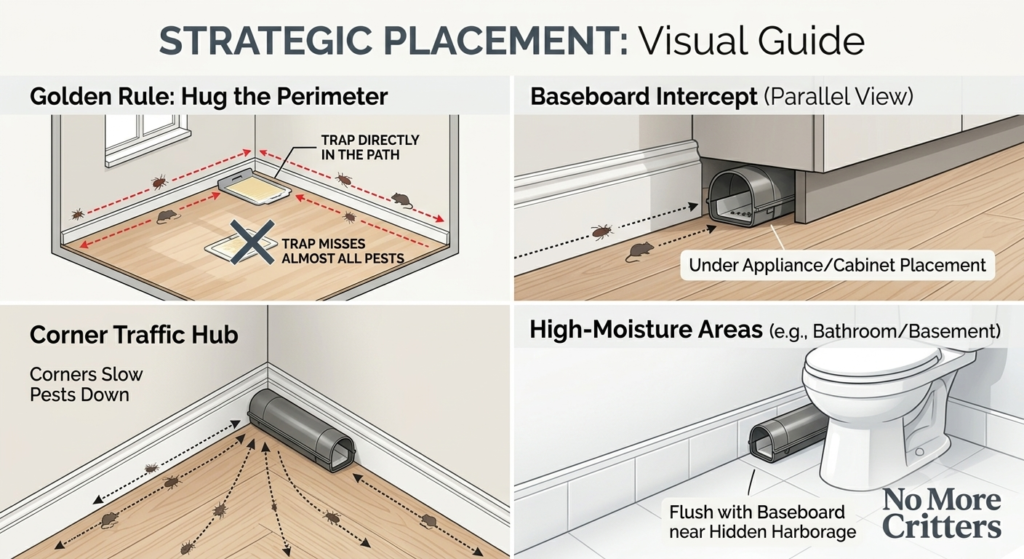
Glue traps catch pests that walk across them. Pests almost never walk across open floor space — they travel along walls, baseboards, and the undersides of appliances.
This is the core behavioral fact that changes everything about how to use sticky traps effectively. Mice, cockroaches, silverfish, spiders, and most other household pests are thigmotactic — meaning they prefer to move while maintaining contact with a surface. They hug walls. They run along baseboards. They squeeze under appliances and travel along the back wall.
A trap placed in the center of a room is essentially invisible to them. A trap placed flush against a baseboard in a corner is directly in their path.
Which Pests Do Sticky Traps Actually Work For?
Mice and rats — glue boards are effective monitoring tools for rodents, though snap traps are more reliably lethal. Use glue boards to identify where rodents are traveling before deciding on treatment.
Cockroaches — highly effective. Cockroaches travel along wall-floor junctions almost exclusively. A glue trap in the right corner can catch dozens in a single night and confirm the severity of an infestation.
Silverfish — glue traps are one of the best tools for silverfish. They travel along baseboards in bathrooms and basements and walk directly onto flat glue boards.
Spiders — effective for ground-dwelling species. Less effective for web-building spiders that never come down to floor level.
Fruit flies and gnats — standard flat glue traps don’t work well for flying insects. Use yellow sticky cards designed for flying pests instead.
Bed bugs — standard glue traps are not effective for bed bugs. Use interceptor cups under bed legs instead.
Where to Place Sticky Traps for Maximum Results
For cockroaches:
- Flush against the wall in the corner under the kitchen sink
- Along the back wall inside lower kitchen cabinets
- Behind the refrigerator along the motor housing
- Inside the gap under the stove kick plate
- Behind the toilet where the base meets the wall
For mice:
- Flush against the baseboard along the wall — not perpendicular to it, parallel to it
- In the corner where two walls meet — rodents slow down at corners
- Under the refrigerator along the back wall
- Inside cabinet openings where you’ve seen droppings
- Along the wall behind the washing machine or dryer
For silverfish:
- Along bathroom baseboards, particularly near the tub or shower
- Inside bathroom vanity cabinets against the back wall
- In basement corners, especially near any moisture source
- Inside closets along the back baseboard
For spiders:
- In corners at floor level in garages, basements, and storage areas
- Along the baseboards of rooms where you’ve seen activity
Safe Placement Around Pets and Children
Standard flat glue traps pose a real risk to pets and small children — a curious cat or dog can get a paw stuck, and the adhesive is genuinely difficult to remove from fur. Small children can also pick them up and get them stuck to hands or hair.
Safe placement strategies:
Use enclosed bait station-style glue traps rather than flat open boards. Many brands offer glue traps inside a plastic housing that only allows pests to enter from the ends — these are far safer around pets.
For open flat boards, place them inside enclosed spaces: under appliances pushed against the back wall, inside lower cabinets, or inside a cardboard box with entry holes cut in the sides. The box allows pests in while blocking access from pets and children.
Never place open flat glue boards on surfaces a pet or child can reach.
If a pet gets stuck: Apply vegetable oil or cooking oil generously to the adhesive and work it loose gently. Do not pull. The oil breaks down the adhesive without harming fur or skin.
How to Read a Sticky Trap
Glue traps double as monitoring tools — what you catch tells you a lot about what you’re dealing with.
Catching mostly small cockroaches suggests a heavy infestation, since juveniles are pushed out of harborage areas when populations are high. Catching one large cockroach occasionally suggests occasional wandering rather than nesting. Catching mice in multiple locations simultaneously suggests multiple entry points rather than one animal. Catching silverfish consistently in one bathroom suggests a moisture problem in that room worth investigating.
When to Call a Professional
If glue traps are filling up consistently — multiple cockroaches per night, or mice in more than one location — the infestation is established beyond what monitoring tools alone can manage. Glue traps tell you the problem exists. A professional addresses where it’s coming from.
We can match you with vetted local exterminators — no spam, no pressure.
No More Critters provides vetted pest identification and treatment information for homeowners. This site is a free service to assist homeowners in connecting with local service providers. All contractors and providers are independent. This site does not warrant or guarantee any work performed.
Filed under