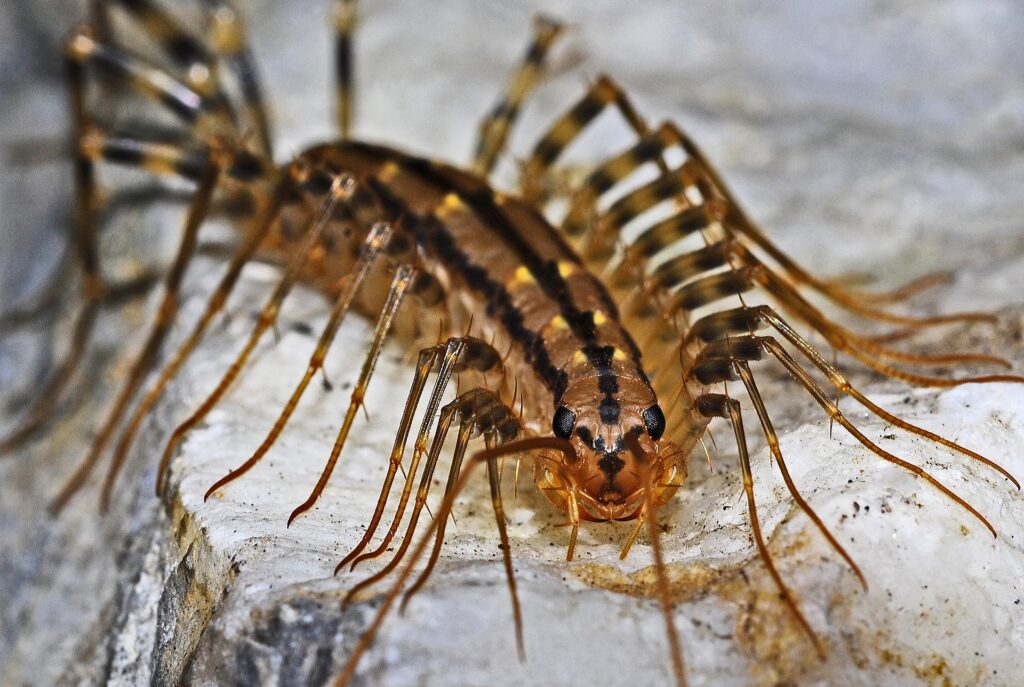
Centipedes are among the most startling indoor pests due to their multi-legged, predatory appearance and lightning-fast speeds. However, unlike many other structural invaders, they are actually beneficial biological hunters that enter your home for one reason: to track down and eat other insects.
The Complete Guide to Household Centipedes
The House Centipede is a unique nocturnal invader that causes immediate panic when spotted sprinting across a wall or floor. While their appearance is deeply unsettling, they are efficient predators that act as a natural pest control team inside your home. Successfully managing them requires addressing the damp environments they love and eliminating the insects they feed on.
1. Identification: Who is Sprinting Across Your Floor?
The specific species found inside residential properties is almost exclusively the House Centipede (Scutigera coleoptrata). They are physically distinct from outdoor centipedes or slow-moving millipedes.
Look closely at their physical traits, leg counts, and movement styles to confirm what you are dealing with:
-
Physical Appearance: House centipedes have flat, elongated, yellowish-to-light-brown bodies measuring about $25\text{mm}$ to $35\text{mm}$ in length. Their bodies feature three dark, parallel stripes running down their backs. Their most defining trait is their 15 pairs of long, thread-like legs, with the final pair on females extending significantly past the body.
-
Locomotion and Speed: They are extraordinarily fast, capable of traveling at speeds of over 1.3 feet per second. When resting, they stay pinned flat to walls or baseboards, but when disturbed, they dart away in a fluid, darting motion that makes them look like a blur.
-
Distinguishing Lookalikes: Unlike slow, cylindrical millipedes that have two pairs of tiny legs per body segment and curl into a tight ball when threatened, centipedes have long, splayed legs and will instantly sprint away to find a dark hiding spot.
2. Why They Enter & What Keeps Them There
Centipedes are strict carnivores. They do not enter your home to chew on your framing, eat your fabrics, or nest in your pantry goods.
-
An Active Insect Population (The Prey Drive): If you are seeing house centipedes regularly, it is a direct indicator of an underlying pest issue. Centipedes stay because your home provides an abundant, high-protein hunting ground filled with cockroaches, silverfish, bed bugs, ants, carpet beetle larvae, and spiders.
-
High-Humidity Microclimates: Centipedes lack the waxy, water-retaining outer coating found on most other insects, meaning their bodies dehydrate rapidly in dry air. They enter through foundation gaps and migrate straight toward dark, humid zones like damp basements, crawlspaces, bathrooms, and concrete block walls.
-
Undisturbed Hiding Voids: They are highly nocturnal and thrive in dark, quiet spaces during the day. Cardboard boxes stacked on concrete basement floors, damp storage bins, and floor drains provide ideal daytime shelters.
3. Potential Harm & Damage
Anatomy of Risk: Centipedes cause absolutely zero structural or cosmetic damage to your property. They do not chew wood, tear insulation, or contaminate human food supplies. Their threat profile is limited to intense psychological distress and rare, minor defensive bites.
Human, Child & Pet Health
-
Defensive Venom Bites: Centipedes possess two modified front legs near their head that function as venom-injecting claws (forcipules) used to paralyze prey. They do not hunt humans or pets. However, if stepped on bare-footed or squeezed inside a clothing item, they will bite defensively.
-
Minor Venom Severity: A house centipede bite is rarely serious. For most adults and children, it feels similar to a mild bee sting, resulting in localized redness, slight swelling, and temporary itching. Their venom is completely non-toxic to domestic dogs and cats, though a bite can cause minor irritation to a curious pet’s nose.
Damage to the Property
-
Zero Material Footprint: They do not leave behind dark stains, ruin paper goods, or create unappealing cobwebs. Their physical impact on the structural house is completely non-existent.
3.5 When to Bypass DIY and Call a Professional
While an occasional centipede sighting can be handled with environmental fixes, a sudden explosion of centipedes requires a deeper evaluation.
3 Signs It’s Time to Call an Exterminator
-
A Massive, Constant Centipede Presence: Seeing multiple centipedes every single day means they have a massive, hidden food supply. You must call a professional to identify and eliminate the underlying infestation of roaches, termites, or silverfish that is keeping the centipedes fed.
-
Entrenched Subfloor Moisture Problems: If centipedes are breeding inside a saturated, inaccessible crawlspace or beneath a cracked concrete foundation slab, a professional must treat the structure to break the cycle.
-
Commercial Presentation Risks: For home businesses, daycares, or client-facing home spaces, the sudden appearance of a fast-moving centipede can ruin professional presentation. A professional can apply long-lasting, perimeter-defense barriers to keep them out entirely.
4. Prevention: How to Keep Them Out
Because centipedes are solitary apex predators of the bug world, they do not nest in massive colonies. Keeping them out relies on drying out your home and starving them of food.
Structural Proofing & Moisture Control
-
Starve Them Out: Treat the underlying insect issues. Use sticky traps and targeted sanitation to eliminate the ants, silverfish, and carpet beetles. If you remove their food supply, the centipedes will naturally die off or relocate outdoors to hunt.
-
Run a Basement Dehumidifier: Keep the relative humidity in your lower levels and crawlspaces below 50%. Use bathroom exhaust fans during showers and clear out wet leaves or damp mulch away from your external foundation blocks.
-
Seal Ground-Level Entry Gaps: Use silicone caulk to seal cracks in basement floors, gaps around cellar windows, and spaces where utility lines pass through concrete walls. Ensure door sweeps are installed tightly on all basement walk-out doors.
Natural Deterrents (Scent Barriers)
Centipedes have highly sensitive chemical receptors on their antennae that are deeply irritated by intense botanical odors.
-
Peppermint and Tea Tree Oils: Mix 20 drops of pure peppermint or tea tree essential oil with water in a spray bottle. Mist along basement baseboards, floor drains, window wells, and exterior doorways to create an aromatic barrier they avoid crossing.
-
Cayenne Pepper Dusting: Lightly sprinkling cayenne pepper powder inside exterior window wells or along basement foundation sills acts as a natural sensory deterrent.
5. Control & Eradication Methods
Using chemical bug bombs or broadcast aerosol sprays is highly ineffective for centipedes because they do not congregate in a central nest. Eradication relies on localized physical containment and long-lasting desiccant shields.
Treatment Protocols
-
Deploy Perimeter Sticky Boards (Step 1: Intercept the Hunters): Place pesticide-free sticky glue traps flat against baseboards, behind stored boxes, and near plumbing entry points in basements and bathrooms. Because centipedes patrol floorboards continuously at night to hunt, they will run straight across these boards and become permanently trapped.
-
Apply Long-Lasting Desiccant Powders (Step 2: Dry Out Runways): Use a powder duster to puff a thin, uniform layer of Food-Grade Diatomaceous Earth (DE) or Boric Acid Powder deep into basement expansion joints, behind baseboards, and under washing machines. When a centipede runs through the dust, the microscopic particles scratch their outer shell, causing them to dehydrate and die within hours.
-
Clear Hiding Clutter (Step 3: Eliminate the Shelters): Purge the basement floor of cardboard storage boxes, stacked lumber, and piles of damp laundry. Moving items up onto wire shelving units dries out the floor perimeter, removing the dark, humid daytime sanctuaries that centipedes rely on to rest between hunts.