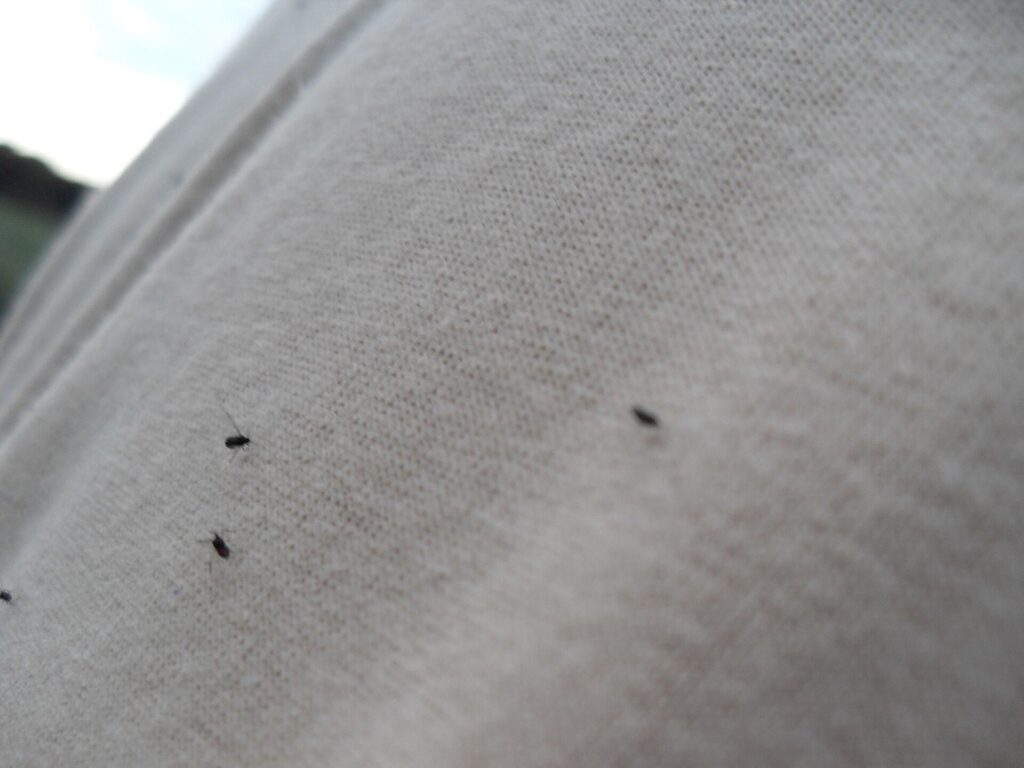
Gnats (specifically Fungus Gnats) are a highly common and annoying indoor pest that homeowners frequently mistake for fruit flies. Because they spend their larval stage in moist soil, they are directly tied to the health and environment of your indoor houseplants, making their treatment strategy completely different from other flying insects.
The Complete Guide to Household Gnats
Gnats are incredibly frustrating, weak-flying pests that constantly hover around your face, television screens, and indoor greenery. Because they reproduce rapidly within the soil of potted plants, eliminating them requires shifting focus away from the air and directly targeting the root systems where their larvae thrive.
1. Identification: Who is in Your Plants?
The term “gnat” is often used loosely, but the primary culprit behind indoor residential swarms is the Fungus Gnat. Knowing how to separate them from lookalikes keeps you from using the wrong control methods.
Look closely at physical features, flying styles, and specific locations to confirm what you are dealing with:
-
Physical Appearance: Fungus gnats are tiny, measuring about $2\text{mm}$ to $4\text{mm}$ in length. They are jet black or dark dark brown, with long, slender legs and translucent, vein-patterned wings. Under close inspection, they resemble microscopic, delicate mosquitoes.
-
Flight and Behavior: Gnats are exceptionally weak, erratic flyers. They spend very little time hovering in open air; instead, you will notice them frantically running or hopping across the top layer of soil, pot rims, and nearby windowsills. They are heavily attracted to bright light sources.
-
Distinguishing the Lookalikes:
-
Fruit Flies: Have distinct, bulbous bright red eyes and tan bodies, and cluster directly around kitchen fruit bowls or trash bins.
-
Drain Flies: Look like tiny, fuzzy moths with broad wings and stay pinned flat to bathroom and shower walls.
-
2. Why They Enter & What Keeps Them There
Gnats do not enter your home looking for rotting fruit or garbage; they are exclusively drawn to moisture, decay, and soil fungi.
-
Overwatered Houseplants (The Ultimate Nursery): The number one cause of a gnat outbreak is overwatering indoor plants. Constant moisture creates a stagnant environment that encourages the growth of soil fungi and root rot, which serves as the primary food source for gnat larvae.
-
Hitchhiking in Bagged Potting Soil: Many commercial bags of potting soil stored outdoors at garden centers are already infested with microscopic gnat eggs and larvae. When you repot your plants indoors, the warm home environment triggers a massive hatching cycle.
-
Decaying Organic Matter: Potted plants with poor drainage or those utilizing heavy organic fertilizers (like fish emulsion or poorly cured compost) provide an ideal, nutrient-rich environment that keeps the gnat colony reproducing indefinitely.
3. Potential Harm & Damage
Anatomy of Risk: Common indoor fungus gnats do not possess biting mouthparts, meaning they cannot bite humans or pets, nor do they transmit blood-borne pathogens. Their primary threat is botanical destruction and psychological annoyance.
Human, Child & Pet Health
-
Zero Disease Vectoring: Gnats do not carry dangerous diseases or track bacteria across counters the way filth-flies or cockroaches do. They are a harmless, non-toxic nuisance to children and family pets.
-
Inhalation Annoyance: Because they are attracted to the carbon dioxide humans exhale, they constantly fly directly toward eyes, noses, and mouths, causing high levels of daily irritation.
Damage to the Property & Plants
-
Root System Destruction: While adult gnats are harmless, their underground larvae possess chewing mouthparts. If the soil population gets too large, the larvae will stop eating fungi and begin chewing on the plant’s delicate root hairs. This strips the plant of its ability to absorb water and nutrients.
-
Plant Wilt and Death: Heavy larval feeding results in noticeable plant damage, causing leaves to turn yellow, wilt, drop prematurely, and can ultimately kill expensive or delicate indoor houseplants.
3.5 When to Bypass DIY and Call a Professional
While the vast majority of gnat problems can be solved by adjusting your plant care habits, certain structural scenarios require professional pest control intervention.
3 Signs It’s Time to Call an Exterminator
-
Hidden Atrium or Greenhouse Infestations: If your home features an indoor atrium, large built-in planter beds, or an attached residential greenhouse where soil is deep and widespread, localized DIY fixes will be rapidly overwhelmed.
-
Swarms Outside of Plant Zones: If hundreds of gnats are emerging from crawlspaces, subfloors, or behind walls where there are no houseplants, it indicates a serious hidden structural leak that has rotted internal wood or insulation, creating a massive fungal breeding ground.
-
Compromised Commercial Spaces: If you run a home office, commercial business, or client-facing space where constant swarms damage professional presentation, an exterminator can apply targeted sub-surface soil drenches to stop the cycle instantly.
4. Prevention: How to Keep Them Out
Preventing gnats is entirely an exercise in strict plant moisture management. If you dry out their environment, they cannot physically survive.
Structural Proofing & Plant Habits
-
The Dry-Out Rule: Allow the top $3\text{cm}$ to $5\text{cm}$ ($1\text{ to 2 inches}$) of a plant’s potting soil to dry out completely before watering it again. Gnat eggs and larvae require constant, swampy moisture; drying out the top layer kills them mechanically through dehydration.
-
Bottom Watering: Transition your plants to bottom-watering. Fill the drainage saucer with water and let the roots drink from below for 20 minutes, then dump out the excess. This keeps the top layer of soil bone-dry, preventing adult gnats from laying new eggs.
-
Quarantine New Soil: Always inspect new plants before bringing them home, and store open bags of potting soil in airtight plastic bins rather than leaving them exposed to outdoor air.
Natural Deterrents (Physical Scent Barriers)
-
The Sand Top Barrier: Pour a clean $1\text{cm}$ layer of fine horticultural sand or aquarium gravel directly over the top of your plant’s potting soil. Sand dries out instantly and lacks organic matter. Adult gnats cannot burrow through it to lay eggs, and newly hatched larvae cannot chew their way out, completely breaking the breeding loop.
-
Cinnamon Powder Dusting: Lightly dust the surface of your plant’s soil with organic Ceylon cinnamon. Cinnamon is a natural anti-fungal agent; it systematically kills the soil fungi that the gnat larvae rely on for food, effectively starving them out.
5. Control & Eradication Methods
To completely clear a gnat outbreak, you must run a dual-action campaign: catch the active flying adults in the air while using biological controls to wipe out the larvae in the dirt.
Treatment Protocols
-
Trap the Flying Adults (Step 1: Yellow Sticky Cards): Place bright yellow sticky traps on small plastic stakes directly into the soil of every indoor pot. Adult gnats are visually compelled by the specific yellow wavelength of light; they will fly straight to the card and become permanently stuck, preventing them from laying future generations.
-
Neutralize the Larvae (Step 2: Mosquito Bits Hydro-Drench): Soak Mosquito Bits or Dunks containing Bacillus thuringiensis israelensis (BTI) in your watering can for 30 minutes, strain out the granules, and thoroughly water your plants with the treated liquid. BTI is a natural soil bacterium that selectively targets and dissolves the digestive linings of gnat larvae, killing them within 24 hours while remaining 100% safe for the plant, humans, and household pets.
-
Hydrogen Peroxide Cleanse (Step 3: Root Flush): For severe cases, flush the soil with a mixture of 1 part 3% household hydrogen peroxide to 4 parts water. The solution will fizz gently upon contact with the soil, instantly killing gnat larvae on contact while releasing oxygen that helps heal damaged, rotted plant roots.