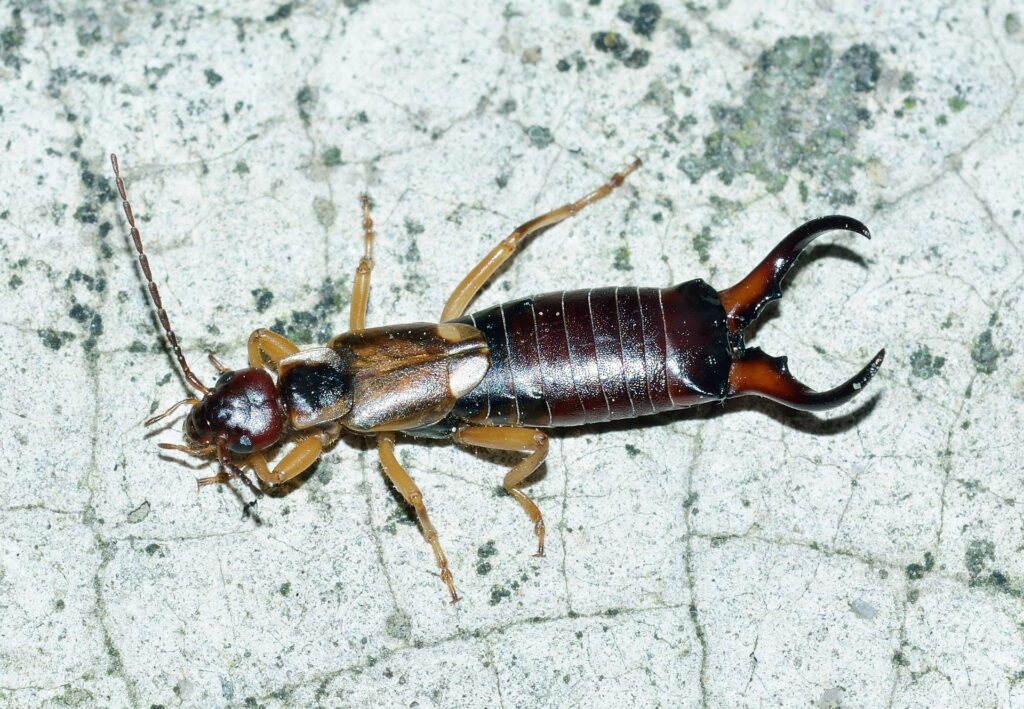
Earwigs are among the most distinctive summer pests due to the formidable-looking pincers extending from the rear of their bodies. While they are primarily outdoor scavengers that feed on organic matter in your garden, heavy rains or extreme summer heatwaves can force them inside in massive numbers to search for cool, humid shelter.
The Complete Guide to Household Earwigs
Earwigs are fast-moving, moisture-loving insects that trigger immediate concern due to their prehistoric appearance and large rear forceps. While old urban myths claim they climb into human ears to nest, they are actually completely harmless to humans. However, when they invade a home in large numbers, they can become a serious structural nuisance and damage sensitive indoor plants.
1. Identification: Who is Hiding in Your Damp Spaces?
The European Earwig (Forficula auricularia) is the primary species responsible for structural home invasions. They are easily separated from other crawling insects by their unique body shape.
Look closely at physical features, pincer shapes, and behavior to confirm what you are dealing with:
-
Physical Appearance: Earwigs have elongated, flattened bodies measuring about $12\text{mm}$ to $16\text{mm}$ in length. They are a rich, shiny reddish-brown to dark dark brown color, featuring short, leathery forewings that protect a set of delicate hind wings underneath.
-
The Pincers (Forceps): Their most defining physical characteristic is the pair of prominent pincers extending from the tail end of the abdomen. Fun Fact for Identification: You can tell the sex apart by looking at the forceps. Males have large, robust, curved pincers resembling ice tongs, while females possess straight, parallel pincers. They use these pincers defensively and to secure prey.
-
Locomotion and Habit: Earwigs are strictly nocturnal ground crawlers. They are exceptionally fast runners but rarely fly. During the day, they squeeze their flat bodies into narrow, damp, dark cracks, frequently clustering together in large groups to conserve body moisture.
2. Why They Enter & What Keeps Them There
Earwigs do not enter your home looking to eat your structural framing or contaminate your pantry grains. They are driven inside entirely by moisture needs and extreme weather shifts.
-
The Drive to Escape Weather: Earwigs are highly vulnerable to drying out. During hot, dry summer heatwaves, or conversely, after heavy torrential rains that saturate the outdoor soil, they migrate en masse toward the cool, stable microclimates of your home.
-
Abundant Exterior Mulch and Litter: Homes with thick layers of organic wood mulch, rotting leaves, or unclipped ground cover directly touching the concrete foundation create a high-density earwig breeding ground right at the entry threshold.
-
Ground-Level Gaps: They exploit loose door sweeps on basement doors, cracks in window wells, crawlspace vents, and openings where outdoor garden spigots or utility lines penetrate the foundation walls.
3. Potential Harm & Damage
Myth Busting: Despite their terrifying name, earwigs do not crawl into human ears, lay eggs in brains, or burrow into human skin. They lack the biological drive and capability to do so. Their threat is strictly limited to cosmetic garden ruin and minor defensive pinches.
Human, Child & Pet Health
-
Minor Defensive Pinches: If an earwig is picked up by a child or stepped on bare-footed, it may use its rear forceps to pinch the skin defensively. While a pinch from a large male can startle you, it rarely breaks the skin, contains absolutely zero venom, and does not pose a biological health risk to family members or pets.
-
Zero Pathogen Vectoring: Earwigs do not spread dangerous transmissible diseases, nor do they track dangerous biological bacteria across countertops the way filth-flies or cockroaches do.
Damage to the Property & Plants
-
Botanical Damage: If you keep sensitive indoor houseplants or seedlings in your basement or kitchen windowsills, invading earwigs will aggressively chew small, ragged holes through the leaves and petals, potentially stunting or killing the plants.
-
Fecal Spotting: In heavy, unchecked infestations, their collective presence in crawlspaces or behind baseboards can leave tiny dark streaks of waste on lower wall sections.
3.5 When to Bypass DIY and Call a Professional
Most earwig invasions taper off naturally as weather stabilizes, but structural imbalances can create entrenched problems.
3 Signs It’s Time to Call an Exterminator
-
Massive, Continuous Indoor Swarms: If you are sweeping up dozens of live earwigs every single morning inside your living spaces, they have established an active nesting zone within your home’s lower framing or wall voids.
-
Entrenched Foundation Moisture Traps: If your home has a gravel crawlspace or a damp stone foundation that remains permanently saturated, a professional must apply specialized chemical residual dusts to halt the reproductive cycle.
-
Simultaneous Landscape Overruns: If your surrounding lawns, mulch beds, and siding are crawling with thousands of earwigs, an exterminator must deploy a heavy, commercial-grade granular insecticide perimeter band to halt the march before they reach your doors.
4. Prevention: How to Keep Them Out
Because earwigs are entirely dependent on damp environments, successful prevention relies on building a dry, barrier zone around your concrete foundation.
Structural Proofing & Landscape Modification
-
The 30cm Clearance Rule: Pull all organic wood mulch, decaying leaves, dead vegetation, and stacked firewood back at least 30cm away from your home’s foundation walls. Replace this zone with a clean strip of dry pea gravel or river rock, which holds zero moisture and starves earwigs of their preferred outdoor shelter.
-
Secure Door Sweeps: Install tight, heavy-duty rubber door sweeps on all exterior and garage doors. Check the sealing along basement window wells and caulk any visible cracks in the concrete block work.
-
Clear the Gutters: Ensure downspouts redirect rainwater at least 1 meter away from your foundation line, preventing the soil adjacent to your walls from becoming swampy.
Natural Deterrents (Scent Barriers)
Earwigs have a highly sensitive chemical tracking system that is easily overwhelmed by intense botanical essential oils.
-
Peppermint and Eucalyptus Spray: Mix 20 drops of pure peppermint or eucalyptus essential oil with warm water in a spray bottle. Clean your baseboards and spray heavily around entry thresholds, window wells, and basement doors to establish an aromatic line they hesitate to cross.
-
Cinnamon Powder Borders: Lightly sprinkling ground cinnamon along the sills of your garage doors or basement windows acts as an organic sensory deterrent.
5. Control & Eradication Methods
If you already have hundreds of earwigs inside your lower levels, standard aerosol bug bombs are highly inefficient because they fail to penetrate the tight cracks where earwigs hide during daylight hours. You must use targeted physical traps and desiccant powders.
Treatment Protocols
-
The Oil and Soy Trap (Step 1: Exploit Their Night Foraging): Create an incredibly effective, non-toxic trap using a shallow plastic container (like an empty sour cream tub). Cut small entry holes near the top rim, then fill the bottom with equal parts vegetable oil and soy sauce. The savory scent of the soy sauce draws the earwigs in at night, while the viscous vegetable oil traps and drowns them quickly. Place these on basement floors or in dark corners.
-
Apply Long-Lasting Desiccant Powders (Step 2: Secure Hiding Crevices): Use a powder duster to puff a thin, uniform coat of Food-Grade Diatomaceous Earth (DE) or Boric Acid Powder directly into baseboard gaps, carpet edges, and expansion joints in concrete floors. When crawling earwigs pass through the powder, it cuts into their waxy protective coating, causing them to dehydrate and die safely without chemical residue.
-
Strategic Perimeter Spraying (Step 3: Establish a Surface Shield): For severe structural entries, apply a liquid permethrin-based residual insect spray (such as EcoGuard Pro-Perm or standard outdoor barrier sprays) directly onto exterior foundation walls, extending out into the adjacent soil. This forms an active chemical shield that knocks down returning nocturnal foragers before they can squeeze past your doors.