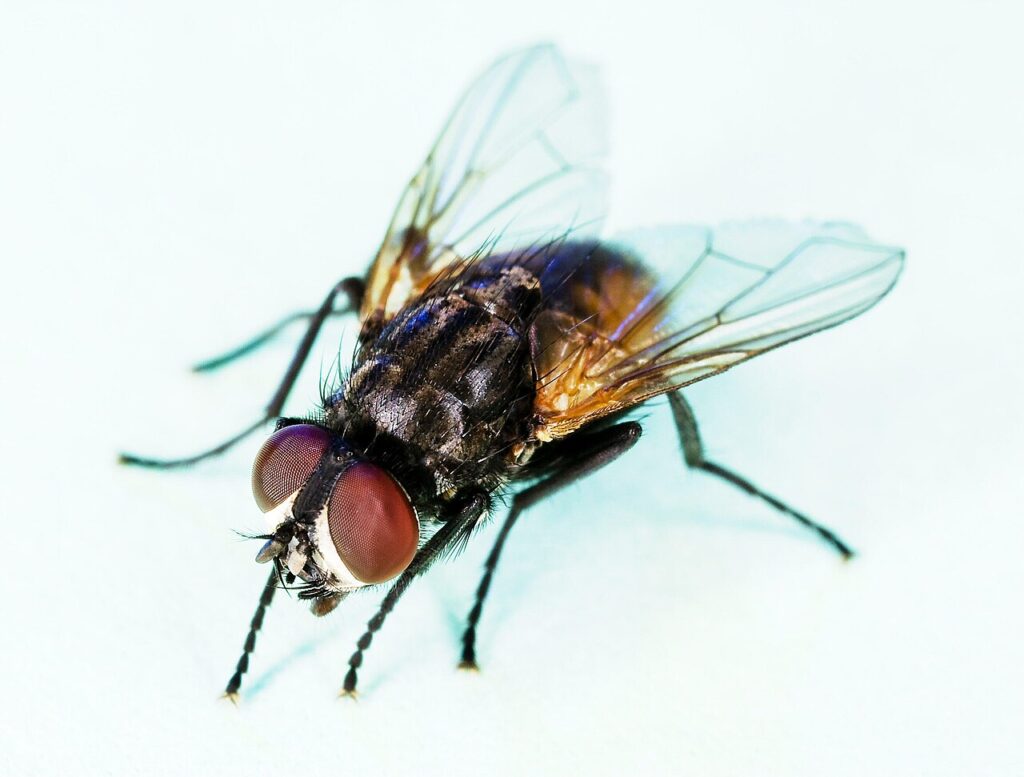
Houseflies are among the most medically significant pests that enter a home. They do not bite, sting, or chew through your walls — but what they carry on their bodies and deposit on your food surfaces makes them far more dangerous than most people realize. Understanding what they are actually doing when they land on your kitchen counter changes how urgently you take them seriously.
1. Identification: What Is Actually Landing on Your Food?
The common housefly is Musca domestica. It is not the same insect as the cluster fly, the blow fly, or the fruit fly — though all four are frequently confused.
Physical Appearance: Adult houseflies are 6–7mm in length. The thorax is grey with four dark longitudinal stripes running along the top. The abdomen is yellowish on the underside. The eyes are large, reddish-compound, and cover most of the head — males have eyes set closer together than females. Wings are clear and held flat at rest.
Distinguishing Features: Unlike blow flies (Calliphora spp.), houseflies have no metallic sheen. Unlike fruit flies (Drosophila spp.), they are significantly larger and not attracted primarily to fermenting liquids. Unlike cluster flies, they do not overwinter in wall voids in large masses.
Behavior: Houseflies are active during daylight hours and rest on walls, ceilings, and surfaces after dark. They are drawn to food odors, garbage, animal waste, and decay. Indoors, you will find them orbiting garbage bins, hovering near food preparation areas, and repeatedly returning to the same landing surfaces.
2. Why They Enter & What Keeps Them There
Houseflies do not enter your home because it is dirty. They enter because your home represents warmth, food, and breeding opportunity — and your doors and windows open.
Entry Points: Gaps around window screens, open doors, torn door sweeps, and utility line penetrations are the primary access points. A single unscreened window on a warm afternoon is enough.
What Keeps Them: Once inside, they stay because the conditions sustain their full life cycle. A single female housefly lays between 400 and 600 eggs across her lifespan, in batches of 75–150 at a time, and she needs only a small amount of warm organic material to do it — an uncovered compost bin, a forgotten bag of garbage, pet waste near a door, or the moisture trapped beneath a kitchen mat.
Breeding Conditions: Larvae (maggots) require moist organic matter and temperatures above 10°C to develop. In summer, the full cycle from egg to adult can complete in as few as 7–10 days, meaning a small problem can become a large one inside a single week.
3. Potential Harm & Damage
This is where houseflies separate from most household nuisance insects. Their threat is not structural and not venomous — it is microbial.
The Pathogen Transfer Mechanism: A housefly cannot chew or bite. Instead, it feeds by regurgitating saliva onto a food surface to liquefy it, then sponging the result back up. Every time it lands and feeds, it deposits whatever is on its body and in its digestive tract onto that surface. Houseflies are known mechanical vectors of over 65 pathogens, including Salmonella, E. coli, Shigella, Campylobacter, Staphylococcus aureus, and Listeria.
Surface Contamination: A fly that has recently visited animal feces, a garbage bin, or a decomposing food source and then lands on your cutting board has transferred bacteria directly to your food preparation surface. This transfer happens on contact — no extended exposure required.
Human, Child & Pet Health: Children, elderly individuals, and immunocompromised people face the most serious risk from foodborne illness introduced by housefly contamination. Gastrointestinal infections, dysentery, and typhoid fever have documented transmission routes through housefly activity in areas with poor sanitation. In a typical residential kitchen in Ontario, the risk is lower but not negligible — particularly around uncovered food during summer months.
3.5 When to Bypass DIY and Call a Professional
Most residential housefly problems resolve through sanitation and exclusion. A few situations warrant professional intervention.
3 Signs It’s Time to Call an Exterminator
Persistent Large Numbers Indoors: If you are killing dozens of flies daily and cannot locate a breeding source after a thorough inspection, there may be a hidden reservoir — a dead animal in a wall void, a sewage leak beneath a slab, or a waste accumulation in a crawl space. A pest professional can locate it.
Maggot Activity Inside the Home: Visible maggot clusters inside a wall void, beneath flooring, or in a structural cavity indicate an active breeding site that sanitation alone cannot reach.
Commercial Kitchen or Food Handling Space: In food-service environments, a housefly presence during a health inspection carries regulatory consequences. Professional IPM monitoring and documentation are required.
4. Prevention: How to Keep Them Out
Housefly prevention operates on two tracks simultaneously — exclusion and elimination of breeding opportunity.
Structural Exclusion
Screen Integrity: Inspect all window and door screens for tears, gaps at the frame edges, and bent corners. A hole the width of a pencil is sufficient entry for a housefly. Repair or replace damaged screens before summer temperatures peak.
Door Sweeps and Seals: Exterior doors that do not fully seal at the threshold are a primary entry route. Install tight-fitting rubber door sweeps and check that weatherstripping compresses fully when the door closes.
Utility Penetrations: Gaps around pipe entries, dryer vents, and HVAC lines are overlooked entry points. Seal with steel wool packed into the gap and covered with exterior caulk.
Eliminating Breeding Opportunity
Garbage Management: Keep all indoor bins lined and lidded. Move outdoor bins at least 3 metres from entry doors. Empty indoor kitchen bins daily during summer months — houseflies can complete early larval development inside a bin within 24–48 hours in warm temperatures.
Pet Waste: Dog waste left in a yard adjacent to the home is a primary fly-breeding reservoir. Remove it within 24 hours.
Compost Placement: Compost bins placed directly against the home’s exterior wall create a consistent breeding source at the foundation. Move them to the far end of the yard and ensure they have tight-fitting lids.
Moisture Control: Overly moist soil around foundation plantings, standing water in saucers beneath potted plants, and wet organic mulch piled against siding all create suitable larval habitat. Reduce unnecessary moisture at the foundation perimeter.
5. Control & Eradication Methods
Chemical sprays applied to open kitchen surfaces are not recommended — the surfaces where flies land are the same surfaces where food is prepared. Control relies on targeted mechanical and physical methods.
Treatment Protocols
Locate and Eliminate the Breeding Source (Step 1: The Foundation): No control method works sustainably while an active breeding site remains. Inspect garbage storage areas, beneath appliances, inside recycling bins, behind refrigerators where drip pans collect organic residue, beneath kitchen mats, and around any plumbing leaks. Eliminate the source before anything else.
Light Traps (Step 2: Indoor Population Reduction): UV light traps with glue boards are the most effective and food-safe method for reducing adult fly populations indoors. Place them away from windows — competing with natural light reduces their effectiveness — and at fly-height, between 1 and 1.5 metres from the floor. Replace glue boards regularly.
Fly Paper and Strip Traps (Step 3: Targeted Capture): In utility areas, garages, and storage rooms, traditional sticky fly strips placed near entry points intercept flies before they reach living areas. Replace them before they become saturated.
The Deep Sanitation Pass (Step 4: Surface Reset): Once the breeding source is removed and the adult population is reduced, clean all surfaces that flies were observed landing on with a hot soapy solution followed by a food-safe disinfectant. Pay particular attention to the undersides of appliances, bin lids, and drain openings — areas that routinely harbor the organic residue flies are drawn to.
See all pests.