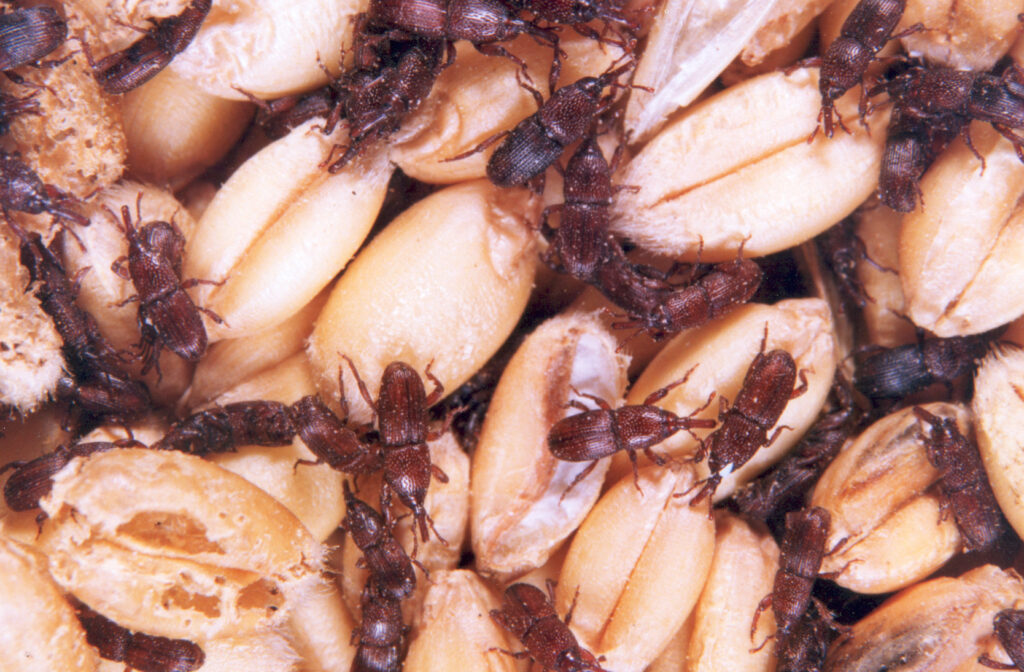
The Complete Guide to Household Weevils
Weevils are specialized beetles notorious for infesting dry kitchen staples, pantries, and food cupboards. Because their life cycle begins hidden inside individual grains and seeds, simply wiping down your shelves will never solve the problem; you must isolate and eliminate the infested core items to completely clear an outbreak.
1. Identification: Who is Crawling in Your Rice?
While there are thousands of outdoor weevil species that target crops, the primary indoor pests are Granary Weevils (Sitophilus granarius) and Rice Weevils (Sitophilus oryzae).
Look closely at physical shapes, sizes, and specific locations to confirm what you are dealing with:
- The Defining Snout: Weevils are instantly separated from standard flour beetles by their unique head structure. They possess an elongated, downward-curved snout or “beak” (rostrum) extending from the front of their heads, with tiny chewing mouthparts located right at the tip.
- Physical Appearance: They are tiny, their bodies are slender, cylindrical, and range from a rich reddish-brown to a dark dark brown or dull black color.
- Behavior and Flight: Granary weevils are completely wingless and cannot fly, while Rice weevils possess functional wings and are strong flyers. You will usually discover them clustered inside dry food containers, crawling slowly up the interior walls of pantries, or drawn toward nearby kitchen windows and light fixtures.
2. Why They Enter & What Keeps Them There
Weevils do not chew their way through your home’s foundation or slip in through window screens to find your food. They are almost always brought straight through the front door.
- The Internal Entry Loop: Weevils enter your home as microscopic eggs tucked inside bulk grain products purchased from the grocery store or pet shop. A female weevil uses her snout to chew a tiny hole inside a hard grain seed (like a single kernel of corn, wheat, or rice), deposits an egg inside, and seals the opening with a gelatinous fluid. The grain is packaged and sold, entirely undetected.
- Abundant Dry Goods: Once the hidden egg hatches inside your pantry, the larva eats the inside of the seed until it matures, chews an exit hole, and emerges as an adult to breed. They stay because they have immediate access to adjacent unsealed goods, easily chewing through paper bags and thin plastic wrapping to colonize new targets.
- Preferred Food Targets: They prefer whole, hard grains and seeds. Their primary targets include white and brown rice, whole wheat, corn kernels, dry beans, birdseed, dry pet kibble, sunflower seeds, and whole-grain pasta.
3. Potential Harm & Damage
Anatomy of Risk: Weevils do not possess stingers, their mouthparts are incapable of biting human skin, and they do not carry dangerous blood-borne pathogens. Their entire threat profile is focused on food spoilage and economic loss.
Human, Child & Pet Health
- Harmless to Ingest: While discovering weevils in your dinner is deeply unappealing, they are completely non-toxic. If a child or pet accidentally consumes whole grains or flour contaminated with weevil eggs or larvae, it poses zero biological health risk or disease transmission.
- Zero Filth Vectoring: Unlike cockroaches or filth-flies, weevils do not walk through sewage or decay before crawling on your food. They spend their lives strictly inside clean, dry grain environments.
Damage to the Property & Kitchen Inventory
- Complete Food Spoilage: An unchecked weevil infestation can ruin hundreds of dollars worth of baking supplies, bulk grains, and organic dry goods. As they eat and breed, they leave behind hollowed-out hulls, cast skins, and fine powdery dust that causes food to spoil rapidly.
3.5 When to Bypass DIY and Call a Professional
Almost every household weevil outbreak can be completely eradicated with strict isolation and sanitation. However, rare scenarios can complicate things.
3 Signs It’s Time to Call an Exterminator
- Massive, Repetitive Re-infestations: If you have thrown away all infested items and scrubbed your kitchen, yet dozens of new weevils continue to appear on your countertops every week for over a month, they have found an alternative hidden food reservoir.
- Infestations Behind Built-In Cabinetry: If grains have spilled behind your kitchen walls or deep beneath built-in, unmovable island cabinetry, creating an unreachable breeding ground, a professional must use targeted dusts to clear the void.
- Large Home-Based Bulk Storage Overruns: For families who store massive bulk supplies of grains, animal feed, or birdseed for rural properties or home businesses, a large-scale outbreak requires professional monitoring and targeted atmospheric controls to save the inventory.
4. Prevention: How to Keep Them Out
Because weevils frequently hitchhike into your kitchen inside healthy-looking packaging, prevention relies on strict quarantine habits and hard material barriers.
Grocery Selection & Storage Habits
- The 48-Hour Freeze Rule: To prevent a hidden infestation from ever starting, place newly purchased bags of flour, rice, oats, birdseed, and dry pet food into your freezer for 48 hours as soon as you bring them home from the store. The extreme cold completely neutralizes any invisible eggs or larvae nested inside the seeds.
- Hard Plastic or Glass Canisters: Ditch original paper bags, cardboard boxes, and thin plastic sacks. Weevils can easily chew through these materials. Transfer all dry goods immediately into airtight, hard plastic or heavy glass storage containers with secure silicone or rubber gaskets.
- First In, First Out: Practice rotating your pantry inventory. Use up older bags of flour and rice before opening newly purchased ones, as weevils thrive in dry items that sit undisturbed in the back of dark cupboards for long periods.
Natural Deterrents (Scent Barriers)
Weevils possess highly sensitive olfactory organs on their antennae, and certain clean botanical odors completely repel them from setting up a breeding trail.
- The Bay Leaf Shield: Weevils have a natural, intense aversion to the scent of fresh bay leaves. Placing a loose, dried bay leaf directly inside your rice, flour, and grain canisters acts as an effective, food-safe organic deterrent that keeps adult weevils away without altering the taste of your dry goods.
- Cloves and Black Pepper: Tucking small mesh bags filled with whole dried cloves or whole black peppercorns onto your pantry shelves creates a sharp, aromatic line that foraging weevils actively avoid.
5. Control & Eradication Methods
Using chemical aerosol bug bombs or spraying heavy liquid pesticides inside food cupboards is highly discouraged; doing so contaminates your food preparation surfaces without hitting the larvae hidden inside the grain packages. Total management relies on strict physical separation and deep mechanical sanitation.
Treatment Protocols
- The Pantry Isolation and Purge (Step 1: Destroy the Core): Remove every item from your kitchen cabinets and pantries. Inspect every single package of dry goods carefully. Throw away any container or bag where you spot adult weevils or fine grain dust directly into an outdoor trash bin. Do not leave the trash bag inside the house, as surviving adults can crawl back out.
- Deep Crack Vacuuming (Step 2: Clear Hidden Larvae): Use a vacuum cleaner equipped with a narrow crevice tool attachment to thoroughly clean every shelf, corner, support peg hole, and baseboard seam inside your cabinets. Weevil larvae that have escaped their grain seeds will often hide in these tight structural cracks to pupate. Crucial: Empty the vacuum canister or seal the bag into a plastic trash bag and move it to your outdoor bin immediately.
- The Thermal Vinegar Cleanse (Step 3: Sterilize the Shelves): Scrub down all empty shelving, brackets, and cabinet walls with hot soapy water, followed by a thorough wipe-down using a 50/50 mixture of white vinegar and warm water. Vinegar cleanses the surface of any lingering pheromone tracking trails, strips away microscopic food dust, and naturally deters any surviving adult foragers from re-entering the zone.